
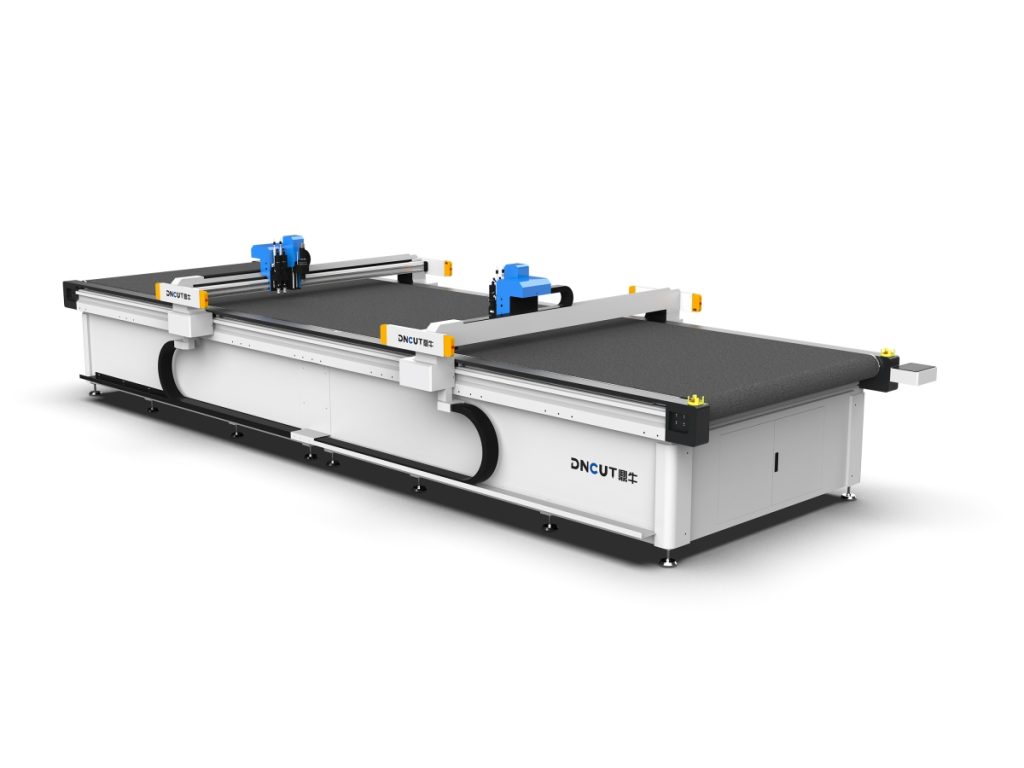
An oscillating knife cutting machine is a CNC device that cuts flexible and semi-rigid sheet materials by means of a blade moving vertically in high-frequency reciprocation, cutting through a micro-amplitude shearing action.
- The upper limit of vibration frequency for the eccentric wheel structure is approximately 12,000 times/minute, while a voice coil motor direct drive can reach over 20,000 times/minute.
- The empirical amplitude value is 1.5–2 times the material thickness; for example, a 0.5mm film pairs with 0.8–1.5mm, and a 30mm sponge requires 5–10mm.
- The vacuum adsorption negative pressure is approximately −8 to −15kPa, and zone control can enhance local adsorption force for small pieces.
- The positioning accuracy is ±0.1mm, the repeat positioning accuracy is ±0.05mm, and the feed speed is 100–1200mm/s.
- The cutting depth generally overcuts by 0.3–0.5mm, and the kerf compensation is commonly 0.3–0.9mm.
- The applicable thickness range covers 0.1–60mm, and the small fillet radius can be made within 1mm.
- The upper limit of vibration frequency for the eccentric wheel structure is approximately 12,000 times/minute, while a voice coil motor direct drive can reach over 20,000 times/minute.
- The empirical amplitude value is 1.5–2 times the material thickness; for example, a 0.5mm film pairs with 0.8–1.5mm, and a 30mm sponge requires 5–10mm.
- The vacuum adsorption negative pressure is approximately −8 to −15kPa, and zone control can enhance local adsorption force for small pieces.
- The positioning accuracy is ±0.1mm, the repeat positioning accuracy is ±0.05mm, and the feed speed is 100–1200mm/s.
- The cutting depth generally overcuts by 0.3–0.5mm, and the kerf compensation is commonly 0.3–0.9mm.
- The applicable thickness range covers 0.1–60mm, and the small fillet radius can be made within 1mm.
An oscillating knife cutting machine is a CNC device that cuts flexible and semi-rigid sheet materials by means of a blade moving vertically in high-frequency reciprocation, cutting through a micro-amplitude shearing action; its blade edge generates almost no lateral thrust, the kerf is stable, and there is no heat-affected zone.
- The frequency upper limit of the eccentric wheel structure is about 12,000 times/min, while the voice coil motor direct drive can reach more than 20,000 times/min.
- The empirical amplitude value is 1.5–2 times the material thickness: 0.5mm film pairs with 0.8–1.5mm, and 30mm sponge requires 5–10mm.
- The vacuum adsorption negative pressure is about −8 to −15kPa, and zone control can improve local adsorption force for small parts.
- The positioning accuracy is ±0.1mm, the repeat positioning accuracy is ±0.05mm, and the feed speed is 100–1200mm/s.
- The cutting depth generally overcuts by 0.3–0.5mm, and the kerf compensation is commonly 0.3–0.9mm.
- The applicable thickness covers 0.1–60mm, and the small fillet radius can be made within 1mm.
I. The Core Action of the Oscillating Knife
The end effector of the oscillating knife cutting machine is a blade that only performs high-frequency reciprocating motion in the vertical direction. The rotational motion output by the motor is converted by the transmission mechanism into the up-and-down reciprocation of the knife rod. During cutting, the blade has a very small vertical stroke and a very high frequency, while in the horizontal direction it moves along the X/Y axes with the head. Therefore, the force applied by the blade edge to the material is nearly purely vertical, with almost no lateral thrust.
This characteristic determines the fundamental difference between the oscillating knife and the drag knife, round knife, and laser: it does not rely on edge turning or high-temperature melting, but rather cuts the material apart through extremely high-frequency micro-amplitude penetration. Understanding this point provides the basis for the subsequent parameter settings.
II. Three Mainstream Transmission Structures
1. Eccentric Wheel + Crank Slider
This is the most common solution on industrial models. A servo or brushless motor drives the eccentric shaft, and the eccentricity equals half of the amplitude. If the rotational speed of the eccentric shaft is n, then the vibration frequency of the single-eccentric structure is f≈n; if a double-eccentric symmetrical arrangement is adopted, f≈2n. The structure has good rigidity, can withstand relatively large cutting resistance, and has low maintenance cost; the disadvantage is that the amplitude needs to be adjusted by replacing the eccentric sleeve, and the frequency upper limit is limited by the inertia of the bearings and connecting rod, generally within 12,000 times/min.
2. Voice coil motor or linear motor direct drive
The mover directly drives the blade shaft, eliminating the linkage. The frequency can reach over 20,000 times/minute, and the amplitude can be steplessly adjusted within 0.3–5 mm via the program, with fast response and low noise. The thrust is relatively limited, making it more suitable for medium-to-high-speed cutting of thin materials such as film, paper, and fabric, and the overall machine cost is relatively high.
3. Pneumatic or electromagnetic vibration
Simple structure and low cost; mostly used for light-duty advertising materials and garment sampling. Its frequency stability and continuous working capability are inferior to the previous two, and it is rarely used on continuous mass-production equipment.
III. Cutting mechanism: why it is “cutting” rather than “scoring”
Micro-serrated layer-by-layer shearing
The edge of the oscillating knife blade has fine serrations. Each downward stroke only penetrates a very shallow layer of the material, and the edge completes local shearing within an extremely short distance. Stress concentration causes the material to fracture along the edge line rather than being squeezed and pushed apart. During multi-layer cutting, this action causes the top, middle, and bottom layers to break sequentially, and the consistency of the cut from top to bottom is much better than that of a drag knife.
No lateral force, stable kerf
A dragged knife relies on material traction to passively steer the blade; when turning, the cutting edge exerts lateral thrust on flexible materials, stretching them, and the cut rounded corners tend to be oversized or show serrations. With an oscillating knife, the blade orientation is actively controlled by the program, the kerf width remains essentially constant, and small corner radii can be cut to within 1 mm, making it suitable for the fine contours of automotive interiors, footwear materials, and composites.
Cold cutting, no change to material properties
Laser cutting relies on high-temperature melting, leaving burnt marks and a hardened layer at the edges, and heat-sensitive materials may yellow; an oscillating knife produces no heat-affected zone. Also, because the blade does not continuously compress the material, compression of compressible materials such as sponge and foam is small, and the cut surface remains flat after rebounding, without slanted edges.
IV. Whole-machine coordination: the knife is only the final link
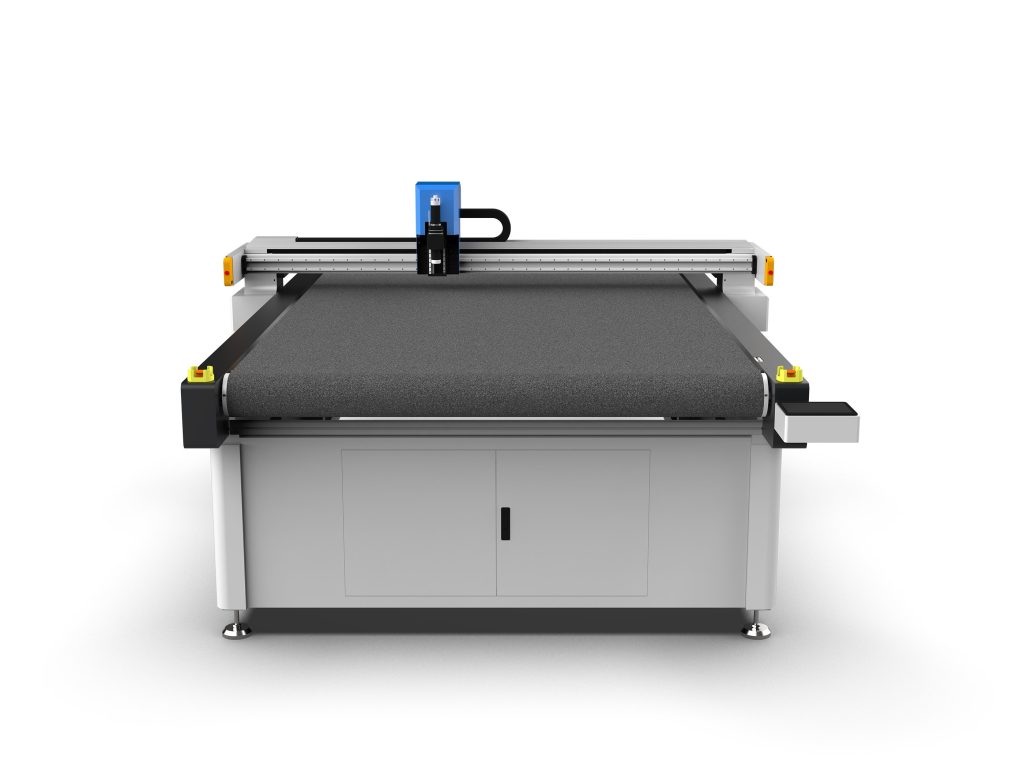
Vacuum adsorption worktable
If flexible materials are not secured, even the best knife cannot cut accurately. The standard configuration is a zoned vacuum adsorption tabletop with a negative pressure of about −8 to −15 kPa, and the base plate uses felt or honeycomb structure to ensure uniform air permeability. When cutting small parts, shutting off the air paths in non-working zones can significantly increase local adsorption force and prevent the material from being lifted when the blade travels upward.
Motion platform
Large working area models mostly use servo motors with rack and pinion, while small working area models use timing belts. Typical specifications: positioning accuracy ±0.1 mm, repeat positioning accuracy ±0.05 mm, cutting feed speed 100–1200 mm/s, and idle speed can reach over 1500 mm/s.
Tools and tool magazine
Common tool types include straight knife, round knife, V-shaped knife, pneumatic knife, punching knife, and milling cutter. The straight knife is suitable for foam and cardboard, the round knife is suitable for multi-layer fabric and carpet, and the V-shaped knife is used for grooving and chamfering. Automatic tool change magazines usually have 8–16 stations, and different tools can be called by area on the same layout drawing.
Vision and positioning
Cutting of printed materials and signage relies on CCD to recognize Mark points or contours, with positioning accuracy up to ±0.05 mm; projection positioning is used for semi-automatic stations with manual loading and unloading.
V. How to determine key parameters
- Vibration frequency: Use a high value for thin materials, e.g. 0.5 mm film and paper commonly use 10,000–15,000 strokes/min; use a low value for thick materials, EVA and sponge generally 3,000–6,000 strokes/min. Too high a frequency causes blade heating and poor chip evacuation.
- Amplitude: Slightly greater than the material thickness is enough to cut through; the empirical value is 1.5–2 times the material thickness. 0.5 mm film uses 0.8–1.5 mm amplitude, 30 mm sponge needs 5–10 mm.
- Feed speed: Together with frequency and amplitude, it determines the feed per tooth. Too fast and the cut is incomplete with stringing; too slow and edge friction generates heat, causing burnt edges or material sticking.
- Cutting depth: Generally overcut by 0.3–0.5 mm to ensure a complete cut without damaging the base plate.
- Kerf compensation: Set according to blade thickness, commonly 0.3–0.9 mm, otherwise finished dimensions will be systematically oversized.
VI. Common Defects and Troubleshooting
- Frayed edges, whiskers: First increase frequency or replace with a new blade, then reduce feed speed.
- Local incomplete cuts: Check whether the vacuum adsorption has zone failure and whether the material is bulging, then confirm whether the amplitude is sufficient.
- Overall oversized dimensions: Kerf compensation is not set or is set too small.
- Blade breaks easily: Cutting depth too deep, feed too fast, or blade protrusion too long causing insufficient rigidity.
- Yellowed, shiny cut surface: Edge friction overheating; reduce frequency or increase feed, and switch to a coated blade if necessary.
VII. Applicable Boundaries
The oscillating knife excels at handling flexible and semi-rigid sheet materials: leather, apparel fabrics, automotive interior leather and headliners, advertising inkjet-printed banners and KT boards, corrugated cardboard and honeycomb paper, foam sponge, gaskets, glass fiber and carbon fiber prepreg, carpets, sound insulation cotton, etc., covering thicknesses from 0.1–60 mm.
But it is not universal: materials such as thick steel plates, hard glass, and high-hardness ceramics require laser, waterjet, or plasma; it is also not suitable for machining extremely high-precision thin metal parts. When selecting a machine, first confirm the material’s hardness, thickness, and whether it contains hard particles, then decide the blade type and frequency range—this is more meaningful than simply comparing machine speed.
FAQ
How thick a material can an oscillating knife cutting machine cut?
The oscillating knife cutting machine covers a thickness range of 0.1–60 mm and can handle flexible and semi-rigid sheet materials such as leather, foam, honeycomb paper, and prepreg.
How should the vibration frequency and amplitude be set?
For thin materials, use high frequency such as 10,000–15,000 times/minute; for thick materials, use 3,000–6,000 times/minute; set the amplitude to 1.5–2 times the material thickness.
How do I troubleshoot fuzzy cut edges or incomplete cuts?
For fuzzy edges, increase the frequency or replace the blade and reduce the feed rate; for local incomplete cuts, check whether the vacuum zone adsorption and amplitude are sufficient.
What is the core difference between an oscillating knife and laser cutting?
The oscillating knife uses high-frequency, small-amplitude shear for cold cutting with no heat-affected zone; laser relies on high-temperature melting, which leaves scorch marks on edges and changes the material’s physical properties.