01Industry Pain Points in Cutting Polishing and Grinding Materials
Polishing and grinding materials come in a wide variety, including sandpaper and abrasive belts (dry grinding/wet grinding), backing-fleece sanding discs, fleece sheets, self-adhesive sanding discs, scouring pads and industrial wiping cloths, sponge sanding blocks, polishing pads, wool polishing wheels, non-woven polishing wheels, nylon wheels and laminated wheels, flannel wheels, grinding discs and abrasive discs, diamond sandpaper, adhesive-backed sandpaper, polishing felt and wool felt, rubber abrasive gasket pads, etc. These materials generally have flexible, laminated, coated, or fibrous structures, and traditional die cutting is prone to issues such as burrs, delamination, deformation, and blade sticking. For example, the abrasive layer of sandpaper is highly hard, causing rapid die wear; the fleece backing of backing-fleece sanding discs is easily stretched; and sponge sanding blocks rebound after compression, causing dimensional deviation. Therefore, cutting processes and parameters must be selected according to the characteristics of different materials.
02Selection of Cutting Method: Die Cutting vs CNC Oscillating Knife
For large-volume, simple shapes (such as circular sanding discs), die cutting is highly efficient, but note:
- Sandpaper dies need to be made of carbide or coated, with a service life of about 50,000-100,000 cuts;
- Backing-fleece materials require sharp single-edge blades to avoid pulling the fleece;
- Sponge sanding block dies need exhaust grooves designed to prevent compression deformation.
- No die cost, changeover time <5 minutes;
- Can cut any contour with accuracy of ±0.1mm;
- Adapts to different materials by adjusting the tool and parameters.
03Tool Selection and Cutting Parameters
1. Sandpaper and Abrasive Belts (Dry Grinding/Wet Grinding)
Sandpaper consists of a substrate (paper, cloth, fiber) and an abrasive layer (aluminum oxide, silicon carbide, zirconia alumina). During cutting, the abrasive layer quickly wears the tool, so it is recommended to use a carbide oscillating knife or a diamond-coated knife. Parameters:
- Cutting speed: 300-500mm/s (dry grinding paper substrate); 200-300mm/s (wet grinding cloth substrate, to prevent the cloth substrate from fraying);
- Oscillation frequency: 8,000-12,000 times/min;
- Tool angle: 30°-45° (a smaller angle is sharper but prone to chipping);
- Cutting depth: 0.3-0.5mm (paper substrate), 0.5-0.8mm (cloth substrate);
- Auxiliary: Turn on high-frequency vibration during cutting to reduce friction between the abrasive and the blade surface, and use a brush hold-down to prevent material displacement.
2. Backing-Fleece Sanding Discs, Fleece Sheets, Self-Adhesive Sanding Discs
These products consist of an abrasive surface plus a backing-fleece/adhesive layer. The backing-fleece layer is knitted fleece, which is easily stretched; the self-adhesive layer is pressure-sensitive adhesive, which easily sticks to the blade. A sharp single-edge knife is recommended. Parameters:
- Cutting speed: 400-600mm/s (backing fleece), 300-400mm/s (self-adhesive);
- Oscillation frequency: 10,000-14,000 times/min;
- Cutting depth: 0.4-0.6mm (backing fleece), 0.3-0.5mm (self-adhesive, to avoid cutting through the release paper);
- Auxiliary: When cutting self-adhesive sanding discs, apply silicone oil to the blade surface or use a PTFE-coated knife to prevent sticking; backing-fleece materials need to be fixed with vacuum adsorption to prevent the fleece from wrinkling.
3. Scouring Pads and Industrial Wiping Cloths
Scouring pads are made of non-woven fabric + abrasive, 2-10mm thick, prone to fuzzing; industrial wiping cloths are spunlace/hot-rolled non-woven fabric, thin and soft. Parameters:
- Cutting speed: 500-800mm/s (thin wiping cloth), 300-500mm/s (thick scouring pad);
- Blade: wave-edge blade or serrated blade, to reduce fiber pulling;
- Oscillation frequency: 12000-16000 times/minute (high frequency reduces burrs);
- Cutting depth: 0.2-0.3mm (wiping cloth), 0.5-1.0mm (scouring pad);
- Auxiliary: use cold air cooling to prevent hot-melt fiber adhesion.
4. Sponge sanding blocks
Sponge sanding blocks consist of a sponge base + abrasive surface, with strong compressibility. During cutting, the sponge must be fixed to avoid deformation. Parameters:
- Cutting speed: 200-300mm/s (slow speed reduces compression);
- Blade: thin-edge blade (0.6-0.8mm thick), to reduce squeezing;
- Oscillation frequency: 6000-8000 times/minute (low frequency reduces sponge vibration);
- Cutting depth: 0.5-1mm beyond the sponge thickness, to ensure complete cut-through;
- Auxiliary: use double-sided tape to fix the sponge on the fixture, or use freeze cutting (-10°C) to increase rigidity.
5. Polishing pads, wool polishing wheels, fleece wheels
Polishing pads are mostly polyurethane foam or wool felt, and wool wheels are compressed wool. These materials are soft and easily deformed. Parameters:
- Cutting speed: 300-500mm/s;
- Blade: circular blade or oscillating knife, with polished edge;
- Oscillation frequency: 8000-10000 times/minute;
- Cutting depth: 0.5-1.0mm (wool wheels need complete cut-through);
- Auxiliary: vacuum adsorption + press roller, to prevent material movement; after cutting wool wheels, use a brush to clean debris.
6. Non-woven polishing wheels, nylon wheels and laminated wheels
Non-woven polishing wheels are made of nylon fiber + abrasive, nylon wheels are cast nylon, and laminated wheels are multi-layer cloth/paper laminations. Parameters:
- Cutting speed: 200-400mm/s (nylon wheels have high hardness and require slow speed);
- Blade: carbide blade or diamond blade;
- Oscillation frequency: 10000-14000 times/minute;
- Cutting depth: 0.8-1.5mm (nylon wheels);
- Auxiliary: when cutting laminated wheels, layered cutting is required, with a cutting depth of 0.3mm per layer, to avoid interlayer peeling.
7. Grinding discs and abrasive discs
Grinding discs are resin bond + abrasive, 1-3mm thick, with high brittleness. Parameters:
- Cutting speed: 400-600mm/s;
- Blade: diamond-coated blade;
- Oscillation frequency: 12000-16000 times/minute;
- Cutting depth: 0.3-0.5mm;
- Auxiliary: water cooling or air cooling to prevent the resin from overheating and melting.
8. Diamond sandpaper, adhesive-backed sandpaper
The substrate of diamond sandpaper is polyester film, and the abrasive is diamond micro-powder, which is prone to micro-cracks during cutting. Parameters:
- Cutting speed: 200-300mm/s;
- Blade: diamond blade or ceramic blade;
- Oscillation frequency: 8000-10000 times/min;
- Cutting depth: 0.1-0.2mm (film substrate);
- Auxiliary: use low tension cutting to avoid film stretching.
9. Polishing felt and wool felt
Wool felt has high density and intertwined fibers. Parameters:
- Cutting speed: 300-500mm/s;
- Blade: serrated blade or wave blade;
- Oscillation frequency: 10000-12000 times/min;
- Cutting depth: 0.5mm beyond the thickness;
- Auxiliary: freeze cutting (-20°C) can significantly improve cut quality.
10. Rubber abrasive gasket
Rubber gaskets are highly elastic and tend to stick to the blade. Parameters:
- Cutting speed: 100-200mm/s (slow speed reduces elastic deformation);
- Blade: sharp single-edge blade, with the edge coated with molybdenum disulfide;
- Oscillation frequency: 6000-8000 times/min;
- Cutting depth: 0.5-1.0mm;
- Auxiliary: liquid nitrogen freezing or dry ice cooling makes the rubber brittle and improves cutting accuracy.
04Common problems and countermeasures
- Burrs: increase the oscillation frequency to above 12000 times/min, or use a wave-edge blade;
- Delamination: reduce the cutting speed, reduce the cutting depth, and use layered cutting;
- Blade sticking: use coated blades, increase air blowing or silicone oil lubrication;
- Dimensional deviation: strengthen vacuum adsorption, use a pressure roller, and reduce the cutting speed;
- Blade wear: for abrasive materials, check the edge every 500-1000 meters cut and replace it in time.
05Equipment selection reference
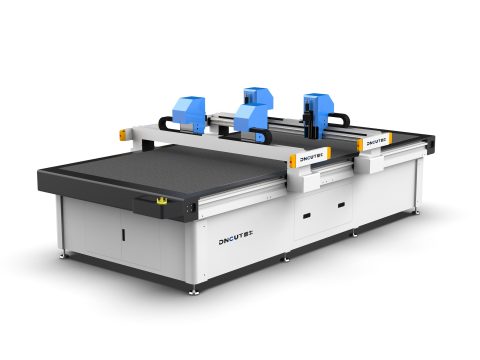
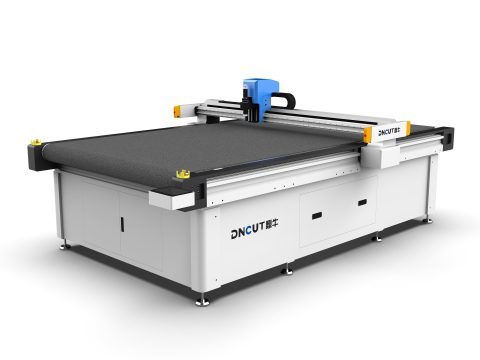
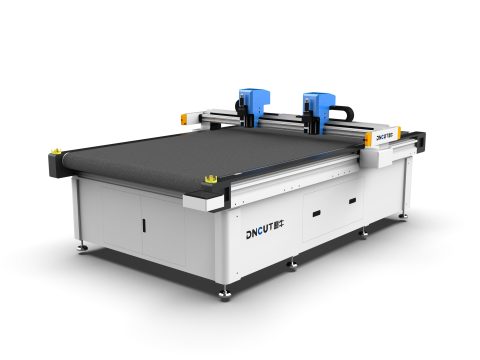
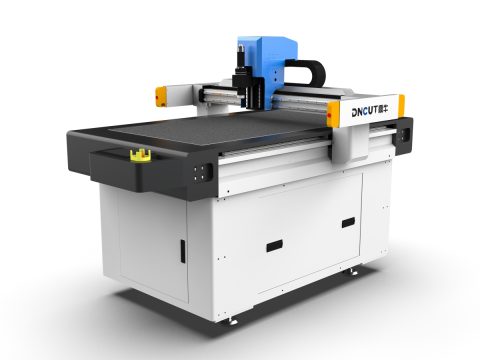
For cutting polishing and grinding materials, it is recommended to choose a CNC cutting machine with high-frequency oscillation, vacuum adsorption, and multi-head switching functions. For example, a custom all-purpose cutting machine can be equipped with a variety of blades (oscillating knife, circular knife, drag knife, punching knife) to adapt to different materials such as sandpaper, sponge, and wool felt; an intelligent dual-head cutting machine can perform cutting and punching simultaneously, improving efficiency; an electronic auxiliary material cutting machine is suitable for precision cutting of thin sandpaper and adhesive-backed sandpaper. The actual selection needs to be determined according to material thickness, production capacity, and accuracy requirements.
06Summary
The key to cutting polishing and grinding materials lies in selecting the blade, speed, and auxiliary process according to material characteristics. Sandpaper types require carbide blades and high-frequency oscillation; sponge types require slow speed and fixture fixing; wool felt types can consider freeze cutting; rubber types require anti-stick and cooling. Through reasonable parameter settings, CNC oscillating knife cutting can achieve ±0.1mm accuracy, with neat cuts and no burrs, meeting the cutting quality requirements of the polishing and grinding industry.