01Core Challenges in Cutting New Energy Materials
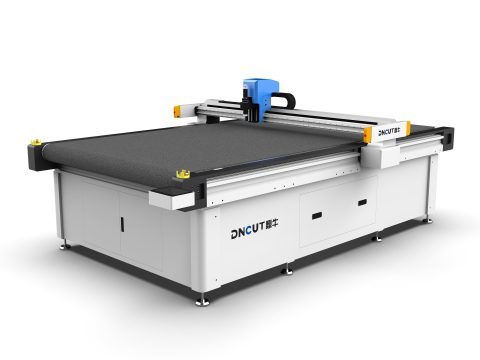
The new energy industry involves a wide variety of materials, from flexible rolled materials to brittle thin sheets, from multilayer composites to highly resilient felt materials. Their cutting processes face three common challenges: high precision requirements (for example, dimensional tolerances for photovoltaic backsheets often need to be controlled within ±0.2mm), large differences in material properties (EVA encapsulant film is prone to sticking, graphite paper is prone to brittle cracking, aerogel felt is prone to dust shedding), and balancing mass production efficiency with tool life. Traditional die cutting or laser cutting often struggles to balance flexibility and cost, while oscillating knife cutting technology, with its characteristics of no thermal effect, strong adaptability, and flexible programming, has become the preferred solution for cutting new energy materials.
This article provides specific cutting parameters, process key points, and problem avoidance methods for typical materials in fields such as photovoltaics, energy storage, and electronic heat dissipation, for reference by production technical personnel.
02Cutting Solutions for Photovoltaic Module Encapsulation Materials
Photovoltaic Backsheet (TPT/TPE/CPC)
Backsheets are mostly multilayer composite structures (for example, TPT is PVF film + PET substrate + PVF film), and cutting must avoid delamination, burrs, and edge whitening. It is recommended to use an oscillating knife combined with pneumatic clamping feed, set the cutting speed to 300-500mm/s, set the oscillation frequency to medium (about 8000-12000 times/minute), and select a sharp single-edge blade (angle 20°-30°). For CPC backsheet (PVDF+PET+PVDF), because the PVDF layer is harder, the speed can be appropriately reduced to 250-400mm/s, and the knife pressure increased by 0.1-0.2MPa to ensure full cut-through. After cutting, use a brush or ionized air to remove edge debris to prevent interlayer peeling.
EVA/POE Encapsulant Film
Encapsulant film is soft and sticky at room temperature, and is prone to sticking to the knife and stretching deformation during cutting. It is recommended to use low-temperature cold cutting assistance (ambient temperature controlled at 15-20℃) or use PTFE-coated blades to reduce sticking. The cutting speed should be fast rather than slow (600-800mm/s), and the oscillation frequency should be adjusted to medium-high frequency (12000-15000 times/minute) to avoid the blade staying on the material for too long. For POE encapsulant film, because of its higher elasticity, the negative pressure of the vacuum adsorption platform needs to be increased (-0.6 to -0.8kPa) to secure the material and prevent displacement. After cutting, the edges should be neat without stringing, and the dimensional tolerance should be controlled within ±0.3mm.
Photovoltaic Module Encapsulation Materials (Insulating Strips, Busbar Insulating Gaskets, etc.)
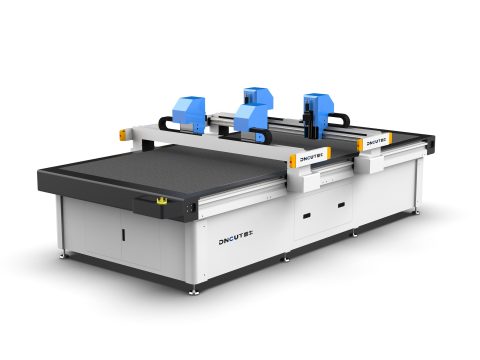
These materials are mostly PET/PI composite films or paper-based composite materials, with thickness of 0.1-0.5mm. Using an electronic auxiliary material cutting machine combined with a multi-tool holder can complete the cutting of multiple narrow strips at once, significantly improving efficiency. Recommended parameters: speed 400-600mm/s, knife pressure 0.15-0.25MPa, use a circular knife or pointed knife, and note to regularly check tool tip wear (replace or grind every 50,000-80,000 meters cut). For adhesive gaskets with release paper, the half-cut mode can be enabled to cut only through the material layer while preserving the release paper, facilitating subsequent mounting.
03Cutting Solutions for Graphite and Carbon-Based Materials
Graphite Felt, Carbon Felt
Graphite felt and carbon felt are interwoven from carbon fibers, with a loose texture that easily sheds powder. During cutting, there is a lot of dust and the edges easily unravel. It is recommended to use an ultrasonic oscillating knife or high-frequency oscillating knife, together with a dedicated dust collection device (negative pressure ≥-1.5kPa) to remove dust in real time. Cutting speed 150-300mm/s, oscillation frequency 15,000-20,000 times/minute, and use a serrated blade or wavy blade to reduce fiber pulling. For felt materials thicker than 10mm, it is recommended to use layered cutting (3-5mm depth per layer) or a dual-knife synchronous process to avoid edge collapse caused by cutting through in a single pass. After cutting, heat sealing of the edge can be used (temperature 120-150°C) to prevent fiber shedding.
Graphite paper
Graphite paper (thickness 0.05-0.5mm) is highly brittle and prone to cracks and edge chipping. A sharp pointed blade should be selected (angle 15°-20°), cutting speed 200-400mm/s, oscillation frequency 8,000-10,000 times/minute, and low knife pressure (0.05-0.1MPa) should be used to reduce impact. For the worktable surface, it is recommended to use a felt pad or soft PVC pad to cushion the pressure of the blade tip. For complex shapes, the tangent following function can be enabled to ensure no cracking at corners. If the graphite paper has adhesive backing, note that the adhesive layer may stick to the blade during cutting; the blade can be cleaned regularly with anhydrous ethanol.
Graphene thermal conductive film, graphite heat sink
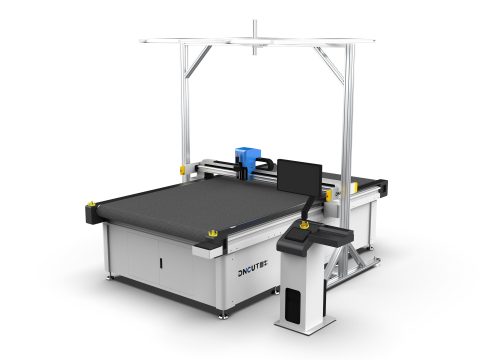
Graphene thermal conductive film (thickness 10-100μm) and graphite heat sink (thickness 0.1-1mm) usually have a PET release film protective layer, and the surface must be prevented from being scratched during cutting. It is recommended to use a large vision cutting machine, which uses CCD alignment to identify registration marks on the material, ensuring cutting accuracy of ±0.1mm. Cutting parameters: speed 300-500mm/s, oscillation frequency 10,000-12,000 times/minute, use an ultra-thin blade (thickness 0.3mm), knife pressure 0.1-0.15MPa. For graphite heat sinks, if special-shaped holes need to be cut, a drill first, then cut process can be used to reduce stress concentration when the blade tip presses down. Note: during cutting, avoid scratches caused by friction between the material surface and the table; a layer of protective film can be placed on the table.
04Cutting solutions for conductive and metal foil materials
Conductive cloth
Conductive cloth (nickel-copper plated polyester fiber) is often used for electromagnetic shielding. During cutting, it is necessary to ensure that the edges do not unravel and the base material is not exposed. Using a hot cutting knife (temperature 180-220°C) can complete cutting and edge sealing at the same time, speed 200-300mm/s, knife pressure 0.2-0.3MPa. If cold cutting is used, a serrated blade must be selected together with high negative pressure adsorption (above -0.8kPa) to prevent fiber displacement. For conductive cloth with adhesive backing, it is recommended to cut first and then peel off the release paper to avoid the adhesive layer contaminating the blade.
Copper foil/aluminum foil
Copper foil (thickness 0.01-0.1mm) and aluminum foil (0.02-0.2mm) are soft and prone to wrinkling. It is recommended to use a vacuum adsorption platform together with a brush hold-down wheel to ensure the material stays flat. Cutting speed 400-600mm/s, oscillation frequency 6000-8000 times/minute, use a single-edge blade (angle 30°), knife pressure 0.1-0.2MPa. For ultra-thin copper foil (<0.02mm), place a layer of PET release film underneath the material so that cutting only goes through the copper foil without damaging the carrier film, making it easier to pick up. Note: cutting aluminum foil easily produces aluminum chips, so the table surface needs to be cleaned with a vacuum cleaner every 2 hours.
05Cutting solutions for thermal insulation and sealing materials
Mica board
Mica board (thickness 0.1-5mm) is relatively hard and brittle, and edges tend to chip during cutting. It is recommended to use a carbide blade, cutting speed 200-300mm/s, oscillation frequency 12000-15000 times/minute, knife pressure 0.3-0.4MPa. For mica board with thickness >2mm, multi-pass progressive cutting can be used (0.5-1mm depth per pass) to avoid edge fracturing caused by cutting through in a single pass. The worktable surface must be flat; it is recommended to use a rigid PVC board as the backing plate.
Aerogel insulation felt
Aerogel felt (thickness 1-10mm) is lightweight, sheds powder severely, and has fragile fibers. During cutting, dust collection must be kept on throughout (negative pressure ≥-2kPa), and a ultrasonic knife or high-frequency oscillating knife should be used (frequency 18000-22000 times/minute), speed 100-200mm/s. Use a sharp flat blade, knife pressure 0.1-0.15MPa. To reduce dust flying, the material surface can be moistened with a fine water mist before cutting (note: only suitable for non-water-absorbing aerogel felt). After cutting, the edges can be lightly sealed with a hot air gun (temperature 200-250℃), but the time must be controlled to avoid material shrinkage.
Insulation cotton, sealing gaskets
When cutting insulation cotton (fiberglass or ceramic fiber), fiber scattering must be prevented; it is recommended to use a serrated blade together with a sealed cutting chamber, speed 150-250mm/s, oscillation frequency 10000-12000 times/minute. Sealing gaskets (rubber, asbestos, non-asbestos, etc.) need to be adjusted according to hardness: soft gaskets (hardness <70 Shore A) use a pointed knife at low speed (200-300mm/s); hard gaskets (>80 Shore A) use a round knife and increase knife pressure to 0.3-0.5MPa. For gaskets with adhesive backing, the half-cut mode can be enabled to preserve the release paper.
06PI/PET film cutting solutions
PI film (thickness 0.025-0.25mm) and PET film (0.012-0.5mm) are the foundational materials for electronic insulation and flexible circuits. When cutting, it is necessary to ensure burr-free edges and no tensile deformation. It is recommended to use an oscillating knife, with a speed of 500-800mm/s, an oscillation frequency of 15,000-18,000 times/minute, and a ultra-thin blade (thickness 0.2-0.3mm), with a knife pressure of 0.1-0.15MPa. For PI film, because the material is relatively brittle, the speed can be appropriately reduced to 400-600mm/s, and a small-radius cutting path (radius ≥0.5mm) should be used to avoid stress concentration. For PET film, if high-precision patterns need to be cut, the vision alignment system can be enabled to ensure a repeat positioning accuracy of ±0.05mm. After cutting, it is recommended to use an ionizing air bar to eliminate static electricity and prevent the film from attracting dust.
07General Process Points and Troubleshooting
Knife Selection and Maintenance
- Blade angle: use 20°-30° for thin and soft materials (EVA, PET); use 15°-20° for hard and brittle materials (mica, graphite paper); use serrated edges for fibrous materials (carbon felt, conductive cloth).
- Replacement cycle: based on the statistics of cutting meters, usually the blade edge of PET film needs to be inspected every 100,000-150,000 meters, carbon felt every 20,000-30,000 meters, and graphite paper every 50,000-80,000 meters.
- Cleaning: wipe the blade with anhydrous ethanol every shift to remove adhesive residue.
Common Problems and Countermeasures
- Edge burrs: check the blade sharpness, reduce the cutting speed by 10%-20%, or increase the oscillation frequency.
- Material displacement: increase the vacuum adsorption negative pressure (to above -0.8kPa), or increase the number of pressing wheels.
- Incomplete cutting: increase the knife pressure by 0.05-0.1MPa, or reduce the speed; check whether the cutting mat is excessively worn.
- Dust pollution: strengthen the dust collection negative pressure, and use a closed cutting chamber for carbon felt and aerogel felt.
Precision Control
For materials with high precision requirements such as photovoltaic backsheets and graphene films, it is recommended to use a 2D vision measuring machine to inspect the dimensions of the first piece of each batch, and regularly calibrate the X/Y axis positioning accuracy of the equipment (once a month). The ambient temperature should be controlled at 20±5°C and the humidity at 40%-60% to avoid dimensional stability being affected by thermal expansion and contraction of the material.
08Conclusion
There is no "one-size-fits-all" solution for cutting new energy materials; equipment parameters and process paths need to be flexibly adjusted according to material characteristics, thickness, and precision requirements. With its advantages of cold cutting, wide adaptability, and flexible programming, oscillating knife cutting technology, combined with auxiliary modules such as vision alignment, vacuum adsorption, and dust collection systems, can cover the vast majority of new energy materials from photovoltaic backsheets to graphene films. It is recommended that enterprises give priority to equipment with multi-tool holder expansion and parameter recipe management functions when selecting models, so as to quickly switch product models and improve production line flexibility.