01Why Carpet and Floor Mat Cutting Requires a Professional Solution
Carpet and floor mat materials come in a wide variety, from broadloom carpet and carpet tiles to PVC roll flooring, SPC stone-plastic flooring, loop-pile door mats, rubber anti-slip mats, EVA interlocking mats, yoga mats, car floor mats, artificial turf, and more. Their physical properties differ enormously: thickness ranges from 1mm to over 20mm, hardness ranges from soft and fluffy to rigid and brittle, and the backing may feature anti-slip granules, adhesive backing, or composite layers. Traditional cutting methods (such as manual scissors, rotary blades, and lasers) often face problems including low efficiency, rough edges, scorching, delamination, or the inability to cut high-density materials. Oscillating knife cutting technology, with its cold cutting, high precision, and strong adaptability, has become the mainstream solution for these materials. This article provides specific cutting parameters and process highlights for different materials.
02Core Equipment Capabilities and Process Selection
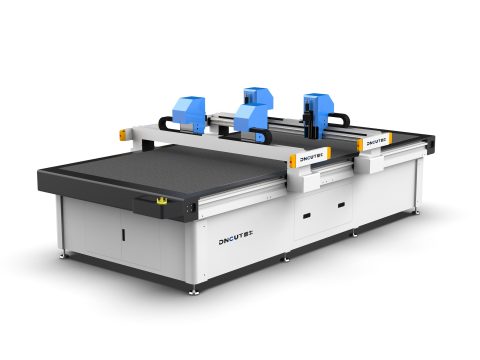
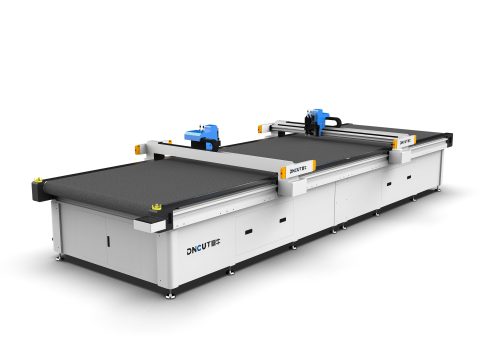
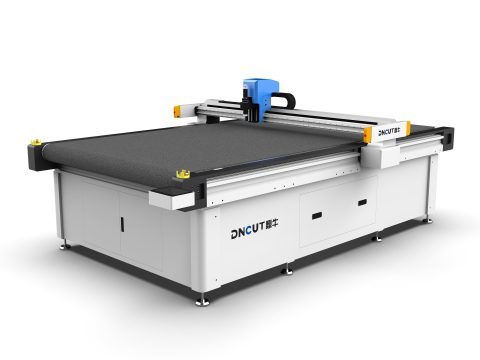
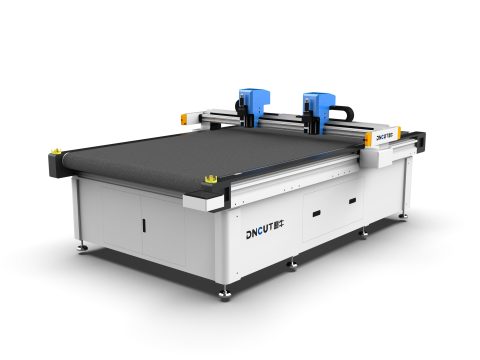
The oscillating knife cutting machine performs cold cutting through a high-frequency vibrating blade, combined with vacuum adsorption to secure the material, enabling high-precision cutting of complex shapes. For the carpet and floor mat industry, common configurations include:
- Tool types: oscillating knife (suitable for carpet, non-woven fabric, PVC, rubber, etc.), round knife (suitable for thin roll materials), drag knife (suitable for soft materials such as EVA and yoga mats), and punch knife (for hole punching).
- Adsorption system: zoned vacuum adsorption ensures the material does not shift during cutting, which is especially critical for fluffy carpets and roll materials.
- Feeding method: roll materials can use an automatic feeding rack, while sheet materials can be loaded manually, combined with CCD vision positioning for nesting cutting.
- Software functions: supports layout optimization, common-edge cutting, and bridge connections to improve material utilization.
Depending on production capacity requirements, single-head, dual-head, or dual-beam structures can be selected. The dual-beam configuration enables asynchronous cutting, improving efficiency by more than 30%.
03Material Classification and Detailed Cutting Parameters
1. Broadloom Carpet and Carpet Tiles
Broadloom carpet is typically tufted or woven, with a primary backing and secondary backing on the reverse side, and a thickness of approximately 5-12mm. Carpet tiles are mostly 500x500mm in size, with an asphalt or PVC backing. Cutting highlights:
- Tool: oscillating knife; blade angle of 45° or 30° is recommended (for high-density tufted carpet).
- Vibration frequency: 8000-12000 times/min; too high a frequency can cause edge melting (when synthetic fibers are present).
- Feed speed: adjusted according to thickness, generally 800-1500mm/s. For carpet tiles, 600-1000mm/s is recommended to ensure vertical cut edges.
- Adsorption: vacuum adsorption must be used, with negative pressure no lower than -0.6bar, to prevent the pile surface from being pulled up.
- Special notes: when cutting carpet tiles, it is recommended to cut with the backing facing up first to reduce pile surface damage; if the face is up, reduce the vibration frequency and use a sharp blade.
2. Hospitality Project Carpet and Residential Carpet
Hospitality project carpet is mostly high-density wool or nylon blend, with a thickness of up to 15mm and complex patterns. Residential carpet places more emphasis on clean edges. Cutting parameters:
- Blade: Oscillating knife, with a thickened blade to handle high density.
- Oscillation frequency: 10,000–14,000 strokes/min, ensuring fibers are cut through.
- Feed speed: 500–800 mm/s; too fast a speed will result in incomplete cuts.
- Multi-pass cutting: For carpets thicker than >10 mm, it is recommended to cut in two passes—the first pass cuts through the surface layer, the second cuts the bottom layer—to avoid blade deflection.
- Vacuum hold-down: Zoned vacuum hold-down is used, with negative pressure in the cutting area increased to -0.8 bar.
3. PVC Roll Flooring and SPC Stone-Plastic Flooring
PVC roll flooring is 2–5 mm thick, soft and elastic; SPC stone-plastic flooring is 4–6 mm thick and relatively rigid. Key cutting points:
- Blade: For PVC roll, use an oscillating knife or rotary knife; for SPC, an oscillating knife (hard blade) or diamond-coated blade is recommended.
- Oscillation frequency: PVC roll 8,000–10,000 strokes/min; SPC 12,000–15,000 strokes/min.
- Feed speed: PVC roll 1,000–1,500 mm/s; SPC 600–900 mm/s; too fast a speed easily causes edge chipping.
- Vacuum hold-down: SPC requires strong vacuum hold-down, with negative pressure ≥ -0.8 bar, to prevent the board from moving.
- Edge quality: When cutting SPC, it is recommended to use a sharp blade and reduce the feed speed to obtain smooth edges.
4. Loop-Pile Door Mats, Rubber Anti-Slip Mats, TPR/TPE Floor Mats
Loop-pile door mats have a loop-pile surface and a rubber or PVC backing; rubber anti-slip mats are 3–10 mm thick and highly elastic; TPR/TPE floor mats are soft and elastic. Cutting parameters:
- Blade: Oscillating knife, with a wavy-edge or serrated-edge blade to prevent material stretching.
- Oscillation frequency: Loop-pile door mats 10,000–12,000 strokes/min; rubber mats 12,000–15,000 strokes/min.
- Feed speed: 400–800 mm/s; rubber materials are highly elastic, and too fast a speed will result in uneven cuts.
- Vacuum hold-down: Strong vacuum hold-down must be used, with negative pressure ≥ -0.8 bar, together with hold-down rollers.
- Special note: When cutting rubber mats, apply a small amount of lubricant to reduce friction, or use cooling air blow to prevent the blade from overheating and sticking.
5. EVA Interlocking Floor Mats and Yoga Mats
EVA floor mats are 10–20 mm thick, low in density, and prone to debris; yoga mats are 4–8 mm thick, soft and elastic. Key cutting points:
- Blade: oscillating knife or drag knife, use sharp thin-edge blades.
- Oscillation frequency: EVA 8000-10000 times/min; yoga mat 6000-8000 times/min.
- Feed speed: EVA 800-1200mm/s; yoga mat 1000-1500mm/s.
- Vacuum hold-down: Medium hold-down, negative pressure -0.4 to -0.6bar, avoid excessive hold-down causing material deformation.
- Special notes: EVA cutting produces debris; a dust extraction device is recommended; yoga mat edges may be slightly sticky after cutting, so the oscillation frequency can be appropriately reduced.
6. Car Floor Mats and Bathroom Anti-slip Mats
Car floor mats are mostly multi-layer composite materials (surface carpet layer, middle XPE, bottom anti-slip particles), thickness 10-15mm; bathroom anti-slip mats are mostly PVC or rubber material with suction cups. Cutting parameters:
- Blade: Oscillating knife, use extended-length blades to handle multi-layer structures.
- Oscillation frequency: 10000-13000 times/min.
- Feed speed: 500-900mm/s.
- Vacuum hold-down: Strong hold-down, negative pressure ≥-0.8bar, with zone control to strengthen hold-down in complex-shaped areas.
- Special notes: Car floor mats often require cutting positioning holes; a punch knife can be equipped for one-step forming; the suction cup areas of bathroom anti-slip mats require reduced oscillation frequency to avoid tearing.
7. Artificial Turf and Non-woven Carpet
Artificial turf has a grass height of 20-50mm, with a PP or mesh-structured backing; non-woven carpet has a thickness of 3-8mm and a loose texture. Cutting key points:
- Blade: Oscillating knife, use long-edge straight blades.
- Oscillation frequency: Artificial turf 12000-15000 times/min; non-woven fabric 8000-10000 times/min.
- Feed speed: Artificial turf 600-1000mm/s; non-woven fabric 1000-1500mm/s.
- Vacuum hold-down: Artificial turf requires strong hold-down, negative pressure ≥-0.8bar, to prevent grass filaments from being pulled up; non-woven fabric requires medium hold-down.
- Special notes: When cutting artificial turf, it is recommended to cut from the back side and reduce the oscillation frequency to minimize grass filament melting.
8. Carpet Backing and Anti-slip Base, Mat Composite Materials
These materials are usually multi-layer composites, such as carpet + anti-slip base, TPE + fabric, etc. Cutting key points:
- Blade: Oscillating knife, use general-purpose blades.
- Oscillation frequency: 10000-12000 times/min.
- Feed speed: 600-1000mm/s.
- Vacuum hold-down: Strong hold-down, negative pressure ≥-0.8bar.
- Special notes: Multi-layer materials must be ensured to be cut through; multiple passes or increased blade extension length can be used.
04Common Problems and Solutions
- Rough edges: Check blade sharpness, reduce feed speed, increase vibration frequency.
- Material delamination: Use sharp blades, reduce feed speed, increase the number of cutting passes.
- Incomplete cutting: Check blade extension length, increase vacuum suction, reduce feed speed.
- Material displacement: Strengthen vacuum suction, use hold-down rollers, optimize nesting to reduce empty areas.
- Blade overheating: Reduce vibration frequency, use cooling air blow, clean blades regularly.
05Nesting and Efficiency Optimization
For carpet and floor mat cutting, nesting optimization can significantly improve material utilization. Recommendations:
- Use nesting software to combine and arrange cut pieces of different shapes, improving utilization by 10%-15%.
- For roll materials, use continuous feeding and common-edge cutting to reduce offcuts.
- Dual-beam machines can perform cutting and feeding simultaneously for continuous production.
- Build a material parameter library to store optimal cutting parameters for different materials, reducing setup time.
06Summary
The core of carpet and floor mat cutting solutions lies in selecting the appropriate blade, vibration frequency, feed speed, and suction strength based on material characteristics. Oscillating knife cold cutting technology can effectively handle a wide range of materials from soft carpets to rigid SPC, ensuring smooth cuts with no burning and no delamination. Through proper equipment configuration and parameter optimization, production efficiency and product quality can be greatly improved. It is recommended to conduct small-sample tests first in actual production to determine the optimal parameters before mass production.