
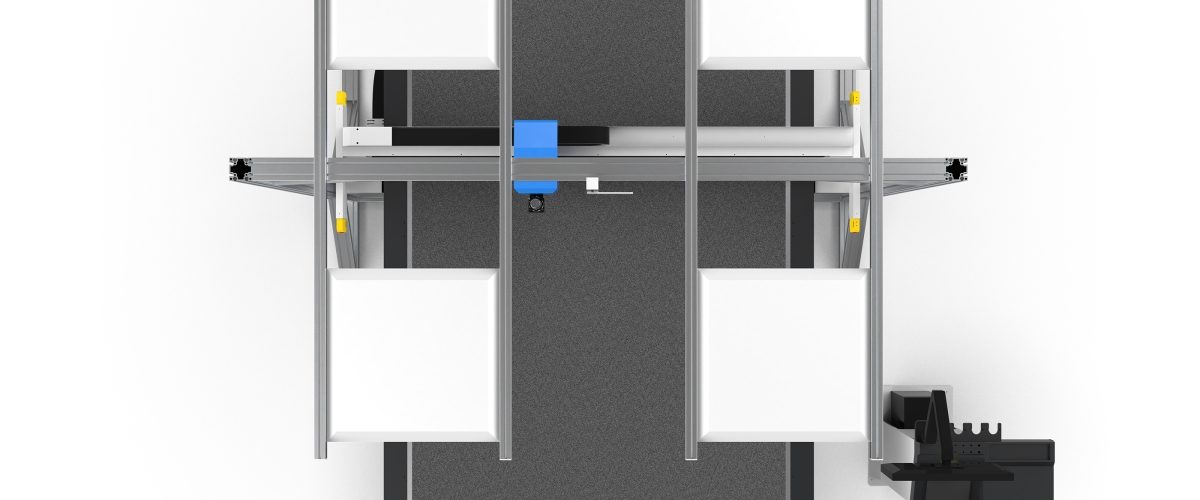
An oscillating knife cutting machine is an industrial device that performs CNC cutting of flexible and semi-rigid materials using a blade that reciprocates at high frequency.
- Before selecting a model, three numbers must be clarified: the material list, the thickness range (0.1–100mm), and the precision requirement (±0.3mm to ±0.05mm).
- The industry-standard repeat positioning accuracy is ±0.02–0.05mm, which reflects mass-production consistency better than the nominal positioning accuracy.
- The effective cutting speed is limited by acceleration (0.5G–1.5G); cutting 3mm EVA is typically 200–400mm/s, while cutting honeycomb cardboard is only 100–200mm/s.
- Common vacuum table sizes range from 1600×2500mm to 2500×3500mm, with vacuum pump power of 5.5–11kW, requiring 4–8 independent zones.
- Tool heads commonly have 3–5 stations with automatic switching; the oscillating knife frequency is 3000–12000 strokes/minute, and the kiss-cut knife depth adjustment precision reaches the 0.01mm level.
- Budget tiers: entry level 80,000–150,000 RMB, mid-range 150,000–300,000 RMB, high-end 300,000–600,000 RMB; the high-end tier includes CCD vision and MES integration.
Step 1: Write the requirements as three numbers
An oscillating knife cutting machine is not a general-purpose device; it is difficult for a single machine to cut both 0.1mm PET film and 100mm honeycomb cardboard well at the same time. Before selecting a model, determine three things first so that the supplier can provide you with a configuration plan.
- Material list: Corrugated paper, honeycomb paperboard, EPE/EVA foam, leather, automotive interior fabrics, PVC/acrylic film, carbon fiber prepreg, fiberglass cloth, rubber sheet. Their hardness and resilience vary greatly, directly determining the blade type and blade pressure.
- Thickness range: Common tiers are 0.1–3mm (film, prepreg), 3–20mm (foam, leather), and 20–100mm (honeycomb board, thick foam). Spanning two tiers usually requires two sets of knife heads or even two machines.
- Accuracy requirements: ±0.3mm is sufficient for the advertising and packaging industries; electronic accessories and automotive interior parts are mostly ±0.1mm; prepreg cutting requires ±0.05mm, and repeat consistency matters more than single-piece dimensions.
Add one more throughput figure: the cutting area to be completed per hour (㎡/h) or the number of pieces per day. This figure determines how much servo power you need and how many zones your vacuum table should have far better than “maximum speed” does.
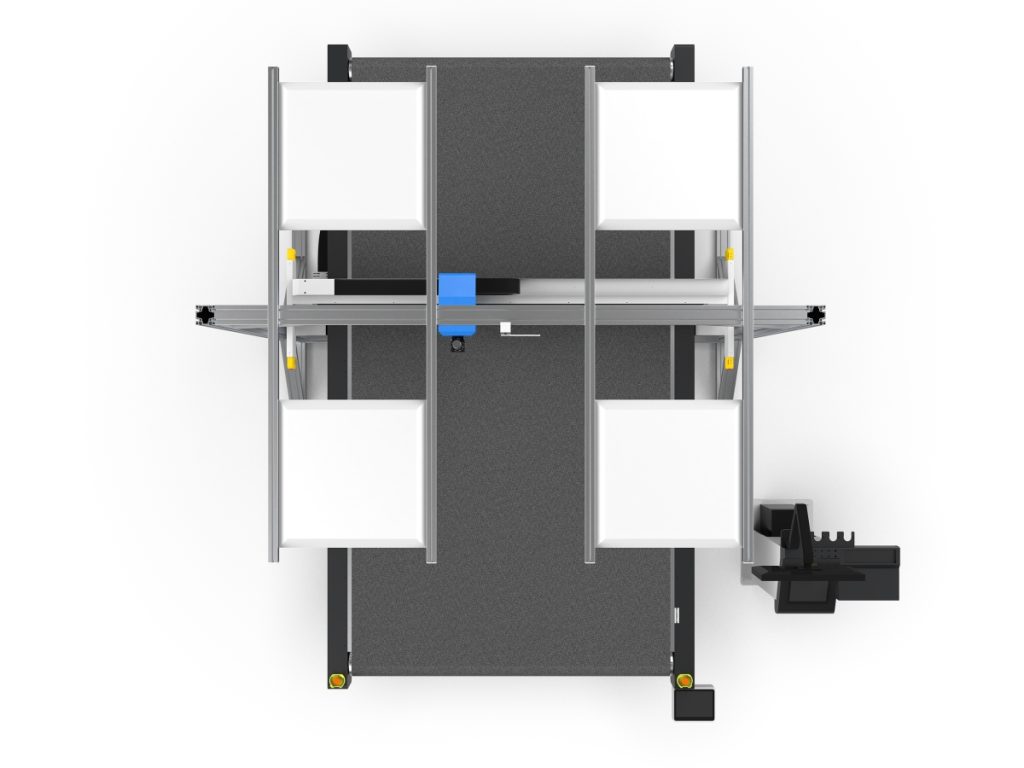
How to read the core parameters
Accuracy: distinguish positioning accuracy from repeat positioning accuracy
The “±0.05mm” on the sample is most likely the positioning accuracy under no-load, low-speed, single-axis conditions. What really affects mass production is repeat positioning accuracy, which is typically ±0.02–0.05mm in the industry. When discussing accuracy, you must ask about the test conditions: what material, how thick, whether vacuum adsorption is enabled, and what the cutting speed is. When cutting foam materials at 25mm thick, blade lateral deflection can cause an actual deviation of more than 0.2mm—this is a process issue, not a machine accuracy issue.
Speed: Look at Acceleration, Not Peak Value
The nominal 0–1800mm/s is the rapid traverse speed. The actual effective speed depends on acceleration (commonly 0.5G–1.5G) and the corner deceleration strategy. When cutting 3mm EVA, the effective cutting speed usually falls in the 200–400mm/s range; when cutting honeycomb cardboard, limited by blade chip evacuation, it is often only 100–200mm/s. The way to judge is simple: ask them to run a segment on site with your material and your pattern (including dense small fillets) and measure the actual cycle time.
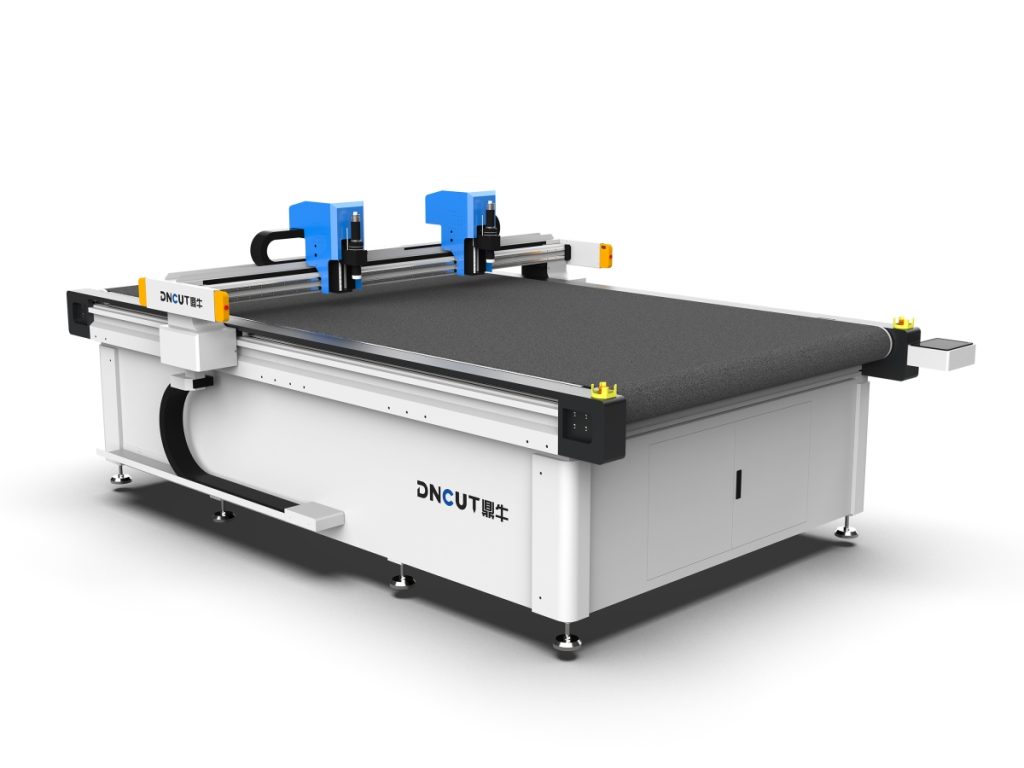
Table and Vacuum Adsorption
Common table sizes are 1600×2500mm, 2100×3100mm, and 2500×3500mm. Vacuum pump power is generally 5.5–11kW, and the key is the number of zones: 4–8 independently switchable vacuum zones, so that when cutting small parts you can hold them by turning on only the corresponding zones. For the table structure, check whether it has a felt sacrificial layer and a replaceable panel; after long-term use, decreased flatness will directly affect the first-cut penetration depth.
Transmission and Structure
For the X/Y axes, ground racks paired with linear guides are preferred, with servo power starting at 1.2–2kW; stepper motors are prone to losing steps after prolonged continuous cutting. For the gantry beam, a welded-then-aged structure or a cast structure is recommended; machine weight is positively correlated with rigidity, and machines under 2 tons will show more obvious vibration when cutting thick materials.
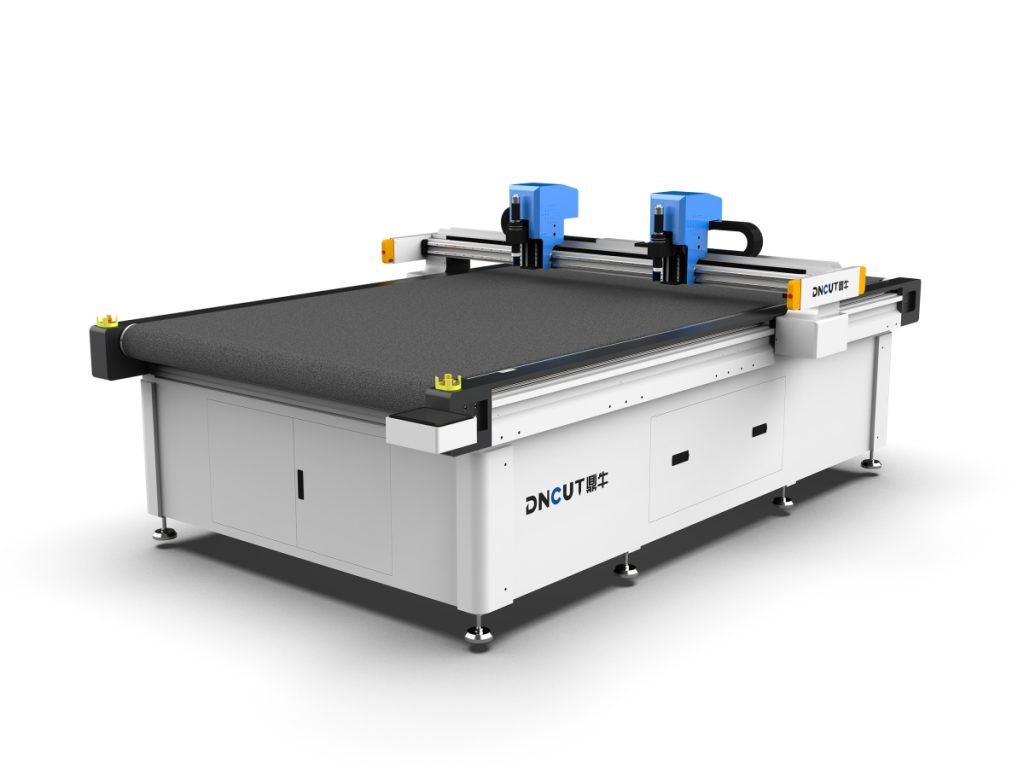
The tool head configuration determines what you can cut
The number of tool head stations affects the range of applications more than the host machine brand; a common configuration is 3–5 stations with automatic switching:
- Oscillating knife: the general-purpose workhorse, suitable for foam, leather, honeycomb cardboard, and rubber; oscillation frequency 3000–12000 times/minute, adjustable to suit different materials.
- Drag knife/circular knife: films, fabrics, non-woven fabrics; clean cuts without stretching.
- Kiss cut knife: labels, tape, adhesive-backed materials; cuts only through the face material while preserving the backing paper, with depth adjustment precision down to the 0.01mm level.
- Creasing wheel: fold lines for corrugated board and cardstock; creasing width must match paper thickness.
- V-groove knife: 30°/45° V-grooves, used for folded corners of thick cardstock and honeycomb board.
- Punch and pen: positioning marks and hole punching, often used in combination with CCD vision.
Also confirm whether the knife pressure is programmable (set by layer), whether the knife head lift is pneumatic or electric, and whether tool changes require tools. These three items determine changeover efficiency.
Software and layout capability
No matter how accurate the machine is, weak layout software will eat into profits. You must confirm: support for importing DXF/DWG/PLT/AI/PDF/HPGL and automatic knife head assignment by layer; support for shared-edge cutting, bridge connection, and automatic nesting (reasonable nesting can improve material utilization by 5%–15%); process parameters can be stored by material (speed, knife pressure, reciprocating frequency, overcut). If there is an ERP/MES integration requirement, confirm whether interfaces and barcode process management are provided.
Easily overlooked details
- Dust extraction interface: Cutting foam and cardboard generates dust, so a vacuum port must be reserved; otherwise dust enters the guide rails.
- Static electricity treatment: Cutting film must be equipped with a static elimination bar; otherwise the material will cling and drift.
- Safety configuration: Safety light curtains, emergency stop, and protective guards are acceptance items, not options.
- Noise: Normal operation should be below 75dB. The vacuum pump is the main noise source, so confirm whether it is in a separate machine room or has soundproofing added.
- Consumable costs: Blade unit price and service life (when cutting EVA, typically replaced every few dozen hours) should be factored into costs based on annual output.
- After-sales: Whether local engineers are available and the delivery lead time for common spare parts (blades, felt, vacuum pump filter elements).
Acceptance trial-cutting checklist
Before signing the contract, bring your own materials for on-site trial cutting and record each of the following items one by one:
- Cut 20 pieces of each of three representative materials, measure key dimensions with calipers, and calculate the deviation distribution rather than only looking at a single piece.
- For patterns containing dense small fillets and sharp corners, check for overcut, fillet collapse, and corner burrs.
- When cutting the smallest parts (e.g., 20×20mm), check whether they are held securely by vacuum and whether they shift.
- Run continuously for 2 hours and observe whether there is step loss, alarms, or a drop in vacuum level.
- The actual time required to switch from material A to material B (including tool change and parameter changes).
- Whether interrupted cutting can be resumed after a power outage and restart.
Budget Tier Reference
- Entry level (80,000–150,000 RMB): single tool head, stepper or low-power servo, within 4 zones, suitable for advertising signage and small-batch packaging.
- Mid-range (150,000–300,000 RMB): 3 stations, servo rack-and-pinion drive, 6–8 zone vacuum, covering multi-material switching among foam, leather, and corrugated paper.
- High-end (300,000–600,000 RMB): 5 stations, CCD vision, automatic feeding, MES integration, used for automotive interiors, electronic auxiliary materials, and prepreg cutting.
There are three common misconceptions: comparing models by peak speed; using nominal accuracy instead of trial-cut verification; and cutting the tool-head stations to save budget, resulting in manual tool changes every time the job changes. Keep these three points in mind, and the selection will generally not deviate significantly.
FAQ
Which specification should be considered for the accuracy of an oscillating knife cutting machine?
For an oscillating knife cutting machine, focus on repeat positioning accuracy, with the industry-standard level being ±0.02–0.05mm, rather than the no-load positioning accuracy shown in the brochure.
How can the actual cutting speed of an oscillating knife cutting machine be determined?
The actual speed of an oscillating knife cutting machine depends on acceleration and corner deceleration strategy. You should ask the supplier to perform an on-site trial cut using your materials and patterns to measure the cycle time.
How many tool-head stations does an oscillating knife cutting machine need?
Oscillating knife cutting machines commonly have 3–5 stations with automatic switching. The number of stations affects material applicability and changeover efficiency more than the machine brand.
What items should be checked during the acceptance trial cut of an oscillating knife cutting machine?
For acceptance testing of an oscillating knife cutting machine, test cuts should be made on three materials with 20 pieces each to measure deviation distribution, checking overcut at small radii, minimum-part hold-down, stability during 2 hours of continuous operation, and material changeover time.
What is the budget range for an oscillating knife cutting machine?
Entry-level oscillating knife cutting machines cost 80,000–150,000 RMB, mid-range 150,000–300,000 RMB, and high-end 300,000–600,000 RMB; high-end configurations include 5 stations, CCD vision, and MES integration.