01Core Challenges of Garment and Textile Cutting
The garment and textile industry involves diverse materials, from lightweight cotton to heavy sheepskin shearling, from elastic knit fabrics to multi-layer composite fabrics. The cutting process must balance precision, efficiency, and material integrity. Common issues include: edge melting, interlayer displacement, pile flattening, and elastic deformation. This article, based on oscillating knife cutting technology, provides actionable solutions.
02Material Properties and Cutting Parameters
Cotton and Polyester
Cotton and polyester are the most commonly used materials in garments. Cotton is prone to fuzzing, and polyester has a melting point of around 250°C, making laser cutting likely to produce burnt edges. Oscillating knife cutting has no thermal effect. Recommended parameters: blade angle 15°–20° (flat blade for cotton, serrated blade for polyester), cutting speed 800–1200 mm/s, vacuum adsorption negative pressure -0.6 to -0.8 bar to ensure the fabric lies flat. For polyester, the speed can be appropriately increased to 1500 mm/s to prevent blade overheating and sticking.
Knit Fabric
Knit fabric is highly elastic and prone to curling. It requires low negative pressure adsorption (-0.3 to -0.5 bar) combined with a pressure roller to prevent stretching deformation. Use a round-tip blade, angle 10°–15°, cutting speed 600–900 mm/s. For highly elastic areas such as ribbing, it is recommended to reduce the speed to 500 mm/s and use layered cutting (thickness per layer ≤5 mm).
Non-woven Fabric
Non-woven fabric has loose fibers and is prone to fraying. Ultrasonic cutting or a hot cutting knife is recommended to seal the edge while cutting. When using oscillating knife cutting, select a sharp flat blade, angle 12°, speed 1000–1300 mm/s, negative pressure -0.5 bar. Note to regularly clean fiber buildup on the blade.
Composite Fabrics and Outdoor Jacket Fabrics
Composite fabrics (such as TPU laminated fabrics) and outdoor jacket fabrics (multi-layer structures) are prone to interlayer separation. During cutting, reduce the speed to 500–700 mm/s, use oscillating knife + air cooling (to prevent the adhesive layer from melting), blade angle 20°, negative pressure -0.7 bar. For film-containing materials, it is recommended to use drag knife mode to reduce pulling on the film layer.
Sheepskin Shearling
Sheepskin shearling is thick (10–20 mm) and the pile is prone to flattening. Use a long-edge oscillating knife (blade length 50 mm), angle 25°, speed 300–500 mm/s, negative pressure -0.8 bar or higher. Before cutting, use a pile-pressing roller to flatten the pile, and after cutting, use a brush to clean the blade. For thick materials, dual-head alternating cutting can be enabled to reduce the load on a single knife.
Leather Components
Leather (genuine/PU) cutting must avoid stretching and fraying. Use an oscillating knife with a pointed blade, angle 15°, speed 800–1000 mm/s, negative pressure -0.6 bar. For genuine leather, it is recommended to avoid defects during layout and use visual recognition for automatic positioning. For PU leather, pay attention to blade temperature; intermittent cutting can be used to prevent sticking.
03Equipment Selection and Function Matching
Different production scenarios have different equipment requirements:
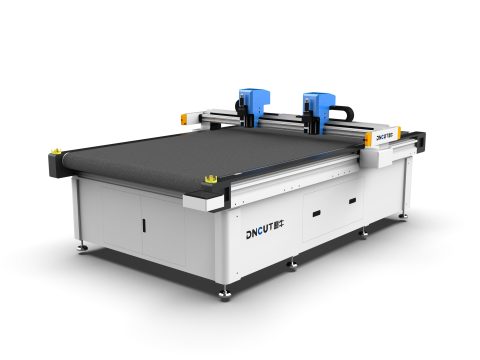
- High-volume single-layer cutting: Choose a dual-head cutting machine with two blades working alternately, increasing efficiency by over 40%, suitable for continuous production of cotton and polyester.
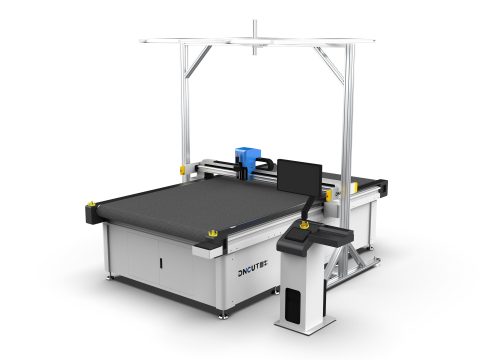
- High-precision multi-layer fabrics: The intelligent large-format vision cutting machine uses a CCD camera to identify contours and automatically compensates for deformation, suitable for aligned cutting of composite fabrics and outdoor jacket fabrics.
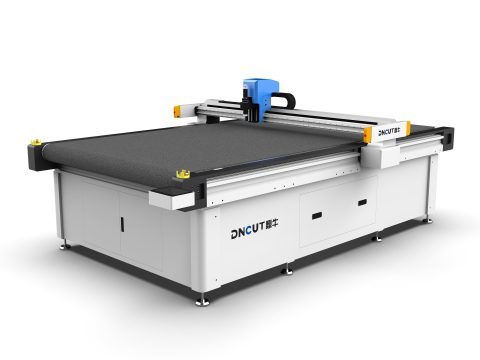
- Small batches, multiple varieties: The general-purpose cutting machine offers high cost-effectiveness and supports quick blade changes, adapting to small and medium orders of knitted fabrics, non-woven fabrics, etc.
All equipment must be equipped with a vacuum adsorption platform (zone-controlled) and an automatic feeding system to ensure continuous operation.
04Process Optimization and Common Issue Handling
Interlayer offset
During multi-layer cutting, interlayer slippage causes dimensional deviation. Countermeasures: pre-adsorption (adsorb for 30 seconds before cutting), reduce cutting speed (speed ≤800mm/s when each layer thickness ≤3mm), and use tape fixation on edges.
Edge melting
Synthetic fiber materials (polyester, nylon) generate frictional heat during high-speed cutting. Countermeasures: reduce blade speed (≤1000mm/s), enable air cooling (compressed air blown toward the blade), or switch to ultrasonic cutting.
Fiber nap flattening
After cutting sheepskin shearling, the fiber nap direction is inconsistent. Countermeasures: lay out in the direction of the nap, cut in a single direction from tail to head, and use a nap pressing roller for pretreatment.
Blade wear
Leather and composite fabrics wear blades quickly. It is recommended to inspect the blade every 8 hours, use coated blades (such as TiN coating) to extend service life, and reduce speed by 20% when cutting abrasive materials.
05Layout and Data Management
Using automatic layout software (such as Optitex, Gerber) can improve material utilization by 5%–15%. For leather, visual recognition must be combined to avoid defective areas; for striped/plaid fabrics, stripe and plaid matching is required, automatically matched through the vision system. Cutting data should be saved to the MES system for traceability.
06Safety and Maintenance
Operators must wear cut-resistant gloves, and the equipment must be properly grounded. Clean the guide rails and racks daily, check the vacuum pump filter element weekly, and calibrate the blade disc parallelism monthly (error ≤0.05mm). For long-term shutdown, loosen the blade to prevent deformation.
Through the above solutions, garment and textile enterprises can significantly improve cutting quality and efficiency while reducing waste. Actual parameters need to be fine-tuned according to material batches and equipment status; trial cutting is recommended for verification first.