
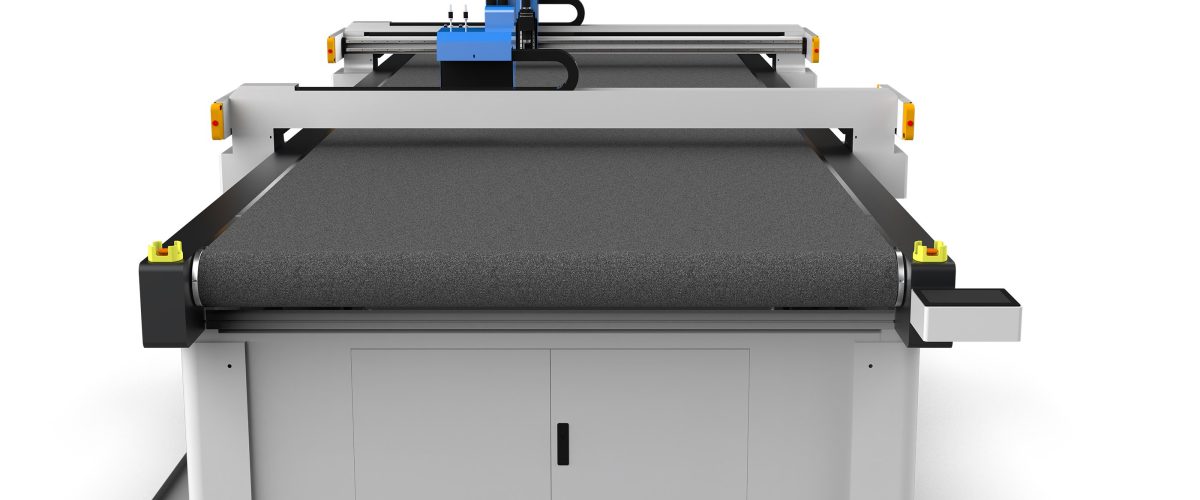
Challenges in Sheep Shearling Cutting and Equipment Selection
Sheep shearling is a leather material with a fuzzy surface, widely used in footwear, apparel, and automotive interiors. Its cutting difficulties lie in: the fuzzy layer is easily crushed, the blade easily heats up causing burnt edges, and the different extensibility of the base genuine leather and the fuzzy layer easily produces dimensional deviations. Traditional die pressing or manual cutting has low efficiency and poor precision, while the oscillating knife cutting machine (also known as a vibrating knife cutting machine) effectively solves the above problems through a high-frequency micro-amplitude vibrating blade. When selecting a model, pay attention to the following core parameters:
- Cutting working area: Common specifications are 1600mm×2500mm and 2100mm×3100mm, selected according to raw material size and nesting requirements. An excessively large working area affects rigidity, while one that is too small wastes material.
- Oscillation frequency: It is recommended to choose a high-frequency model of 8,000-12,000 strokes per minute. The higher the frequency, the smoother the cut surface, but it must match the material thickness.
- Blade type: For shearling, it is recommended to use a pointed blade (angle 15°-20°) or a round blade. The pointed blade is suitable for fine contours, and the round blade is suitable for long straight cuts.
- Vacuum adsorption system: It must be equipped with zoned vacuum adsorption to ensure that the pile layer is not lifted during cutting. The adsorption force is recommended to be ≥0.06MPa.
- Transmission type: rack-and-pinion transmission accuracy ±0.1mm, suitable for most scenarios; linear motor transmission accuracy ±0.05mm, suitable for high-precision automotive interior parts.
In addition, the equipment should be equipped with automatic nesting software that supports DXF, PLT and other formats, and can optimize nesting according to the pile direction to reduce waste.
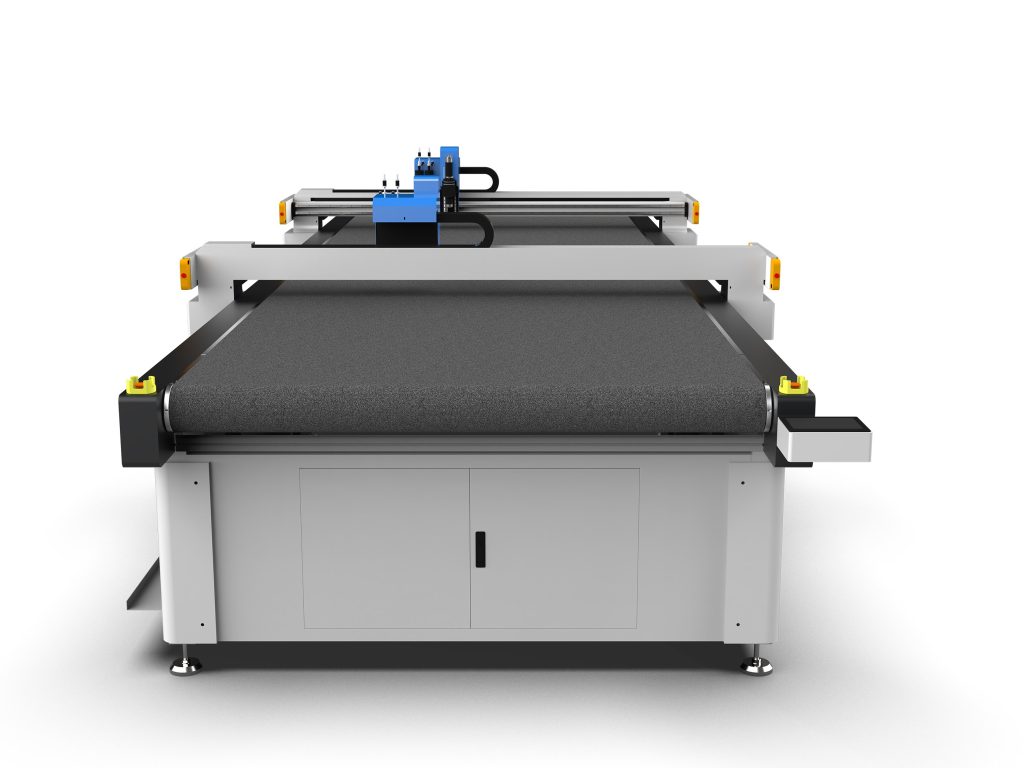
Tool Selection and Parameter Settings
The cutting effect of sheep shearling largely depends on the matching of the knife and parameters. The following are recommended solutions summarized from practice:
1. Knife Selection
- Pointed knife (15°): Suitable for complex curves and small-radius contours (such as shoe upper decorative pieces). The blade is sharp, but wears quickly; it is recommended to check every 200-300 meters of cutting.
- Round knife (diameter 25mm): Suitable for long straight lines and large contour cutting, with a longer service life, but the turning radius is limited (minimum R5mm).
- Oscillating knife (with serrated edge): For thick pile (pile height ≥8mm), it can reduce pile pulling, but the cut is slightly rough.
2. Key Parameter Settings
- Oscillation frequency: For thin materials (pile height ≤5mm), use 10,000-12,000 strokes/min; for thick materials (pile height 5-10mm), use 8,000-10,000 strokes/min. Excessive frequency can easily cause the blade to overheat.
- Cutting speed: Straight segments can be set to 300-500mm/s, while curved segments should be reduced to 150-250mm/s. Excessive speed will cause burrs at the cut edge.
- Knife pressure: Adjust according to material thickness, generally 0.2-0.5MPa. Excessive knife pressure can easily crush the pile, while insufficient pressure will fail to cut through the bottom layer.
- Suction force: Zoned suction; the suction force in the cutting area is 0.04-0.06MPa, and the non-cutting area can be turned off to save energy.
- Blade compensation: For a pointed knife, a tool radius compensation of 0.1-0.2mm must be set; for a circular knife, a compensation of 0.5-1.0mm must be set to ensure dimensional accuracy.
Note: Before the first cut, be sure to test cut with waste material to check whether the cut is smooth, whether there are burnt edges, and whether the dimensions are accurate. It is recommended to recalibrate the parameters each time the material batch is changed.
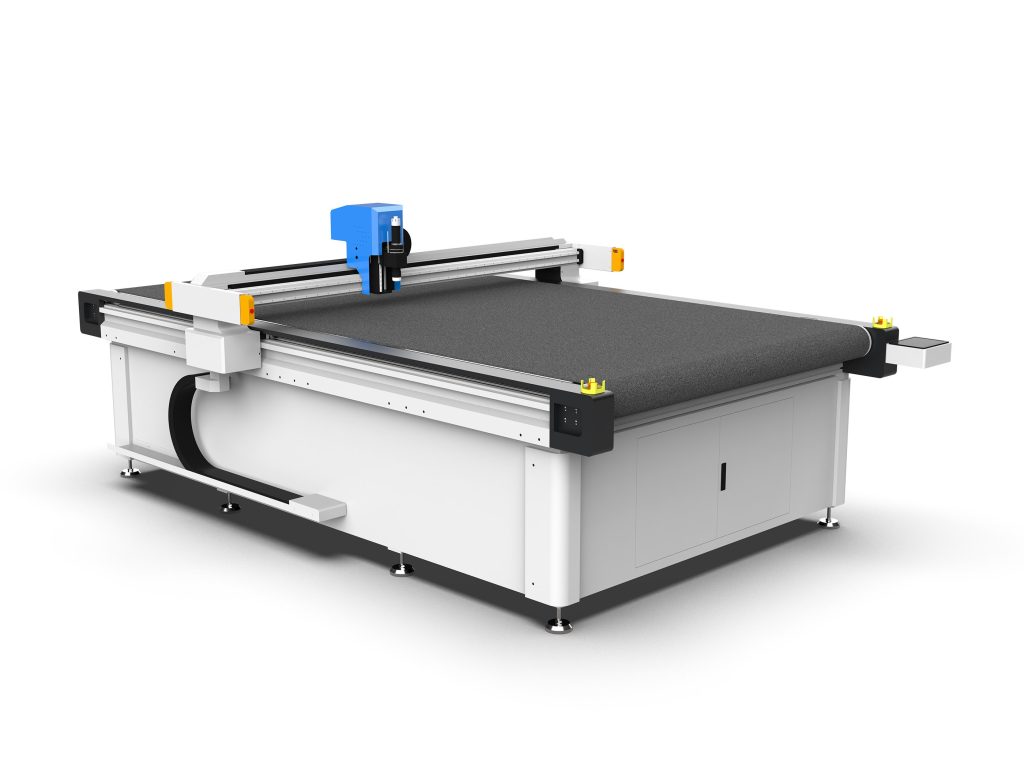
Operating Procedure and Tips
A standardized operating procedure can significantly improve cutting quality and extend equipment lifespan. The recommended steps are as follows:
1. Material Preparation
- Check the moisture content of the sheepskin shearling, keeping it controlled at 8%-12%. Too wet makes it easy to stick to the blade; too dry makes it easy to generate static electricity that attracts lint.
- Lay the material flat on the cutting table, with the pile direction consistent (usually laid out in the direction of the pile).
- Use a bristle brush to comb the pile, removing impurities and loose fibers to avoid them being caught in the blade during cutting.
2. Layout and Fixing
- Use layout software to optimize the arrangement, taking the pile directionality into account; arranging in the same direction can reduce color differences.
- Turn on vacuum adsorption to ensure the material fits completely against the table. For sheepskin shearling with strong air permeability, a thin PE film can be covered over the material to enhance the adsorption effect.
3. Cutting Process
- First cut the inner contour, then the outer contour, to avoid material displacement.
- For thick materials, use layered cutting (each layer depth ≤3mm) to reduce tool load.
- Observe the cut quality in real time; if burrs or scorched edges appear, immediately adjust the speed or frequency.
4. Unloading and Cleaning
- After cutting is complete, turn off the suction, and use a soft brush to clean the fuzz on the table surface to avoid residue affecting the next cut.
- Regularly wipe the blade with a dedicated cleaner to remove fuzz and grease.
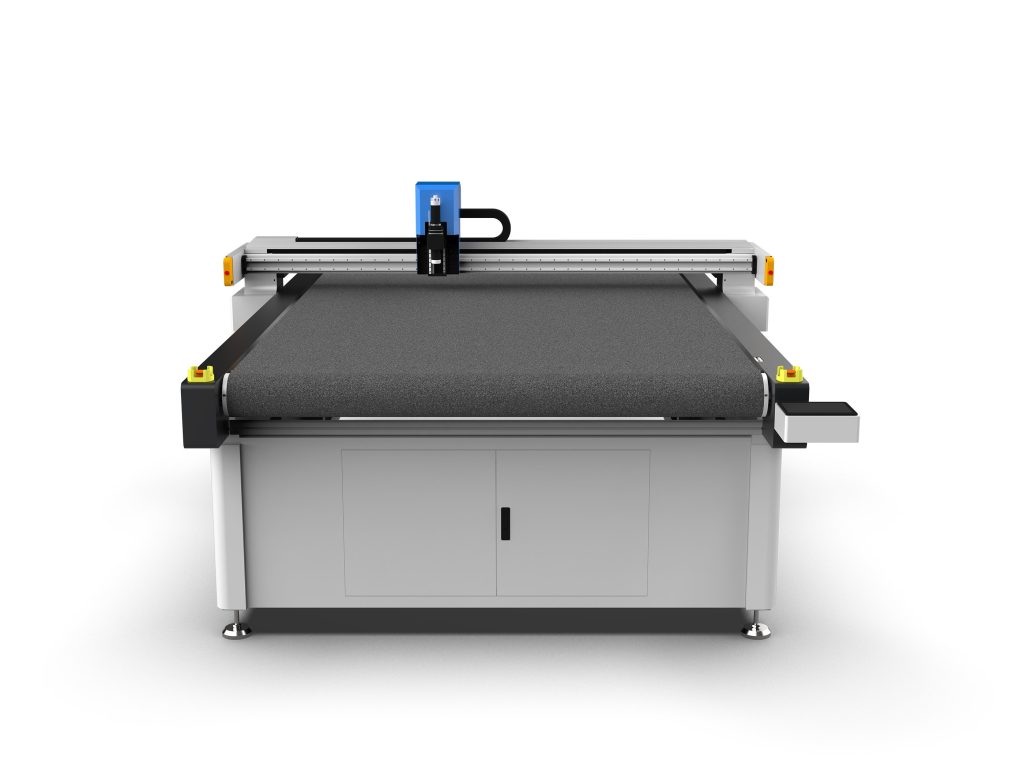
Common Problems and Solutions
Based on customer feedback, common problems and countermeasures in sheepskin shearling cutting are as follows:
- Rough cut edges: The cause may be a dull blade, too low an oscillation frequency, or too high a speed. Solution: Replace the blade, increase the frequency to above 10,000 times/min, and reduce the speed to below 200 mm/s.
- Burnt edges (scorching): Usually caused by blade overheating. Check whether the oscillation frequency is too high (above 12,000 times/min), reduce the frequency and shorten continuous cutting time, and install an air-blow cooling device if necessary.
- Dimensional deviation: Check whether the tool compensation setting is correct, whether the suction force is sufficient (recommended ≥0.05 MPa), and whether the drive belt is loose.
- Fleece crushed: knife pressure too high or blade angle too blunt. Adjust knife pressure to 0.2-0.3MPa and use a sharp pointed blade.
- Material displacement: insufficient suction or too dense nesting. Add suction zones, or place a layer of breathable felt under the material to enhance suction uniformity.
If the problem persists, it is recommended to contact the equipment manufacturer for parameter diagnosis, and if necessary, upgrade the control system (e.g., add servo knife pressure control).
Maintenance and Safety Specifications
Proper maintenance can extend equipment life and maintain cutting accuracy. Key points for daily maintenance:
- Daily: Clean the felt on the table surface, check blade wear (observe the cutting edge with a magnifying glass), and clean the adsorption filter screen.
- Weekly: Lubricate the guide rails and racks (use lithium-based grease), check belt tension (a 10mm depression is appropriate), and calibrate the origin.
- Monthly: Check electrical connections, clean dust from the control cabinet, and test the emergency stop button function.
- Blade management: Establish blade usage records. Replace pointed blades every 500 meters of cutting or when burrs appear, and replace round blades every 1000 meters. When storing, keep the cutting edge facing up to avoid collisions.
Safety aspects: Do not wear gloves during operation (to prevent entanglement); long hair must be tied back; do not put hands into the cutting area while the machine is running; power must be cut off before replacing blades; do not turn on the vacuum when no material is laid on the suction table, to avoid motor overload.
Following the above guidelines, the sheep shearing fleece cutting machine can stably achieve a cutting accuracy of ±0.2mm, with smooth cuts and no burnt edges, and efficiency improved by 5-8 times compared with manual work. In actual production, parameters need to be fine-tuned according to material batch differences, and process records should be established.