
Process Challenges in Cutting Brushed Fabric
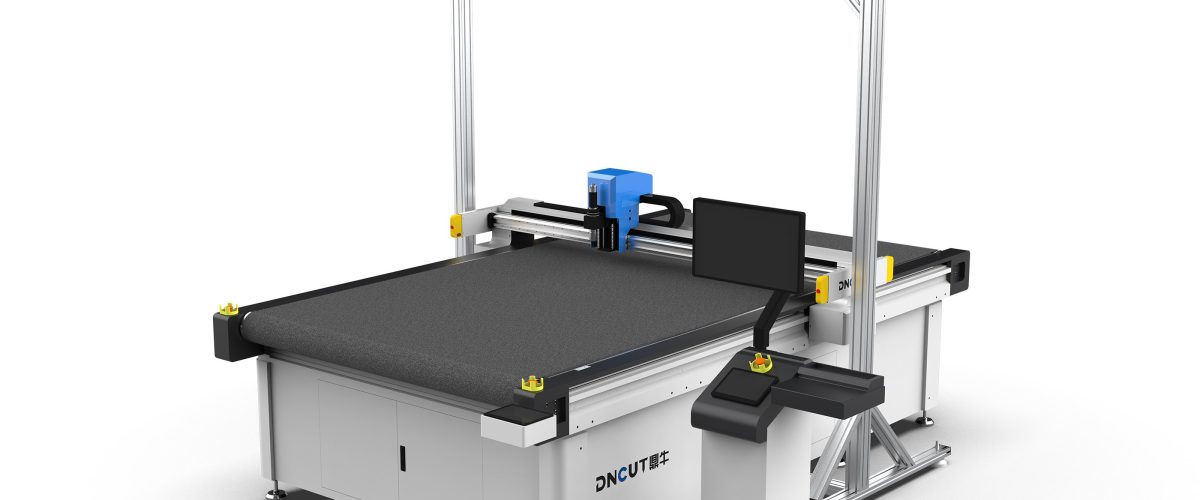
Brushed fabric (such as fiberglass cloth, carbon fiber cloth, and aramid cloth) is woven from high-strength fibers. Traditional cutting methods (such as scissors, hot knives, and lasers) have obvious defects: mechanical blades easily produce frayed edges and fiber stringing, hot knives cause melted edges and hardening, and laser cutting produces burnt edges and harmful gases. These defects directly affect the quality of subsequent lamination, sewing, or layup processes. The oscillating knife cutting machine drives the blade through high-frequency oscillation (10,000-20,000 times per minute) and cuts the fibers in a “cold cutting” manner. The cut is flat, with no melted edges and no frayed edges, making it the mainstream solution for brushed fabric processing.
Core Parameters and Selection of Oscillating Knife Cutting Machines
1. Oscillation Frequency and Amplitude
When cutting brushed fabric, the oscillation frequency is recommended to be set at 12,000-18,000 times/min, with an amplitude of 0.5-1.5 mm. Too low a frequency will increase cutting resistance and cause fiber stringing; too high a frequency will accelerate blade wear. For thin fiberglass cloth below 0.5 mm, high frequency and low amplitude can be used (18,000 times/min, 0.5 mm); for multi-layer aramid cloth above 3 mm, the frequency needs to be reduced to 12,000 times/min and the amplitude increased to 1.2 mm to ensure complete cutting.
2. Blade Type and Angle
Commonly used blades include:
- Sharp-angle blade (30°-45°): Suitable for fine contours and thin cloth, with a narrow cut, but the blade tip wears easily and needs frequent replacement.
- Round-edge blade (60°): General-purpose type, balancing service life and cut quality, suitable for medium-thickness brushed fabric.
- Serrated blade: For high-density aramid cloth, the serrations can grip the fibers to prevent slipping and reduce stringing.
Carbide (tungsten steel) is recommended as the blade material, with a service life 3-5 times that of high-speed steel. When cutting fiberglass cloth, blades wear relatively quickly. It is recommended to check the cutting edge every 8 hours and replace it in time.
3. Cutting Speed and Feed
Speed setting needs to balance efficiency and cut quality. For single-layer fiberglass cloth (0.2 mm), the cutting speed can reach 30-40 m/min; for multiple layers (more than 5 layers) or high-gram-weight cloth (>300 g/m²), the speed is reduced to 10-15 m/min. Too fast a feed will cause blade deflection and diagonal marks on the cut; too slow a feed will cause fiber melting (accumulated friction heat). In actual production, it is recommended to determine the optimal speed through trial cutting: start at 20 m/min and increase by 5 m/min each time, observing whether frayed edges or yellowing appear on the cut.
4. Adsorption and Fixation
Brushed fabric is soft in texture and easily shifts during cutting. A vacuum adsorption platform must be used, with adsorption force adjusted according to cloth weight: low negative pressure (-3 kPa to -5 kPa) for thin cloth (<100 g/m²), and high negative pressure (-8 kPa to -10 kPa) for thick cloth. For highly breathable fiberglass cloth, a layer of PE film can be covered on the cloth surface to improve adsorption. The platform surface needs to be cleaned regularly to prevent fiber debris from clogging the adsorption holes.
Reference Table of Cutting Process Parameters
The following parameters are suitable for common brushed fabrics and need to be fine-tuned in practice according to equipment brand and fabric type:
- Fiberglass cloth (0.2 mm, single layer): frequency 18,000 times/min, amplitude 0.5 mm, speed 35 m/min, 30° sharp-angle blade, adsorption -4 kPa.
- Fiberglass cloth (1.0 mm, three layers): frequency 15,000 times/min, amplitude 0.8 mm, speed 18 m/min, 60° round-edge blade, adsorption -7 kPa.
- Carbon fiber cloth (0.5 mm, prepreg): frequency 16,000 times/min, amplitude 0.6 mm, speed 25 m/min, 45° sharp-angle blade, adsorption -5 kPa (note: prepreg requires a low-temperature environment to avoid resin adhesion).
- Aramid cloth (2.0 mm, multiple layers): frequency 12,000 times/min, amplitude 1.2 mm, speed 10 m/min, serrated blade, adsorption -9 kPa.
Common Problems and Solutions
1. Frayed Cut Edges
Causes: dull blade, too low oscillation frequency, too fast speed. Solution: replace the blade; increase frequency by 10%-15%; reduce speed by 20%. If frayed edges still exist, try using a serrated blade or adding a sacrificial layer (such as kraft paper) beneath the cloth.
2. Melted Edges (yellowing, hardening)
Causes: cutting speed too slow leading to accumulated friction heat, or improper angle between blade and cloth surface. Solution: increase speed to the recommended range; check blade installation angle (should be perpendicular to the cloth surface, deviation <2°); for heat-sensitive fibers (such as certain modified fiberglass), an air cooling device can be added (compressed air blowing to purge the cut).
3. Incomplete Cutting
Causes: insufficient amplitude, insufficient blade extension length, insufficient adsorption force causing sliding between cloth layers. Solution: increase amplitude to 1.0-1.5 mm; adjust blade extension length (usually 1.5 times the cloth thickness); increase adsorption negative pressure or use double-sided tape to fix the edges.
4. Short Blade Life
Causes: rapid blade wear when cutting highly abrasive fibers (such as fiberglass). Solution: use carbide blades; reduce oscillation frequency to 12,000 times/min (to reduce impact wear); check the cutting edge every 500 meters cut and replace in time. Record the number of meters cut by each blade and establish a replacement cycle.
Equipment Maintenance and Care
The long-term stability of the oscillating knife cutting machine depends on regular maintenance:
- Daily: Clean fiber debris from the table and check whether adsorption holes are clogged; check whether the blade is loose.
- Weekly: Clean the guide rails and lead screws and apply lithium-based grease; check synchronous belt tension (sag <5 mm).
- Monthly: Calibrate the eccentric block of the oscillation motor (amplitude decreases after wear); check the air line filter and drain water.
- Quarterly: Replace worn blade collets (decreased clamping force will cause blade deflection); check the vacuum pump oil level.
For multi-shift production, it is recommended to replace the oscillation motor bearings every 500 hours to avoid sudden failures.
Selection Recommendations and Cost Analysis
When choosing a brushed fabric cutting machine, consider:
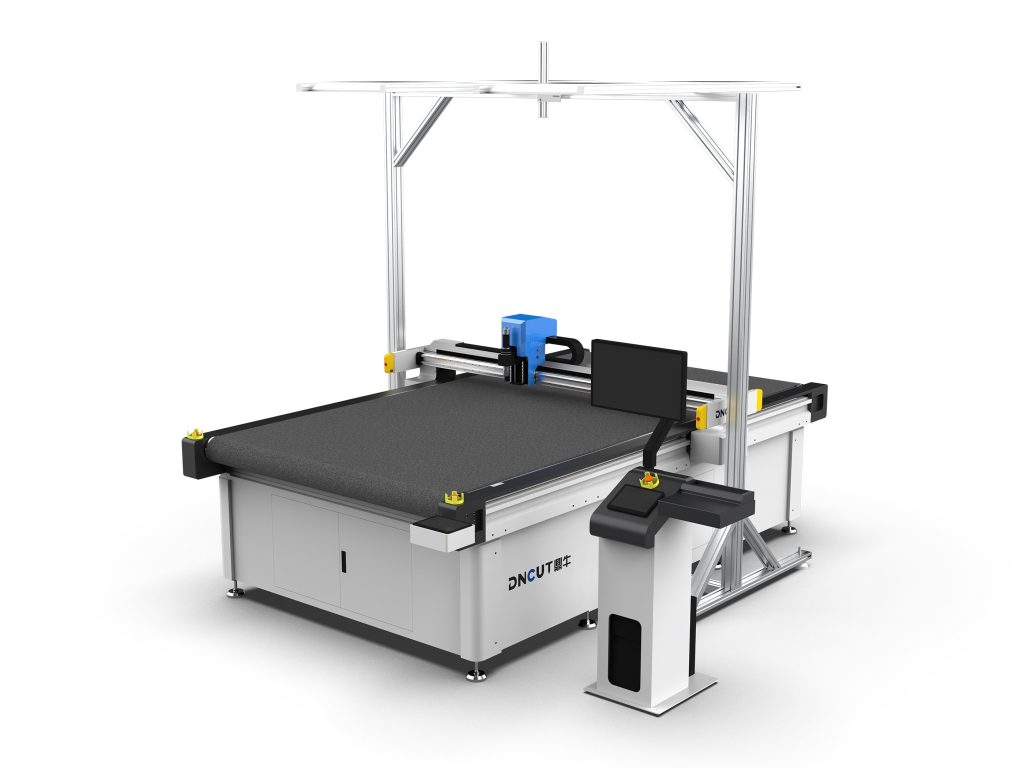
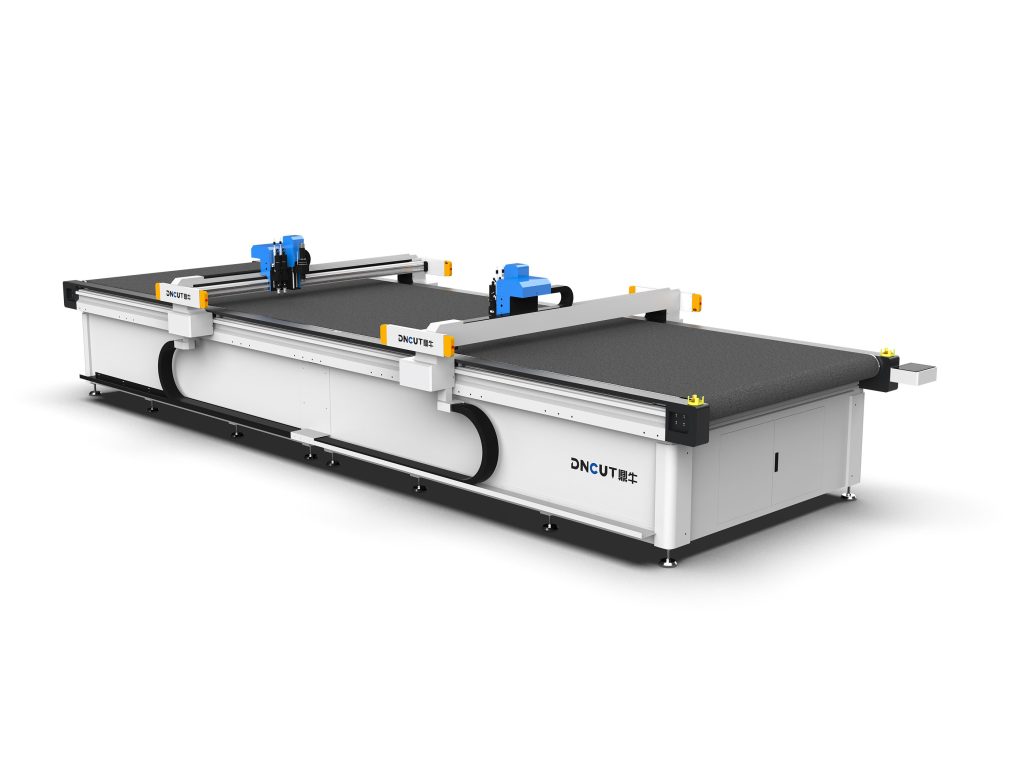
- Cutting working area: Choose according to the maximum cloth roll width, commonly 1600 mm×2500 mm or 2100 mm×3000 mm. If cutting oversized dimensions (such as fiberglass cloth for wind turbine blades), an extended table (over 4000 mm) can be optionally configured.
- Degree of automation: For small batches with multiple varieties, models with CCD camera positioning can be selected to achieve automatic edge finding; for large batches of a single variety, an automatic feeding system can be optionally configured to reduce manual loading and unloading time.
- Power and air supply: The main unit power of the oscillating knife is usually 1.5-2.2 kW, and the vacuum pump requires 5.5-7.5 kW. The air supply requirement is 0.6-0.8 MPa, with air consumption of about 200 L/min (for air cooling and clamping).
- Cost: Domestic equipment prices are about 80,000-150,000 RMB (working area 1600 mm×2500 mm), and imported equipment is 200,000-400,000 RMB. Blade consumable cost: carbide blades are about 50-80 RMB/piece. Calculated at one replacement per day, the monthly consumable cost is about 1,500-2,400 RMB. It is recommended to give priority to brands with a complete after-sales service network to ensure timely supply of blades and accessories.
Summary
The key to cutting brushed fabric lies in the “cold cutting” process and parameter matching. Through a reasonable combination of frequency, amplitude, blade, and speed, the oscillating knife cutting machine can achieve high-quality cutting with no frayed edges and no melted edges. In actual production, it is recommended to establish a cutting parameter database, record the optimal parameters for different fabric types, and strictly implement blade replacement and equipment maintenance plans. For special fibers (such as carbon fiber prepreg), environmental temperature and humidity also need to be controlled to avoid resin adhesion affecting cut quality.