01Why does leather cutting require a dedicated solution?
Leather materials are highly diverse, ranging from natural genuine leather to composite leather, with significant differences in thickness, elasticity, surface texture, and backing fabric. Traditional die cutting has slow changeover and high costs, while laser cutting easily produces burnt edges and odors. Oscillating knife cutting technology uses a high-frequency micro-oscillating blade to achieve cold cutting, avoiding thermal damage, and is especially suitable for leather materials. This article focuses on six common types of leather materials and provides actionable cutting parameters and process recommendations.
02Applicable material characteristics and knife selection
1. Genuine leather (top-grain cowhide)
Thickness is usually 0.8-2.0mm, with uneven texture and regional differences (firm along the backbone, loose on the belly). It is recommended to use a pointed oscillating knife (angle 15°-20°) with a tip radius of 0.1-0.2mm to reduce cutting resistance. For thick leather (>1.5mm), a wave knife can be selected to reduce friction. The recommended cutting speed is 300-600mm/s, with an oscillation frequency of 12,000-15,000 times/minute.
2. Microfiber leather
Thickness 0.6-1.5mm, with an ultrafine fiber backing and a polyurethane coating on the surface. Cutting tends to produce frayed edges; a round-tip knife (radius 0.3mm) is recommended together with cooling air (pressure 0.2MPa) to blow away debris. Speed 400-800mm/s, frequency 10,000-12,000 times/minute. Note: the back of microfiber leather has a high friction coefficient, so ensure the vacuum adsorption force is ≥-60kPa.
3. PU leather
Thickness 0.3-1.0mm, smooth surface, knitted fabric backing. It tends to slip during cutting; it is recommended to use a sharp pointed knife (angle 10°) and reduce the speed to 200-400mm/s. For thin PU (<0.5mm), a drag knife mode can be used to reduce material stretching.
4. Split leather
Thickness 1.0-2.5mm, with a coated surface and a rough fiber backing. A thick-material oscillating knife (blade thickness 0.6mm) is recommended, with a frequency of 8,000-10,000 times/minute and a speed of 200-400mm/s. Before cutting, it is recommended to use a press roller to compact the material and avoid delamination.
5. Suede leather
Thickness 0.8-1.8mm, with a fuzzy surface that easily produces dust. An anti-static knife must be used and a brush dust removal device configured. Speed 300-500mm/s, frequency 12,000 times/minute. After cutting, it is recommended to use a vacuum cleaner to clean the table to prevent fuzz accumulation from affecting adsorption.
6. Composite leather
Thickness 1.0-3.0mm, multi-layer structure (surface layer + backing + base fabric). Layer separation easily occurs during cutting; a double-edged knife or oscillating knife is recommended together with low frequency and high amplitude (frequency 6,000-8,000 times/minute, amplitude 1.0-1.5mm). Speed 150-300mm/s, and adopt a layered cutting strategy (cut the surface layer first, then the bottom layer).
03Key process parameter settings
Knife angle and tip radius
- Thin and soft materials (PU leather, microfiber leather): angle 10°-15°, tip radius 0.1-0.2mm
- Medium-thick materials (genuine leather, split leather): angle 15°-20°, tip radius 0.2-0.3mm
- Thick and hard materials (composite leather): angle 20°-30°, tip radius 0.3-0.5mm
Cutting speed and oscillation frequency
Speed and frequency must match material thickness: thin materials use high speed and high frequency (600-800mm/s, 12000-15000 times/minute), thick materials use low speed and low frequency (150-300mm/s, 6000-8000 times/minute). Excessive frequency causes the blade to heat up and affects leather edge quality.
Vacuum Adsorption and Table Selection
For leather-type materials, it is recommended to use a felt table surface (5mm thick) with zoned vacuum adsorption, with adsorption force of -40 to -80kPa. For highly breathable suede leather, a PVC film can be covered to enhance adsorption. The table surface needs regular cleaning to prevent glue particles and debris from affecting flatness.
04Layout and Nesting Techniques
The core challenges of leather cutting are avoiding defects and improving utilization. It is recommended to use intelligent layout software that supports the following functions:
- Defect marking: Mark areas such as insect holes, scars, and blood veins on the scanned image, and automatically avoid them during layout.
- Directional layout: Genuine leather has a grain direction, and all cut pieces must be kept in a consistent direction (such as shoe uppers and bags).
- Mixed nesting: Combine cut pieces of different sizes in the layout, which can improve utilization by 5%-15%.
- Shared-edge cutting: Adjacent cut pieces share cutting lines, reducing path length and improving efficiency by more than 20%.
For microfiber and PU leather, the material uniformity is good, and automatic nesting algorithms can be used, with utilization reaching over 85%.
05Common Problems and Solutions
Problem 1: Cutting edges turn yellow or scorched
Cause: Blade overheating or oscillation frequency too high. Solution: Reduce frequency to below 8000 times/minute, add cooling air or intermittent cutting (stop for 1 second every 10 seconds of cutting).
Problem 2: Material displacement causing dimensional deviation
Cause: Insufficient adsorption force or worn table surface. Solution: Check vacuum pump pressure (≥-60kPa), replace the felt table surface, and for small cut pieces, add tape fixation.
Problem 3: Suede fuzz clogs the blade slit
Cause: Fuzz accumulates between the blade and the material. Solution: Use a brush knife or air blow device (pressure 0.3MPa), and clean the knife holder every 30 minutes of cutting.
Problem 4: Composite leather delamination
Cause: Cutting speed too fast or blade not sharp. Solution: Reduce speed to below 200mm/s, use a new blade, and adopt double-pass cutting (the first pass cuts through the top layer, the second pass cuts the bottom layer).
06Equipment Selection Reference
Different production scenarios have different equipment requirements:
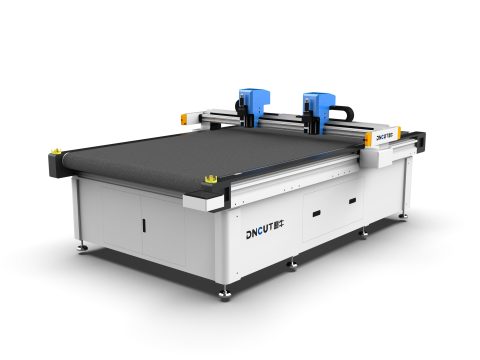
- Small batch, multiple varieties: Choose a dual-head cutting machine, which can perform cutting and punching simultaneously, with tool change time <10 seconds.
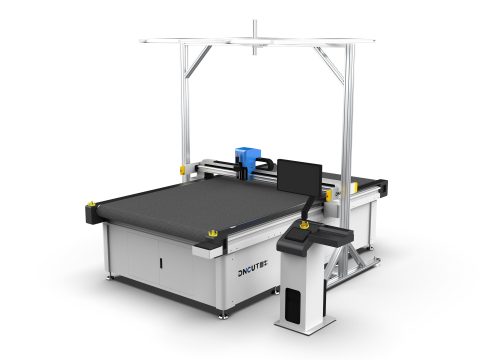
- High-precision complex patterns: Choose a large vision cutting machine, equipped with a CCD camera, automatic contour recognition, and positioning accuracy of ±0.1mm.
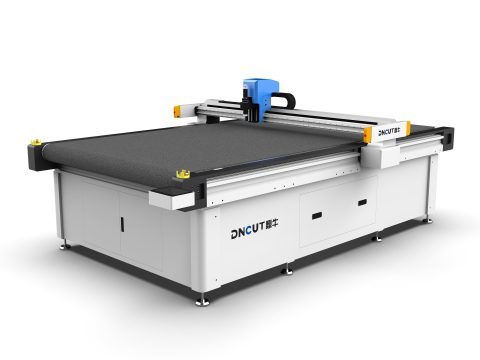
- Large batch standardized production: Choose a general-purpose cutting machine, supporting automatic feeding and high continuous cutting efficiency.
Regardless of the equipment type, it is recommended to configure automatic nesting software and tool life management functions to ensure stable production quality.
07Summary
The core of a leather cutting solution lies in material adaptation: select the blade angle, oscillation frequency, and adsorption method based on the leather type, and combine with intelligent nesting to avoid defects. Through parameter optimization and routine maintenance, cutting quality and material utilization can be significantly improved. It is recommended to perform a test cut on each batch of material first, record the optimal parameter combination, and build the company's own process database.