01Core Challenges of Composite Material Cutting
Composite materials are composed of two or more materials with different properties, commonly including carbon fiber prepreg, glass fiber prepreg, carbon plate, honeycomb panel, hollow panel, and hard composite panels. These materials face three major difficulties during cutting: delamination, burrs, and thermal damage. For example, carbon fiber prepreg tends to produce fiber stringing during cutting, while honeycomb panels are easily crushed. Traditional die cutting or laser cutting often cannot balance precision and efficiency. This solution is based on oscillating knife cutting technology, achieving cold cutting through high-frequency micro-vibration (8,000-12,000 times per minute) to avoid thermal effects, and combines different knives and adsorption systems to solve the above problems.
02Material Characteristics and Cutting Parameters
1. Carbon Fiber Prepreg
Prepreg usually has an epoxy resin matrix, with a thickness of 0.1-0.5mm. During cutting, it is necessary to prevent resin adhesion and fiber fraying. It is recommended to use a oscillating knife + pneumatic knife combination: the oscillating knife is used for straight and curved contours, and the pneumatic knife is used for small holes and fine patterns. The recommended cutting speed is 300-600mm/s, and the vibration frequency is 10,000 times/minute. The worktable needs to be equipped with vacuum adsorption (negative pressure -0.08MPa) and a static elimination device to prevent material movement and adsorb dust. The cut edges should be free of burrs, with dimensional accuracy of ±0.1mm.
2. Glass Fiber Prepreg
Glass fiber is relatively brittle and easily produces dust. It is recommended to use a circular knife or oscillating knife, combined with a brush material-pressing device. The cutting speed is 400-800mm/s, and the vibration frequency is 8,000 times/minute. Since glass fiber dust is irritating, the equipment needs to integrate a dust collection system (air volume ≥200m³/h), and the filter element should be cleaned regularly.
3. Carbon Plate (Cured Carbon Fiber Plate)
Thickness 1-5mm, high hardness. Use a carbide oscillating knife or milling cutter (optional). The oscillating knife cutting speed is 200-400mm/s, the frequency is 12,000 times/minute, and the single cutting depth should not exceed 2mm, with multi-layer cutting. Pay attention to knife wear and check the blade edge every 50 meters of cutting. The cut edges need to be deburred with a diamond file.
4. Honeycomb Panel (Aluminum Honeycomb, Nomex Honeycomb)
Honeycomb panels are easily crushed, so a pointed knife or serrated knife should be used, combined with low-pressure adsorption (-0.03MPa) and a foam backing plate. The cutting speed is 500-800mm/s, and the vibration frequency is 6,000 times/minute. Keep the knife vertical during cutting to avoid lateral force. For thick honeycomb panels (>20mm), it is recommended to cut in two passes: the first pass cuts through the top panel, and the second pass cuts the core material.
5. Hollow Panel (PP/PE Hollow Panel)
Thickness 2-10mm, relatively soft material. Use an oscillating knife or circular knife, with a cutting speed of 800-1200mm/s and a frequency of 8,000 times/minute. To prevent melted edges, a cold air cooling device can be selected. An adsorption pressure of -0.05MPa is sufficient.
6. Hard Composite Panels (such as glass fiber board, epoxy board)
Thickness 1-3mm, medium hardness. Use an oscillating knife, with a speed of 300-500mm/s and a frequency of 10,000 times/minute. It is recommended to use diamond-coated knives to extend service life. After cutting, polish the edges with sandpaper.
03Equipment Configuration and Selection Recommendations
Different configurations can be selected according to production needs:
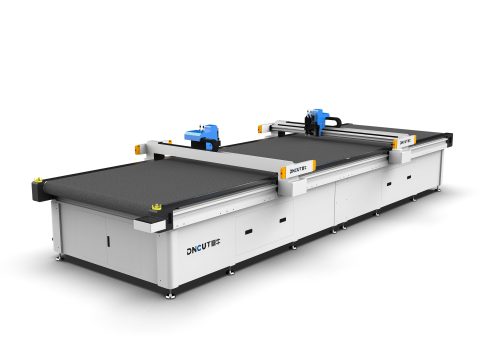
- Customized all-around cutting machine: Suitable for multi-material mixed production, equipped with an automatic tool change system (optional 6-12 tools), supporting oscillating knife, circular knife, pneumatic knife, milling cutter, etc. The worktable size can be customized (e.g., 1600×2500mm to 3000×6000mm), with vacuum zoned adsorption, suitable for batch processing of carbon fiber prepreg and honeycomb panels.
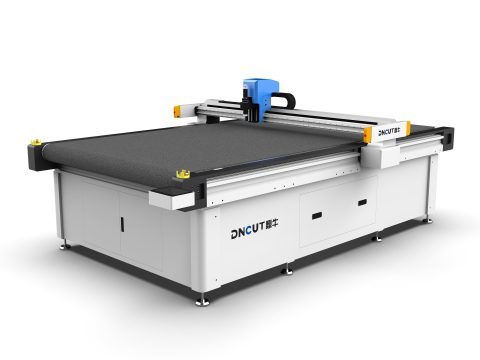
- General-purpose cutting machine: Suitable for small and medium batch production mainly of a single material, standardly equipped with oscillating knife and circular knife, with high cost-effectiveness. Worktable size 1600×2500mm, adsorption pressure -0.06MPa, with optional dust collection device.
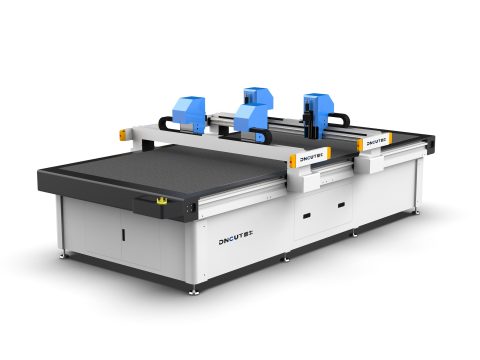
- Intelligent dual-beam cutting machine: Dual-beam structure, two cutting heads working independently, efficiency increased by more than 50%. Suitable for large batch orders, such as cutting of glass fiber prepreg and carbon plate. The beam is made of cast aluminum alloy, with fast dynamic response and repeat positioning accuracy of ±0.05mm.
When selecting a model, consider material type, thickness, production capacity, and budget. It is recommended to first provide samples for trial cutting to verify the cutting effect.
04Process optimization and common problems
1. Delamination and burrs
Causes: blunt tool, too low vibration frequency, insufficient adsorption. Countermeasures: replace tools regularly (inspect carbon fiber every 8 hours), increase vibration frequency to above 10,000 times/minute, and ensure adsorption pressure ≥-0.06MPa.
2. Thermal damage
The oscillating knife is cold cutting and generally causes no thermal damage. If laser or ultrasonic is used, power must be controlled. This solution recommends the oscillating knife to avoid the heat-affected zone.
3. Honeycomb panel collapse
Use a pointed knife and reduce adsorption pressure, place high-density foam (such as EVA, hardness 50 Shore A) under the honeycomb panel, and the cutting speed should not be too fast.
4. Dust control
When cutting glass fiber and carbon fiber, the dust collection system must be turned on. It is recommended to install a follow-up dust collection hood near the cutting head, with an air velocity at the dust collection inlet of ≥20m/s. At the same time, the workshop must be equipped with an explosion-proof dust collector.
05Maintenance and safety
Clean the guide rails and racks daily, check tool wear weekly, and calibrate the vacuum adsorption system monthly. Operators must wear dust masks and protective goggles. The equipment grounding resistance must be ≤4Ω to prevent static electricity accumulation.
Through reasonable tool selection, parameter settings, and equipment configuration, oscillating knife cutting technology can efficiently and precisely process various composite materials, meeting the needs of aerospace, automotive, wind power, and other industries.