01Why the advertising inkjet printing industry needs a dedicated cutting solution
Advertising inkjet printing materials come in many types with widely differing characteristics: inkjet canvas is soft and easy to stretch, knife-coated banner fabric has a hard coating that easily chips the blade, vehicle wraps have adhesive backing that sticks to the blade, reflective film's glass beads wear down the blade, and KT board/foam board easily produces debris. General-purpose cutting equipment often produces burrs, dimensional deviations, material delamination, or blade sticking, resulting in rework rates as high as 15%-20%. This solution is based on oscillating knife cutting technology and provides actionable parameters and operating guidelines for 9 common materials.
02Core equipment capability requirements
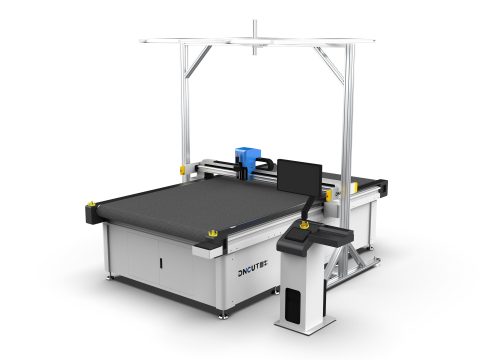
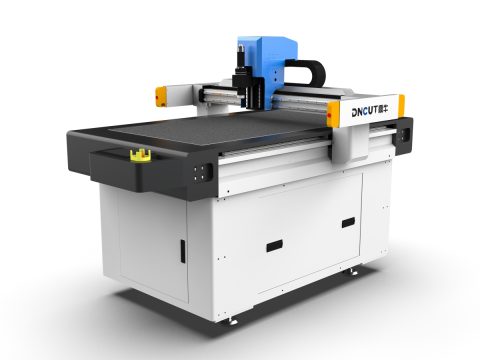
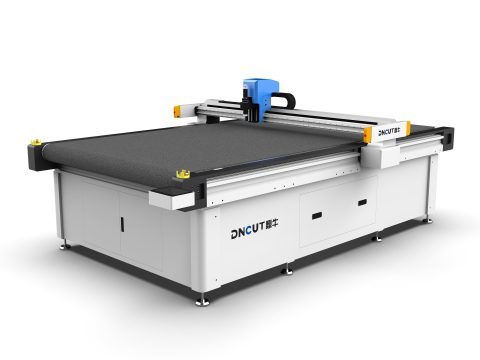
We recommend using an oscillating knife cutting machine equipped with an intelligent vision system (such as the DN6-VI), as well as the general-purpose cutting machine (DN6) and the electronic auxiliary material cutting machine (DN3) for small-batch proofing. Key capabilities:
- Vision positioning: A CCD camera identifies registration marks and compensates for material stretching and deformation, with positioning accuracy of ±0.1mm.
- Closed-loop knife pressure control: Adjustable from 0-1000g with 1g resolution, adapting to different thicknesses.
- Multi-tool head switching: Oscillating knife, drag knife, round knife, V-knife, and creasing wheel, with one-touch tool change.
- Zoned vacuum suction: Independently controlled to prevent small pieces of material from shifting.
03Cutting parameters and practical tips for 9 materials
1. Inkjet canvas (PVC scrim-reinforced fabric, thickness 0.3-0.5mm)
Parameters: Oscillating knife angle 30°, knife pressure 180-220g, speed 800-1000mm/s, vacuum suction 60%-70%. Tips: Cutting along the warp direction reduces burrs; the blade tip must be sharp, and wear should be checked every 500 meters of cutting; after cutting, quickly pass a hot air gun (200°C) along the edge to seal it and prevent fraying.
2. Knife-coated banner fabric (thickness 0.5-0.8mm)
Parameters: Oscillating knife angle 45°, knife pressure 300-350g, speed 600-800mm/s, suction 80%. Tips: The coating is hard and brittle; insufficient knife pressure will cause repeated cutting and delamination; a new blade is recommended, replaced every 200 meters; if micro-cracks appear on the edge after cutting, apply a dab of PVC glue to reinforce it.
3. Vehicle wrap (adhesive-backed PVC, thickness 0.1-0.2mm)
Parameters: Drag knife or oscillating knife angle 30°, knife pressure 80-120g, speed 1200-1500mm/s, suction 40%-50%. Tips: The adhesive backing easily sticks to the blade; coat the blade surface with silicone oil or use a Teflon-coated blade; the cutting depth must just cut through the face material without damaging the release liner, which can be adjusted through test cuts; when the ambient temperature is below 15°C, the adhesive backing hardens, so the material needs to be preheated to 20-25°C.
4. Reflective film (glass bead type, thickness 0.15-0.3mm)
Parameters: Oscillating knife angle 30°, knife pressure 150-200g, speed 800-1000mm/s, suction 50%. Tips: Glass beads wear down the blade extremely quickly; check the blade tip every 100 meters of cutting, and a diamond-coated blade is recommended; turn on an ionizing fan during cutting to eliminate static electricity and prevent beads from scattering; avoid repeated cutting along the same path, otherwise the beads will detach and form white edges.
5. PP paper (synthetic paper, thickness 0.1-0.2mm)
Parameters: Drag knife angle 30°, knife pressure 60-100g, speed 1500-1800mm/s, suction 30%-40%. Tips: PP paper is highly brittle, and excessive knife pressure will cause cracks; using a round knife can reduce edge chipping; after cutting, lightly sand the edge with fine sandpaper (800 grit) to remove burrs; avoid folding during storage.
6. Light box film (PET or PVC, thickness 0.15-0.25mm)
Parameters: Oscillating knife angle 30°, knife pressure 100-150g, speed 1000-1200mm/s, vacuum 40%. Key points: The surface of light box film is smooth and easily scratched, so the knife tip must be polished; cover the material with a protective film during cutting; if high-precision patterns are required, enable visual positioning compensation for thermal deformation (PET thermal expansion coefficient 0.00007/℃).
7. PVC (rigid, thickness 1-3mm)
Parameters: Oscillating knife angle 45°, knife pressure 500-700g, speed 400-600mm/s, vacuum 90%-100%. Key points: Thick PVC requires layered cutting, with each pass no deeper than 1mm, completed in 2-3 passes; use a V-knife to cut 45° bevels; turn on the dust collection device during cutting to collect debris; excessive knife pressure will cause the material to crack, so it is recommended to adjust gradually from low to high.
8. KT board (thickness 5mm)
Parameters: Oscillating knife angle 30°, knife pressure 200-250g, speed 800-1000mm/s, vacuum 50%-60%. Key points: The core material of KT board is brittle, and excessive knife pressure will crush the core; use a thin blade (0.6mm thick) to reduce resistance; after cutting, finish the edges with sandpaper or hot air; avoid cutting in environments below 10℃, otherwise the core material becomes more brittle.
9. Snowflakes board (PVC foam board, thickness 3-10mm)
Parameters: Oscillating knife angle 45°, knife pressure 400-600g (3mm) to 800-1000g (10mm), speed 300-500mm/s, vacuum 90%. Key points: Thick boards require multiple passes, with each pass 2-3mm deep; use a serrated knife to reduce friction heat; after cutting, finish the edges with a dedicated trimming knife; it is recommended to enable dual-zone vacuum suction to prevent board warping.
04General Operating Procedure and Quality Control
- Material pretreatment: Roll materials need to be unrolled on the cutting machine and left to rest for 2-4 hours to release stress, with the ambient temperature controlled at 18-25℃ and humidity at 40%-60%.
- Visual positioning: Set at least 2 Mark points per sheet of material; after camera recognition, automatically compensate for stretching deviation (stretch rate of inkjet cloth is about 1%-3%).
- Test cut verification: Before formal cutting, test cut a 100mm×100mm square at the corner, check cut-through performance and edge quality, and adjust knife pressure by ±20g.
- First article inspection: Measure dimensional tolerance (required within ±0.5mm), check for burrs, delamination, and knife sticking.
- Batch monitoring: Inspect 1 piece out of every 50, record changes in knife pressure and speed, and set blade life according to material type (inkjet cloth 2000 meters, knife-coated cloth 800 meters, reflective film 300 meters).
05Common Problems and Solutions
- Burrs: Blunt knife or excessive speed. Replace the blade, reduce speed by 10%-20%, or switch to a round knife.
- Dimensional deviation: Material stretching not compensated. Increase the number of Mark points and enable the visual deformation compensation function.
- Delamination: Insufficient knife pressure or excessive knife angle. Increase knife pressure by 20-30g and switch to a smaller angle knife (such as 30°).
- Knife sticking: Temperature of adhesive-backed material too high. Lower the ambient temperature to 20℃ and apply silicone oil to the knife surface.
- Debris: Generated when cutting KT board/Snowflakes board. Turn on dust collection, use a serrated knife, and reduce speed.
06Maintenance and Safety
Clean the knife head guide rail and vacuum adsorption table daily; check the knife pressure sensor accuracy weekly (calibrate with standard weights); replace the vacuum adsorption sealing strip monthly. Wear cut-resistant gloves during operation, use dedicated tools when replacing blades, and never reach hands into the cutting area while the machine is running.