01Core Challenges and Solutions for Membrane Material Cutting
Membrane structures are widely used in architectural tensile membranes, tent structures, inflatable structures, environmental covers, and other fields. The physical properties of different membrane materials vary significantly: PVDF membrane has a smooth surface coating, PTFE membrane is brittle and prone to creasing, PVC tarpaulin is heavy and embedded with reinforcing fibers, knife-coated fabric has a thick coating and edges prone to delamination, mesh membrane is permeable with large differences in warp and weft strength, and inflatable membrane materials require airtightness and high cutting piece precision. These characteristics impose different requirements on the cutting process, with core challenges concentrated in four aspects: tension control, tool selection, edge quality, and dimensional accuracy.
Traditional manual cutting or ordinary blade cutting suffers from low efficiency, poor precision, and rough edges. Especially for large-format membrane materials (working widths often reaching 3-5 meters), the cumulative error of manual line-drawing cutting can reach ±10mm or more, failing to meet the splicing precision requirements of tensile membrane structures. Using oscillating knife cutting technology combined with intelligent nesting software can stabilize cutting precision within ±0.5mm while avoiding material stretching deformation.
02Material Properties and Cutting Parameter Comparison
PVDF Membrane
PVDF (polyvinylidene fluoride) coated polyester fiber membrane, with a smooth surface, thickness typically 0.5-1.2mm, and weight approximately 500-1100g/m². During cutting, attention must be paid to the adhesion between the coating and the base fabric to avoid coating peeling. It is recommended to use an oscillating knife (frequency 8000-12000 strokes/min), tool angle 30°-45°, cutting speed 15-25m/min. Tension should be controlled at 50-80N/m; too high will cause membrane creep, too low will produce wrinkles affecting precision.
PTFE Membrane
PTFE (polytetrafluoroethylene) coated glass fiber membrane, thickness 0.3-1.0mm, weight 400-1200g/m². PTFE membrane is relatively brittle, and micro-cracks are prone to appear at cut edges. A high-frequency oscillating knife (frequency 12000-15000 strokes/min) with a sharp tungsten carbide blade should be used, with a cutting speed of 10-20m/min. Tension must be precisely controlled (40-70N/m), and a floating presser foot mechanism should be adopted to avoid local stress concentration. Edge sealing treatment is recommended after cutting.
PVC Tarpaulin
PVC coated polyester or nylon base fabric, thickness 0.5-2.0mm, weight 500-1500g/m². The material is heavy and embedded with reinforcing fibers. A oscillating knife + rotary knife combination, or a high-power oscillating knife (power ≥500W) is recommended. Cutting speed 8-15m/min, tool angle 45°-60°. Tension control 80-120N/m; a strong feeding mechanism is required to prevent material slippage.
Knife-Coated Fabric
Knife-coated fabric is produced through a knife-coating process with PVC coating; the coating is thick and dense, thickness 0.4-1.5mm, weight 400-1200g/m². During cutting, the coating tends to stick to the blade; an oscillating knife with cooling or lubrication, or a Teflon-coated blade should be used. Cutting speed 10-18m/min, tension 60-90N/m. Pay attention to controlling ambient temperature (15-30℃); if the temperature is too high, the coating softens and sticks to the blade.
Mesh Membrane
Mesh membrane is woven from high-strength fibers with an open structure, and the strength differs greatly between warp and weft directions (warp strength is typically 20%-30% higher than weft). During cutting, an oscillating knife + vacuum adsorption table should be used to ensure mesh cells are not stretched and deformed. Tool angle 30°, cutting speed 12-20m/min, tension 30-50N/m (lower tension to avoid mesh deformation). A vision positioning system is recommended to compensate for mesh deformation.
Inflatable Membrane Materials
Inflatable membranes commonly use ETFE, PVC, or TPU materials with a thickness of 0.2-1.0mm, requiring high airtightness and cut-piece precision. It is recommended to use an oscillating knife (frequency 10,000-14,000 strokes/min), knife angle 30°, cutting speed 15-25m/min. Tension control 40-60N/m, requires a high-precision servo feeding system, repeat positioning accuracy ±0.1mm. After cutting, the edges must be flat and burr-free to ensure hot-air welding quality.
03Key Control Points of the Cutting Process
1. Tension Control Strategy
Tension control in membrane cutting directly affects dimensional accuracy. It is recommended to use a closed-loop tension control system, automatically adjusted according to material thickness and working area. For highly elastic PVC tarpaulin, tension fluctuation should be controlled within ±5N/m; for more rigid PTFE membrane material, tension fluctuation should be controlled within ±3N/m. In actual production, tension calibration can be performed before cutting, using tension sensors for real-time feedback.
2. Knife Selection and Wear Management
Different materials require matching knife materials: carbide blades are recommended for PVDF and knife-coated fabric (service life about 800-1,200 meters), tungsten carbide blades for PTFE (service life about 500-800 meters), and high-speed steel blades for PVC tarpaulin (service life about 300-500 meters). Establish a knife wear monitoring mechanism, and replace promptly when burrs appear on the cut edge or dimensional deviation exceeds ±0.3mm.
3. Layout and Path Optimization
Using intelligent nesting software (such as AutoNEST or similar systems) can increase material utilization to 85%-92%. For mesh membrane, the strength direction of warp and weft must be considered; during nesting, the main load-bearing direction should align with the warp direction. The cutting path should follow the principle of "inside first, outside later; small first, large later" to reduce material movement.
4. Environment and Post-Processing
The cutting environment temperature is recommended to be controlled at 18-28°C, with relative humidity 40%-65%. PTFE membrane material must undergo edge sealing within 4 hours after cutting to prevent edge moisture absorption. PVC tarpaulin and knife-coated fabric must be edge-sealed after cutting using a hot-air gun or high-frequency welding, with a sealing width of 8-12mm, and the temperature adjusted according to material thickness (usually 180-220°C).
04Equipment Configuration and Automation Recommendations
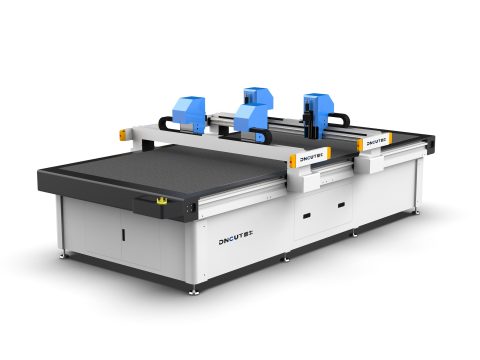
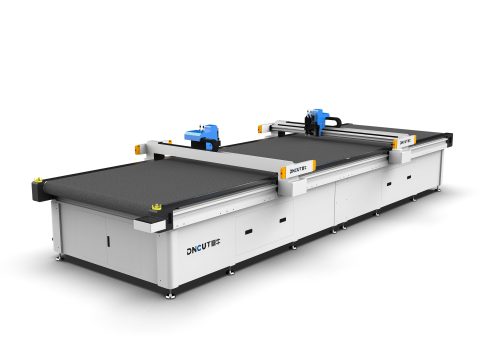
Given the characteristics of large working area and multiple varieties of membrane materials, it is recommended to configure an oscillating knife cutting machine with an automatic feeding system, with an effective cutting working area of no less than 3m×6m, and equipped with a multi-knife magazine (at least 4 types of knives) for rapid knife changes. For a dual-beam structure, cutting and marking operations can be performed simultaneously, increasing efficiency by more than 30%. The intelligent dual-beam design allows one beam to cut while the other beam performs scoring or punching, particularly suitable for complex cut pieces of inflatable membrane materials.
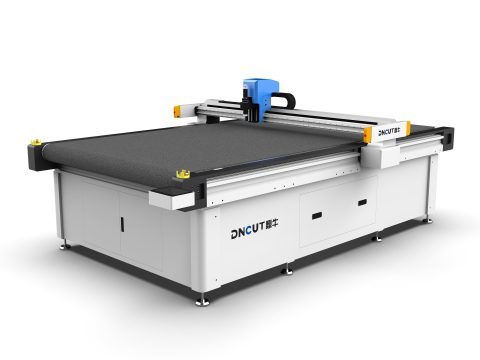
For customized requirements (such as special-shaped membrane structures, small-batch multi-batch production), it is recommended to choose an all-purpose cutting machine with customizable table and knife system, supporting the integration of multiple processes such as oscillating knife, circular knife, punching, and scoring. The equipment should have an automatic deviation correction function, using a CCD vision system to detect the material edge position in real time, with a deviation correction accuracy of ±0.2mm.
In terms of software, it is necessary to provide dedicated nesting software for membrane materials, supporting the import of formats such as DXF, DWG, and PLT, with functions for automatically generating cut-piece numbers, remnant management, and report output. For mesh membrane, the software should be able to identify the mesh direction and automatically optimize nesting.
05Common Problems and Countermeasures
- Rough cutting edges: Check for tool wear (replace the blade), reduce the cutting speed (by 10%-20%), and increase the vibration frequency (by 1000-2000 times/min).
- Dimension deviation out of tolerance: Calibrate the tension system (recalibrate), check whether the feed roller is slipping (clean or replace), and verify encoder accuracy (calibrate weekly).
- Material sticking to the blade: For knife-coated fabric and PVC tarpaulin, use Teflon-coated blades or add an air-blow cooling device; lower the ambient temperature to 20-25℃.
- Mesh membrane deformation: Reduce tension to 30-40N/m, use a vacuum adsorption platform for fixing, and reduce the tool entry angle to 25°-30°.
- Microcracks in PTFE membrane: Increase the vibration frequency to above 14000 times/min, use a new blade, and seal the edge immediately after cutting.
06Summary
The core of membrane structure cutting solutions lies in material adaptability, precise tension control, and scientific tool management. By reasonably selecting oscillating knife parameters, optimizing the layout path, and configuring automated feeding and deviation correction systems, cutting quality and efficiency can be significantly improved. In actual production, it is recommended to establish a material-process parameter database and conduct trial cuts for each batch of material to ensure cutting accuracy remains stable within ±0.5mm, meeting the high standards of membrane structure engineering.