01Why do automotive interior cuts require a dedicated solution?
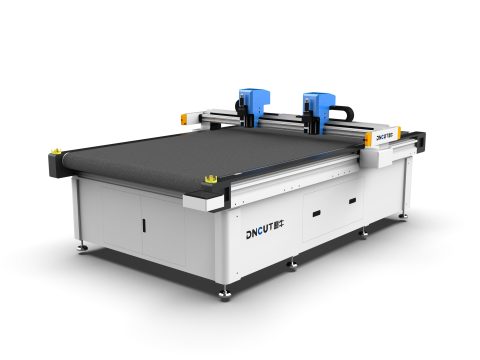
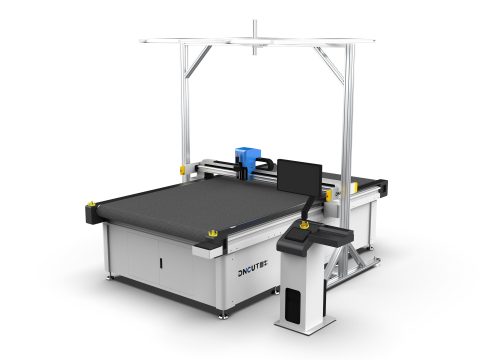
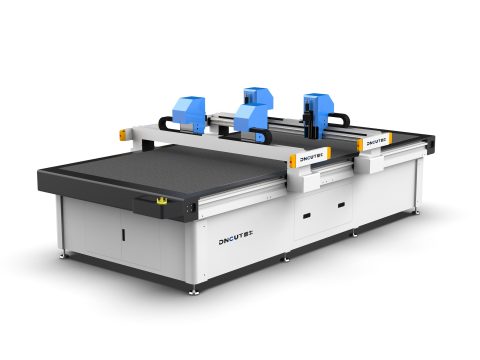
Automotive interior materials are highly diverse, ranging from soft leather to high-density rubber floor mats, with vastly different physical properties. Traditional die cutting or laser cutting often struggles to balance precision, efficiency, and material adaptability. For example, laser cutting leather produces burnt edges and odors, while die cutting faces high die costs and long changeover cycles. Oscillating knife cutting technology performs cold cutting through a high-frequency vibrating blade with no heat-affected zone, and combined with intelligent nesting and visual recognition, it can efficiently handle various flexible materials. This article provides specific cutting parameters, process key points, and problem solutions for six typical interior materials.
021. Automotive seat leather (genuine leather/synthetic leather)
Material characteristics and cutting difficulties
Seat leather is typically 1.0-1.5mm thick genuine leather or PVC/PU synthetic leather, with high elongation and easy sliding. Cutting must avoid edge fuzzing, burnt edges, and dimensional deviation. Genuine leather has natural defects and uneven thickness, requiring intelligent recognition and avoidance.
Recommended cutting parameters
- Blade type: Oscillating knife (angle 15°-20°), sharp edge reduces pulling.
- Cutting speed: 800-1200 mm/s (low speed for genuine leather, high speed for synthetic leather).
- Vibration frequency: 8000-12000 times/min, high frequency reduces cutting resistance.
- Tool downforce: 0.2-0.3mm, ensuring full cut-through without excessive penetration into the conveyor belt.
- Vacuum adsorption: -0.6 to -0.8 bar, zone control prevents material deformation.
Process key points
Use a visual recognition system to scan leather contours and defects, and automatically nest to avoid defective areas. For leather with grain direction requirements, set direction constraints. After cutting, use a brush to remove burrs and avoid secondary contamination. For multi-layer cutting, it is recommended to add interleaving paper between layers to prevent adhesion.
032. Microfiber material
Material characteristics and cutting difficulties
Microfiber (ultrafine fiber synthetic leather) is 0.8-2.0mm thick, with a dense structure and strong resilience, resulting in relatively high cutting resistance. It is prone to whitened cuts, burrs, and rapid blade wear.
Recommended cutting parameters
- Blade type: Oscillating knife (angle 10°-15°), tungsten carbide coated blade extends life.
- Cutting speed: 600-1000 mm/s, too high a speed causes cut tearing.
- Vibration frequency: 10000-15000 times/min, high frequency reduces friction heat.
- Tool downforce: 0.3-0.5mm, ensuring cut-through of the high-density layer.
- Vacuum adsorption: -0.7 to -0.9 bar, strong adsorption prevents material rebound.
Process key points
For microfiber cutting, dual-head alternating operation is recommended, with one head cutting while the other prepares material, improving efficiency. Check blade wear every 4-6 hours and replace promptly. For microfiber thicker than 1.5mm, a circular knife or punch knife can be used as an auxiliary. If edges whiten after cutting, a heat gun can be used for quick edge trimming (temperature 80-100°C).
043. Floor mat materials (XPE/TPE/EVA)
Material characteristics and cutting difficulties
Floor mat materials are mostly foamed materials, 3-10mm thick, lightweight and fragile, prone to debris and burrs during cutting. XPE foam has higher hardness, TPE is flexible, and EVA is highly brittle.
Recommended cutting parameters
- Blade type: oscillating knife (angle 20°-25°), or use a serrated knife to reduce debris.
- Cutting speed: 1000-1500 mm/s (XPE), 800-1200 mm/s (TPE), 600-1000 mm/s (EVA).
- Oscillation frequency: 6000-10000 times/min; low frequency with large amplitude aids chip removal.
- Knife down-pressure amount: 0.5-1.0mm, adjusted according to thickness.
- Vacuum suction: -0.5 to -0.7 bar, avoid excessive suction causing material compression.
Process key points
Use a conveyor belt with brushes to remove debris promptly. For foot pads with anti-slip patterns, adjust the knife pressure to avoid incomplete cutting at the pattern areas. When cutting multiple layers, sprinkle talcum powder between layers to prevent sticking. After cutting, use compressed air to blow off surface particles.
054. Headliner composite materials (PU + fiberglass/non-woven fabric)
Material characteristics and cutting difficulties
Headliner materials are usually multi-layer composite structures, containing PU foam, fiberglass reinforcement layers, and non-woven fabric, with a total thickness of 5-15mm. The hardness of each layer varies greatly, and delamination, burrs, and fiberglass dust are prone to occur during cutting.
Recommended cutting parameters
- Blade type: oscillating knife (angle 15°-20°); a wave-shaped edge is recommended to reduce delamination.
- Cutting speed: 500-800 mm/s; low speed ensures a flat cut surface.
- Oscillation frequency: 12000-18000 times/min; high-frequency cutting reduces material tearing.
- Knife down-pressure amount: 0.8-1.2mm, ensuring all layers are cut through.
- Vacuum suction: -0.8 to -1.0 bar; strong suction secures multi-layer materials.
Process key points
Use a vision positioning system to identify material edges and ensure the cutting path avoids fiberglass accumulation areas. Turn on the dust collection device during cutting to collect dust. For complex curved shapes, first use 3D scanning to obtain data, then generate the cutting path. After cutting, seal the edges with hot air (temperature 120-150°C) to prevent fiberglass from being exposed.
065. Sound insulation cotton (PET/PP/PU foam)
Material characteristics and cutting difficulties
Sound insulation cotton has low density and is fluffy, with a thickness of 10-50mm. It is prone to compression deformation during cutting, resulting in inaccurate dimensions and uneven edges. PU foam materials easily generate static electricity that attracts debris.
Recommended cutting parameters
- Blade type: long oscillating knife (length 50-100mm), or use a circular knife for thick material cutting.
- Cutting speed: 300-600 mm/s; low speed reduces material compression.
- Oscillation frequency: 4000-8000 times/min; low frequency with large stroke aids chip removal.
- Knife down-pressure amount: set according to thickness, usually 1.1-1.2 times the material thickness.
- Vacuum suction: -0.3 to -0.5 bar; low vacuum avoids excessive compression.
Process key points
Use blades with an anti-stick coating to reduce friction. For extra-thick sound insulation cotton (>30mm), horizontal cutting or step cutting can be used. After cutting, use an ion blower to eliminate static electricity for easier debris cleanup. When stacking and cutting multiple layers, fix the layers with double-sided tape to prevent shifting.
076. Rubber floor mats
Material Characteristics and Cutting Difficulties
Rubber floor mats are 3-8mm thick, with high hardness and great elasticity. The cutting resistance is extremely high, and blades wear quickly. Burrs and burnt edges are likely to appear at the cut (if laser is used).
Recommended Cutting Parameters
- Blade type: Heavy-duty oscillating knife (angle 30°-45°), tungsten carbide or diamond-coated blade.
- Cutting speed: 200-500 mm/s, low speed and high torque.
- Vibration frequency: 3000-6000 times/minute, low frequency and large amplitude to enhance cutting force.
- Tool down-pressure amount: 1.0-1.5mm, ensuring full cut-through.
- Vacuum adsorption: -0.9 to -1.0 bar, maximum adsorption force to secure the material.
Process Key Points
Before cutting, clean the surface with alcohol to remove release agents. Use waterjet-assisted cooling (optional) to lower blade temperature. Check blade wear every 2 hours and replace in time. For patterned rubber floor mats, adjust the knife pressure to avoid incomplete cutting at the pattern. After cutting, polish the edges with sandpaper to remove burrs.
08General Process Optimization Recommendations
Intelligent Nesting and Visual Recognition
Use the vision system to scan the actual contour and defects of the material and automatically generate the optimal nesting plan, increasing material utilization by 5%-15%. For directional materials such as genuine leather and microfiber, set grain direction constraints.
Multi-layer Cutting and Fixation
During multi-layer cutting, use double-sided tape or vacuum adsorption between layers for fixation. It is recommended that each layer be no more than 5mm thick and the total thickness no more than 50mm. For slippery materials, use an anti-slip mat on the bottom layer.
Tool Management and Maintenance
Establish a tool life ledger and set replacement cycles according to material type: leather every 8 hours, microfiber every 6 hours, rubber every 2 hours. Regularly clean adhesive residue from the blade.
Environmental Control
Maintain the workshop temperature at 20-25°C and humidity at 40%-60% to prevent the material from expanding or contracting due to temperature and humidity changes. Equip the cutting area with a dust extraction device to keep it clean.
09Common Problems and Solutions
- Burrs at the cut: Increase the vibration frequency or replace with a sharp blade; for rubber, reduce the cutting speed.
- Material displacement: Increase the vacuum adsorption force or use clamps to assist fixation.
- Incomplete cutting: Check the tool down-pressure amount and blade wear, and appropriately reduce the speed.
- Delamination: For composite materials, use a serrated-edge blade and reduce the cutting speed.
- Static adsorption of debris: Install an ion blower and regularly clean the conveyor belt.
Through the above parameters and process key points, the automotive interior cutting solution can significantly improve cutting quality and efficiency. In actual production, parameters need to be fine-tuned according to material batches and equipment status. It is recommended to first conduct small-batch trial cutting for verification.