
Core Types and Working Principles of Fabric Cutting Equipment
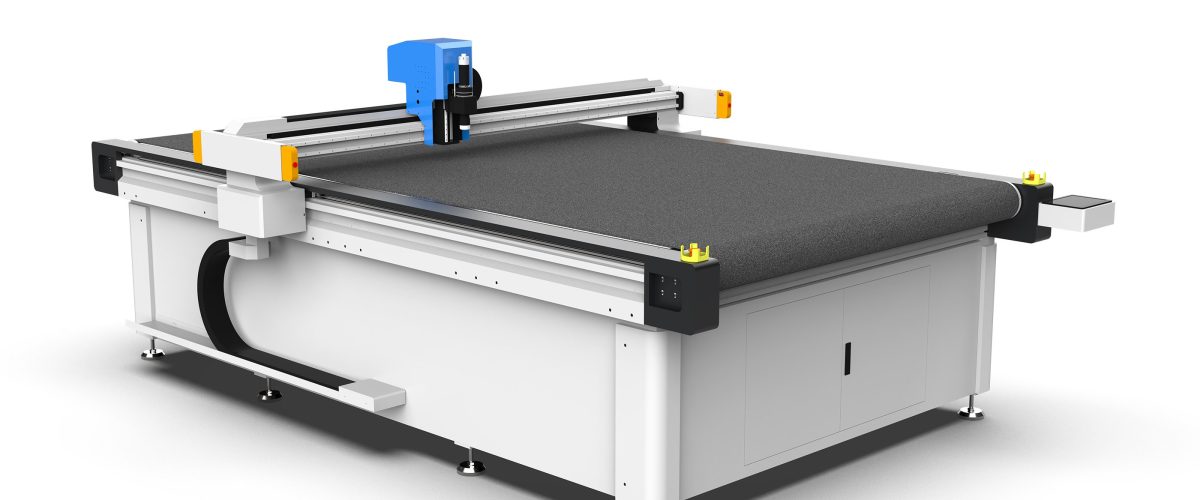
Fabric cutting equipment is mainly divided into two categories: mechanical knife cutting and laser cutting. Among mechanical knife cutting, oscillating knife cutting is the most common. Its principle is to perform cold cutting on fabric through a blade oscillating up and down at high speed (frequency usually 2000-5000 times/min), suitable for cotton, linen, chemical fiber, leather, and many other materials. Laser cutting uses a high-energy laser beam (power usually 60-150W) to melt or vaporize the material, suitable for fine patterns and complex contours, but it produces a heat-affected zone and may cause edge yellowing on certain fabrics (such as those containing polyester).
In addition, there are circular knife cutting machines (suitable for straight-line mass cutting) and ultrasonic cutting (which uses high-frequency vibration to locally melt the material, suitable for thermoplastic materials). When choosing, material characteristics, cutting accuracy, and output should be comprehensively considered.
Key Selection Parameters and Performance Indicators
When purchasing fabric cutting equipment, the following parameters should be focused on:
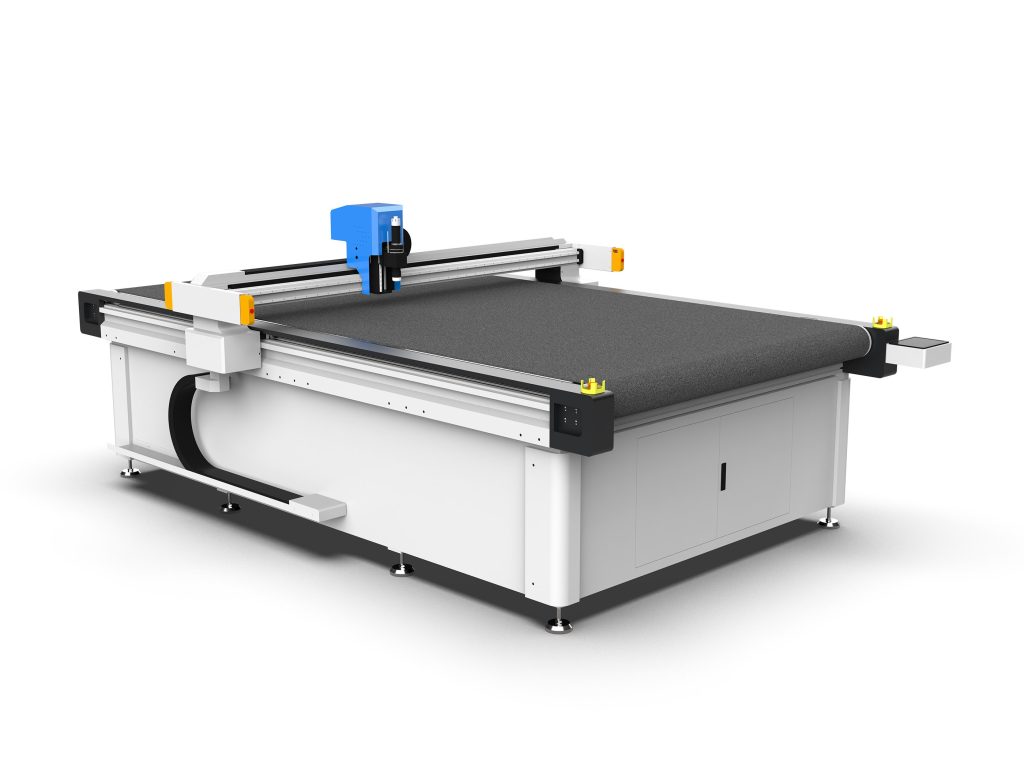
- Cutting thickness: Oscillating knives can usually cut 1-50mm (depending on material density), while laser cutting generally does not exceed 20mm. If multi-layer fabric cutting is required (such as garment cutting), oscillating knife equipment with an automatic feeding system should be selected.
- Cutting accuracy: Repeat positioning accuracy should be ≤0.1mm, and laser cutting can reach ±0.05mm. For automotive interior fabric with complex patterns, a high-precision servo control system is recommended.
- Working area size: Common specifications include 1600×2500mm, 2000×3000mm, etc., and should be selected according to the maximum fabric width. If cutting rolled materials, an automatic feeding rack needs to be configured.
- Cutting speed: The maximum speed of an oscillating knife can reach 1200mm/s, and laser cutting can reach 1000mm/s, but the actual speed is affected by material thickness and pattern complexity.
- Control system: Prioritize CNC systems that support CAD/CAM software import (such as DXF and PLT formats) and have automatic nesting functions to save material.
- Vacuum fixing device: For lightweight and thin fabrics (such as silk and non-woven fabric), a zoned vacuum adsorption table must be equipped to ensure the material does not shift during cutting.
Key Process Points for Cutting Different Fabrics
Cotton and Linen Fabrics
Cotton and linen fabrics easily produce frayed edges. It is recommended to use serrated blades (wave-shaped edges) for oscillating cutting to reduce fiber stringing. Control the cutting speed at 800-1000mm/s and set the vacuum adsorption pressure to 0.4-0.6MPa. If laser cutting is used, pay attention to edge carbonization, and add auxiliary gas blowing (such as nitrogen) to reduce scorching.
Chemical Fiber and Blended Fabrics
The melting point of chemical fiber materials is mostly 200-260°C, and the heat-affected zone during laser cutting is obvious. It is recommended to use low-power multiple-pass cutting (such as 30W power, repeated 2-3 times) to reduce yellowing. Oscillating knife cutting has no heat effect, but attention should be paid to blade sharpness, and the blade should be replaced or sharpened every 2-3 hours of cutting.
Leather and Artificial Leather
Leather cutting commonly uses an oscillating knife or circular knife, with thickness up to 10mm. For genuine leather, equipment with automatic tool setting is recommended to avoid cutting through the backing fabric. Laser cutting leather produces irritating odors, so an exhaust system must be equipped.
Non-woven Fabric and Industrial Filter Cloth
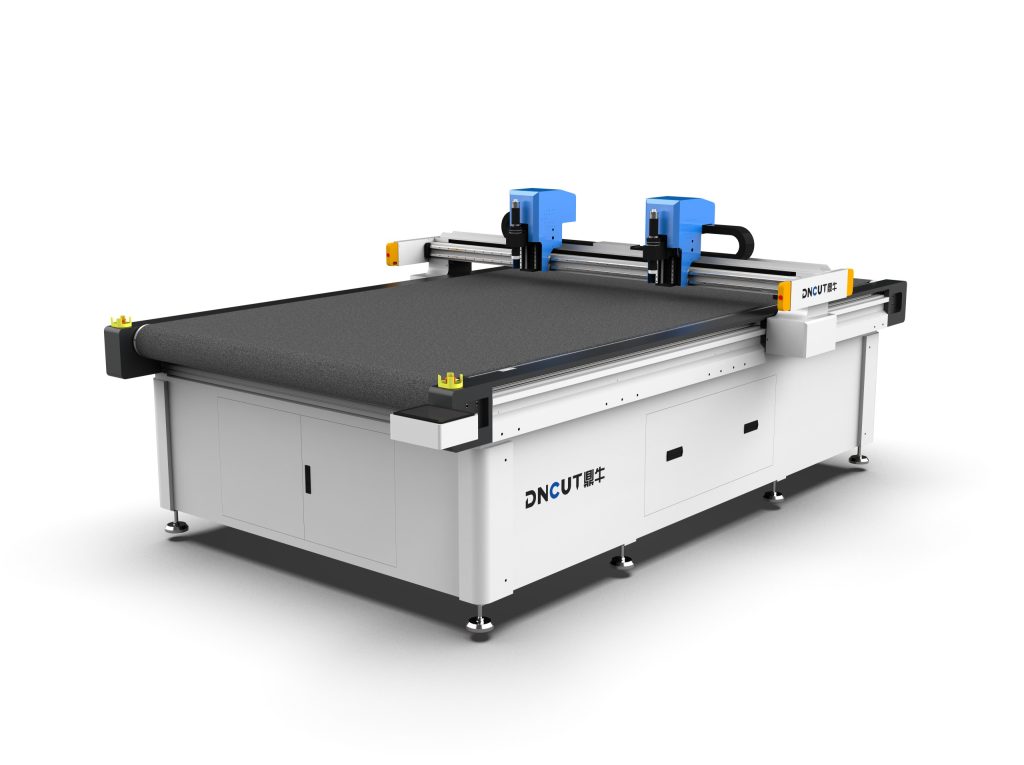
Non-woven fabric easily fuzzes. Ultrasonic cutting or a hot cutting knife (temperature 200-300°C) is recommended for edge sealing. When using oscillating knife cutting, reduce the speed to 600mm/s and use dedicated sharp blades.
Operating Process and Efficiency Improvement Techniques
Standard operating process: material fixing → import cutting file → set parameters → trial cutting → batch cutting → unloading. Key points for improving efficiency:
- Automatic nesting: Use software to optimize layout, which can improve material utilization by 5%-15%. For example, for garment cut pieces, nested layout can reduce waste.
- Multi-layer cutting: Oscillating knives can cut multiple layers at once (such as 10 layers of cotton fabric), but each layer must be separated with thin paper to prevent adhesion. Too many layers will affect accuracy, and it is recommended not to exceed 15 layers.
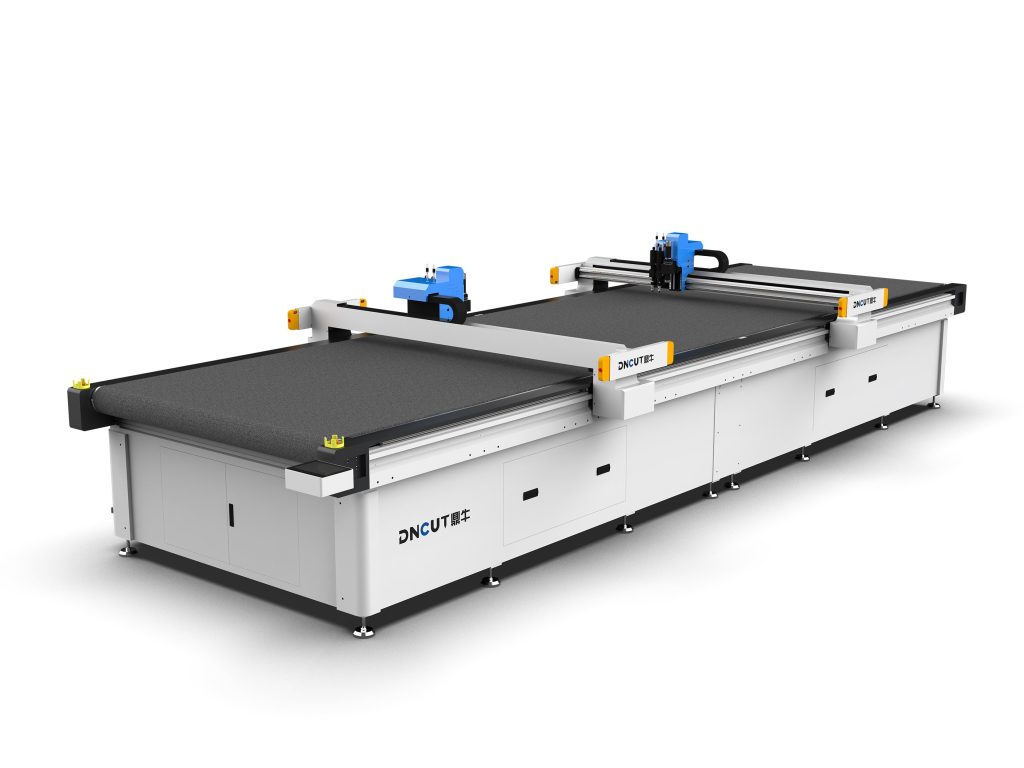
- Continuous feeding: Configure an automatic feeding rack and receiving rack to achieve continuous cutting of rolled materials and reduce loading and unloading time. Feeding accuracy should reach ±0.5mm.
- Tool management: Establish blade life records and set replacement cycles according to material abrasiveness (for example, replace every 4 hours when cutting carbon fiber fabric). Using coated blades (such as TiN coating) can extend life by 30%.
Daily Maintenance and Common Troubleshooting
Equipment maintenance directly affects cutting quality and service life:
- Daily: Clean the table adsorption holes, check whether the blade is loose, and clear debris from the guide rails.
- Weekly: Lubricate the linear guide rails and lead screws (use lithium-based grease), and check the air circuit filter for water drainage.
- Monthly: Calibrate cutting accuracy (test with a standard circle) and check belt tension (deflection ≤5mm).
Common faults: Uneven cutting edges — check whether the blade is worn or vacuum adsorption is insufficient; Dimensional deviation — recalibrate the servo motor or check the timing belt; Laser cutting yellowing — reduce power, increase cutting speed, or increase blowing pressure.
Safety Specifications and Environmental Requirements
When operating fabric cutting equipment, the following must be observed:
- Wear cut-resistant gloves and goggles, tie up long hair, and do not wear gloves when operating rotating parts.
- Laser equipment must be equipped with a fully enclosed protective cover and interlocking device to ensure laser leakage <1mW.
- Turn on the exhaust system when cutting chemical fiber materials and maintain workshop ventilation (air changes ≥6 times/hour).
- Equipment grounding resistance ≤4Ω, and regularly check the emergency stop button function.
In terms of environmental protection, waste gas generated by laser cutting must be filtered through activated carbon before discharge; scraps from oscillating knife cutting can be sorted and recycled.
Selection Recommendations and Cost Analysis
Choose according to production needs: Small-batch, multi-variety production (such as custom clothing) is suitable for 1600×2500mm oscillating knife equipment, priced at about 80,000-150,000 RMB; Large-batch, single-variety production (such as automotive interiors) can consider laser cutting machines, priced at 200,000-500,000 RMB, but with higher operating costs (power consumption about 3-5kW). Oscillating knife equipment has low operating costs (only blades and power consumption) and is suitable for most fabric cutting scenarios. It is recommended to prioritize brands with automatic nesting and remote diagnosis functions to reduce long-term use costs.