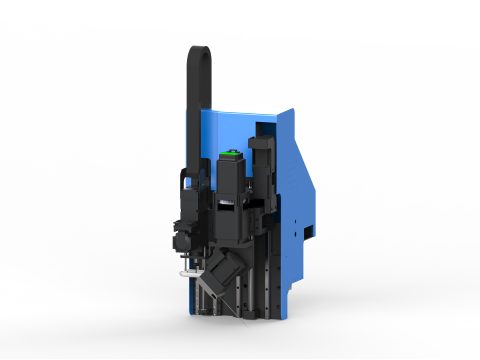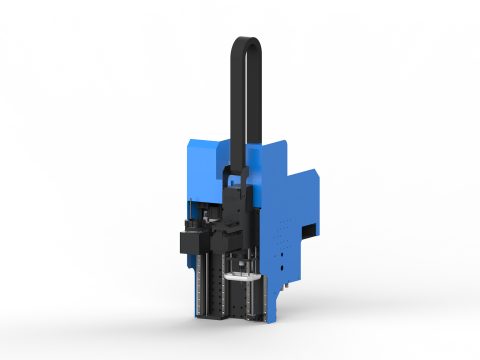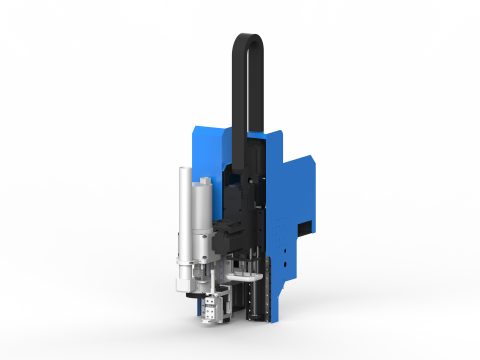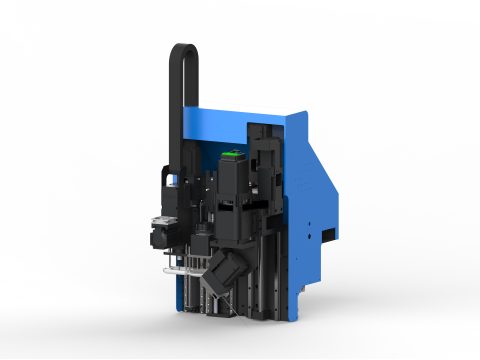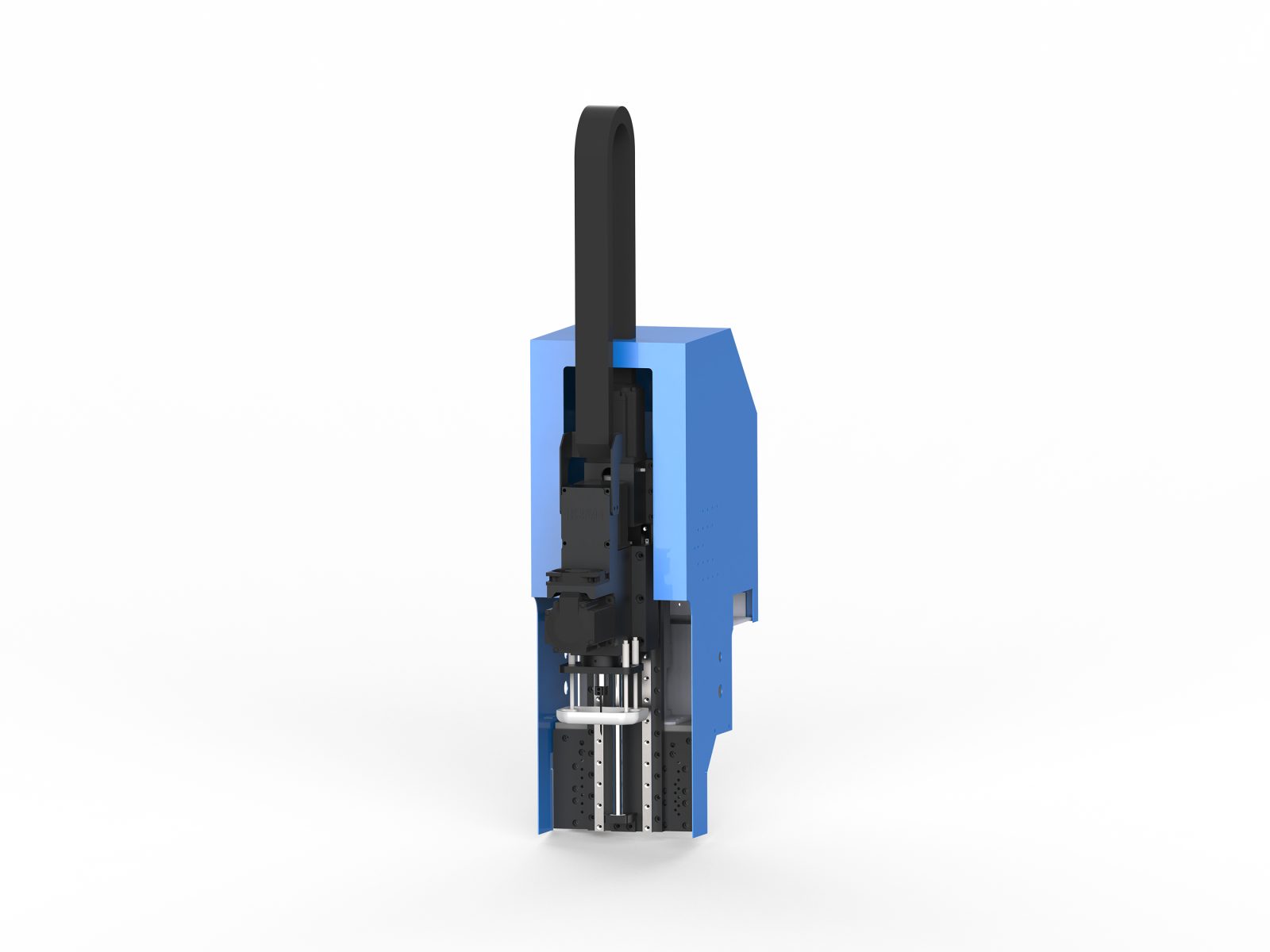
The D-H head combination is a modular head configuration solution centered on an integrated servo oscillating knife, composed of a servo direct-drive oscillating knife holder, oscillating knife, bevel knife, circular punch, spindle, CCD vision component, and inkjet head modules assembled according to process requirements. This combination focuses on high-quality cutting of flexible materials, improving knife head response speed and cutting force through the servo direct-drive structure, while ensuring cut surface quality and balancing production efficiency. It is suitable for users who primarily use the oscillating knife process and wish to reduce maintenance points while maintaining a compact structure.
Core Features
- Servo Direct-Drive Oscillating Knife: The knife head is directly driven by a servo motor, with fast start-stop response and stable cutting force output, suitable for high-speed, continuous contour cutting of flexible materials.
- Bevel Knife Module: Can perform bevel cutting and special-angle contour processing, working with the oscillating knife to achieve one-pass forming of complex shapes and reducing secondary trimming processes.
- Circular Punch and Spindle Module: The circular punch is used for drilling, positioning holes, and small round hole processing; the spindle can extend milling-type processes, enabling the same head combination to cover cutting, punching, and light milling requirements.
- CCD Vision Component: Used to identify registration marks or printed patterns on materials, assisting in registration cutting and improving alignment accuracy, suitable for printed materials and processing scenarios requiring contour tracking.
- Inkjet Head Module: Can perform marking, numbering, or positioning printing before and after cutting, facilitating identification and traceability in subsequent processes and reducing manual labeling steps.
Applicable Materials and Industries
This combination is suitable for cutting, punching, and marking of flexible and semi-rigid materials such as leather, fabric, non-woven fabric, foam, EVA, cardboard, labels, film, and composite materials. Typical application industries include automotive interiors, footwear and luggage, apparel and home textiles, packaging and printing, advertising signage, electronic accessories, and medical protective supplies, etc. It is particularly suitable for batch processing scenarios with high requirements for cut surface quality, cutting speed, and registration accuracy.
Selection and Configuration Recommendations
The integrated servo oscillating knife equipped in this combination is directly driven by a servo motor, with an oscillation frequency of 3500 rpm and an amplitude of 5mm. The large-amplitude reciprocating punching force is strong, making it suitable for thick cutting of soft materials such as leather, foam, and composite materials.
If the processing is mainly oscillating knife cutting and requires auxiliary processes such as bevel cutting, punching, vision registration, or inkjet marking, the D-H head combination is a relatively suitable choice; if heavy-duty milling or large-format thick materials are the main focus, it is recommended to evaluate other head configurations. In terms of supporting equipment, it can be used with automatic feeding systems, roll material unwinding racks, and layout cutting software to achieve continuous feeding and automatic layout; vision and inkjet modules can be added or removed according to actual processes. It is recommended to clarify the material type, cutting pattern complexity, and registration requirements before selection so as to configure the module combination reasonably.
Key Technical Parameters
- Head Model: D-H model (head combination)
- Processing Height: 100mm (H series enlarged)
- Oscillating Knife Type: Integrated servo oscillating knife
- Oscillation Frequency: 3500 rpm
- Amplitude: 5mm
- Combination Configuration: Integrated servo oscillating knife head
- Replaceable Modules: Knife holder / oscillating knife / servo bevel knife / circular punch / spindle / CCD vision component / inkjet head (optional according to model support)
- Applicable Materials: Fabric, leather, foam, EVA, composite materials, cardboard, acrylic, wood board, etc. (depending on the selected module)
- Applicable Processes: Contour cutting, punching, creasing, slotting, milling, vision positioning cutting, inkjet marking (depending on the selected module)
- Applicable models: Dingniu oscillating knife cutting machine series (the head board is custom-installed according to the model)
- Note: The head can be customized and combined according to materials and processes; the specific configuration is subject to the selection plan
FAQ
What materials is the D-H head combination suitable for?
Suitable for soft and semi-rigid materials such as leather, fabric, non-woven fabric, foam, EVA, cardboard, labels, film, and composite materials.
What are the advantages of the servo direct-drive oscillating knife?
Directly driven by a servo motor, it offers fast start-stop response and stable cutting force output, making it suitable for high-speed continuous contour cutting and reducing maintenance points.
What is the role of the CCD vision component?
It identifies registration marks or printed patterns on the material and assists in registration cutting, improving alignment accuracy; suitable for printed materials and contour tracking.
Can the milling function be extended?
Yes. The spindle module can be extended for milling-type processes, enabling the same head combination to cover cutting, punching, and light milling requirements.
What parameters need to be specified during selection?
Material type, cutting pattern complexity, and registration requirements need to be specified so that module combinations such as vision and inkjet can be reasonably configured.
Further Reading
- Complete Analysis of Materials Suitable for Oscillating Knife Cutting Machines
- Oscillating Knife Cutting Machine Purchasing Guide: Parameters and Acceptance
- Working Principle and Parameter Settings of Oscillating Knife Cutting Machines
The core of the D-H model head combination lies in servo direct-drive oscillating knife technology. Compared with traditional pneumatic or eccentric wheel drives, servo direct drive eliminates intermediate transmission links, shortening the start-stop response time of the knife head to within 5 milliseconds and enabling a cutting frequency of dozens of times per second. This high-frequency oscillation, combined with precise Z-axis control, enables smooth cut surfaces on soft materials such as leather and fabric, avoiding burnt edges or burrs. At the same time, the servo system provides real-time feedback on cutting force and automatically adjusts the amplitude according to material thickness, ensuring consistency across different batches of material. For printed materials requiring high-precision registration, the CCD vision component works in coordination with the servo system to achieve dynamic compensation, keeping registration error within 0.01 mm.
Modular design is another major highlight of the D-H model head combination. Users can flexibly configure modules such as the bevel knife, circular punch, spindle, CCD vision, and inkjet head according to process requirements. For example, in automotive interior cutting, a bevel knife is often needed for edge beveling, a circular punch for mounting holes, and an inkjet head for printing traceability codes; while in garment fabric cutting, CCD vision is used for pattern and stripe matching, and the inkjet head is used to mark cut-piece numbers. This on-demand configuration approach avoids functional redundancy and reduces equipment cost. In addition, all modules use quick-change interfaces with a changeover time of no more than 2 minutes, making it convenient for users to switch quickly between different orders and improving equipment utilization.
In actual production, the D-H model head combination can be seamlessly integrated with automatic feeding systems, roll material unwinding racks, and nesting and cutting software. The automatic feeding system ensures continuous material conveyance and reduces manual intervention; the nesting software optimizes cutting paths and improves material utilization. For different materials, it is recommended to adjust the oscillation frequency and cutting speed: for example, when cutting leather with a thickness of 1 mm, set the oscillation frequency to 200 Hz and the speed to 800 mm/s; when cutting 5 mm foam, reduce the frequency to 150 Hz and the speed to 600 mm/s. For regular maintenance, clean the knife holder guide rail and check the servo motor encoder every 500 hours to ensure long-term stable operation. For users who wish to reduce maintenance points and maintain a compact structure, the D-H model head combination is an ideal choice.