01I. Material Characteristics and Cutting Challenges
Soundproof and thermal insulation materials come in many varieties with significantly different physical properties, imposing different requirements on the cutting process:
- Soundproof cotton: usually a composite of polyester fiber or glass fiber with resin, density 80-200kg/m³, thickness 10-100mm, soft texture, easily compressed and deformed; during cutting, pulling must be avoided to prevent uneven edges.
- Thermal insulation cotton: mainly glass wool and rock wool, density 40-120kg/m³, loose fiber structure, cutting easily produces burrs and dust; tool angle and vibration need to be controlled.
- EPE (pearl cotton): density 20-40kg/m³, closed-cell structure, good resilience, easily sticks to the blade during cutting; requires sharp blades and proper lubrication.
- Fiberglass cotton: density 50-150kg/m³, hard and brittle fibers, cutting easily produces debris, fast tool wear; requires wear-resistant materials.
- Phenolic insulation board: density 40-80kg/m³, high brittleness, edges easily chip during cutting; requires high speed and low feed.
- XPE/IXPE: density 30-80kg/m³, cross-linked structure, high toughness, high cutting resistance; requires a high-power motor.
- EVA: density 40-120kg/m³, good elasticity, easily rebounds during cutting; requires sharp blades and precise pressure control.
- Rubber foam: density 60-200kg/m³, high elasticity, high friction coefficient, easily heats up and sticks to the blade during cutting; requires cooling or low-speed cutting.
These materials generally feature softness, elasticity, brittleness, and toughness. Traditional die cutting or manual cutting has low efficiency and poor precision, while CNC oscillating knife cutting machines achieve "cold cutting" through high-frequency oscillating blades (10,000-20,000 times per minute), with no thermal effect and flat edges, making them the ideal solution.
02II. Key Points for Cutting Equipment Selection
For different materials and production capacity requirements, equipment selection should focus on the following core parameters:
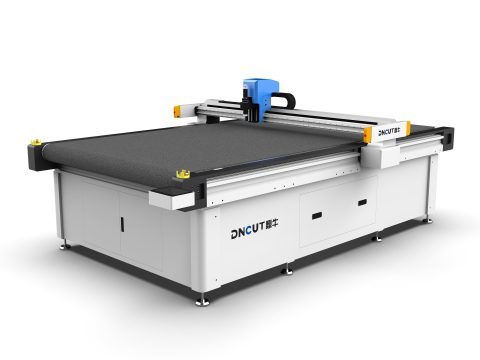
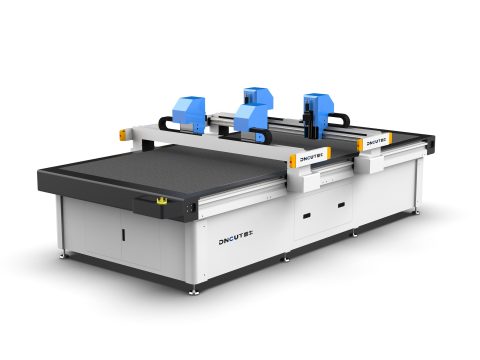
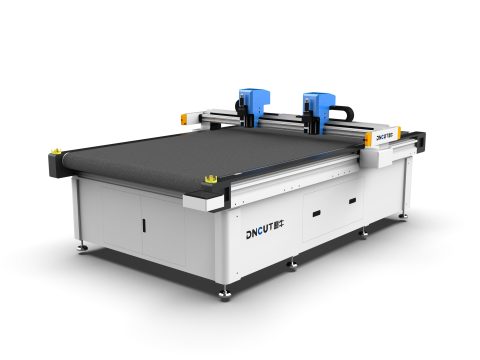
- Number of cutting heads: Single head is suitable for small batches with multiple varieties; dual heads can cut two pieces of material simultaneously, improving efficiency by over 80%, suitable for large-batch production.
- Effective cutting working area: Common sizes are 1600×2500mm and 2100×3000mm; choose according to material dimensions, and custom models are available for wide materials.
- Blade type: Oscillating knife (suitable for foam and EPE), circular knife (suitable for thin materials), pneumatic knife (suitable for thick elastomers).
- Transmission method: Rack transmission offers strong rigidity, suitable for thick materials; belt transmission offers high speed, suitable for thin materials.
- Vacuum adsorption system: The vacuum adsorption platform ensures material fixation, and zone control can accommodate different sizes.
- Software functions: Supports CAD import, automatic nesting, and path optimization to reduce material waste.
For mixed production of multiple varieties, it is recommended to choose a custom all-purpose cutting machine equipped with an automatic tool changer, which can quickly switch blades to adapt to different materials. The intelligent dual-head cutting machine is suitable for large-batch production of a single variety, with independent dual-head control that can cut different patterns simultaneously.
03III. Blade Selection and Parameter Settings
3.1 Blade Type Selection
- Wave knife: Suitable for soft foams such as EPE and EVA; the serrations reduce friction and prevent material from sticking to the blade.
- Straight knife: Suitable for fibrous materials such as soundproof cotton and insulation cotton; the cut is flat with few burrs.
- Pointed knife: Suitable for fine patterns and complex contours, such as profile cutting of rubber foam.
- Round knife: Suitable for thin XPE and IXPE; continuous cutting efficiency is high.
3.2 Key Parameter Settings
The following parameters are reference values and need to be adjusted according to the actual density and thickness of the material:
- Vibration frequency: EPE/EVA: 12000-15000 times/min; soundproof cotton/insulation cotton: 10000-12000 times/min; fiberglass cotton: 8000-10000 times/min (to reduce dust); phenolic board: 15000-18000 times/min (high frequency reduces edge chipping).
- Feed speed: EPE: 800-1200mm/s; EVA: 600-900mm/s; soundproof cotton: 1000-1500mm/s; fiberglass cotton: 500-800mm/s; phenolic board: 400-600mm/s; XPE: 700-1000mm/s; rubber foam: 300-500mm/s.
- Knife pressure: 0.2-0.4MPa for soft materials, 0.4-0.6MPa for hard materials, ensuring the blade penetrates but does not over-compress.
- Vacuum adsorption level: -0.06 to -0.08MPa; it can be appropriately reduced for thin materials.
It is recommended to perform parameter tests during the first cutting; qualification is defined as flat edges, no burrs, and dimensional error within ±0.5mm.
04IV. Common Problems and Solutions
4.1 Uneven edges or burrs
Causes: Blunt blade, vibration frequency too low, feed speed too fast.
Solution: Replace the blade (inspection every 8 hours is recommended), increase vibration frequency by 10%-20%, and reduce feed speed by 15%.
4.2 Material sticking to the blade
Causes: Heat generated by material friction, uncoated blade, cutting speed too slow.
Solution: Use a Teflon-coated blade, increase feed speed, or turn on auxiliary air blowing for cooling.
4.3 Cutting dimension deviation
Causes: Material rebound, insufficient adsorption, tool path not compensated.
Solution: Increase vacuum adsorption level, set tool radius compensation in the software, and for highly resilient materials (such as EVA), appropriately enlarge the contour by 0.2-0.5mm.
4.4 Excessive dust (fiberglass cotton)
Causes: Improper blade angle, vibration frequency too high.
Solution: Switch to a straight knife, reduce vibration frequency to 8000 times/min, and connect a dust extraction device.
05V. Maintenance and Safety Recommendations
- Daily maintenance: Clean the blade and guide rail every shift, check air pressure, and lubricate transmission components weekly.
- Blade life: Depending on material abrasiveness, approximately 200 hours for EPE and approximately 50 hours for fiberglass cotton; the cutting edge needs regular inspection.
- Safe operation: Do not allow hands into the cutting area during cutting, ensure the equipment is well grounded, and explosion-proof measures are required in dusty environments.
Through proper model selection, parameter optimization, and standardized maintenance, the oscillating knife cutting machine can efficiently process various soundproof and insulation materials, with stable cut quality and material utilization improved by more than 15%.