01Why does the packaging and printing industry need dedicated cutting solutions?
The packaging and printing industry involves a wide variety of materials, from corrugated paper and honeycomb cardboard to gray board paper and white card paper, and further to hollow board, EPE foam, and pearl cotton. The physical properties of each material differ significantly. The traditional die-cutting method requires making a cutting die, which has a long cycle and high cost, and is especially unsuitable for small-batch, multi-variety orders. Although laser cutting has high precision, it causes carbonization on paper edges and produces melting and odor with foam materials. Oscillating knife cutting technology cuts materials through a high-frequency vibrating blade, with no thermal effect and no dust, making it an ideal digital cutting solution for the packaging and printing industry.
This article provides specific cutting parameters, stacking techniques, and problem solutions for seven common packaging materials to help you get started quickly in actual production.
02Material characteristics and cutting parameters quick reference
The following parameters are summarized based on practical experience with standard cutting machines (such as DN5) and general-purpose cutting machines (such as DN6). Actual use requires fine-tuning according to material batches and equipment status.
1. Corrugated paper (three-layer/five-layer/seven-layer)
- Blade selection: Wave blade (tooth pitch 2mm) is suitable for three-layer corrugated; for five layers and above, pointed blade or long-edge blade is recommended to reduce edge collapse.
- Cutting speed: Three-layer corrugated 800-1200 mm/s; five-layer 600-900 mm/s; seven-layer 400-600 mm/s.
- Vibration frequency: Medium-high frequency (about 12000-15000 times/min) to ensure neat cuts.
- Stacking recommendation: Three-layer corrugated can be stacked 2-3 layers, five-layer stacked 2 layers, seven-layer stacking is not recommended. When stacking, use double-sided tape to fix the four corners to avoid displacement.
- Common problems: Burrs on the cut — reduce speed or replace with a new blade; corrugated collapse — reduce the blade downward pressure and use a high-density sponge pad.
2. Honeycomb cardboard (thickness 5-20mm)
- Blade selection: Long-edge pointed blade (blade length ≥30mm) to avoid pulling the honeycomb core during cutting.
- Cutting speed: 400-600 mm/s (thickness below 10mm); 200-400 mm/s (above 10mm).
- Vibration frequency: Low frequency (about 8000-10000 times/min) to reduce honeycomb core breakage.
- Stacking recommendation: Stacking is not recommended; cut single sheets. If stacking is required, at most 2 layers, and the edges need to be clamped with fixtures.
- Common problems: Honeycomb core scattering at the cut — pre-apply masking tape along the cutting path; tool heating — reduce frequency and increase cooling intervals.
3. Gray board paper (thickness 1-4mm)
- Blade selection: Standard pointed blade (angle 30°), sharp edge.
- Cutting speed: 1000-1500 mm/s (1-2mm); 600-900 mm/s (3-4mm).
- Vibration frequency: High frequency (18000-20000 times/min) to ensure smooth cuts.
- Stacking recommendation: 1-2mm can be stacked 5-8 layers, 3-4mm stacked 3-4 layers. When stacking, use a vacuum adsorption table for fixation.
- Common problems: Whitening at the cut — reduce speed or increase frequency; stacking misalignment — increase adsorption force and sprinkle a small amount of talcum powder between layers.
4. White card paper (thickness 0.3-1.0mm)
- Blade selection: Fine-point blade (20° angle), for fine pattern cutting.
- Cutting speed: 1500-2000 mm/s (0.3-0.5mm); 1000-1500 mm/s (0.6-1.0mm).
- Vibration frequency: High frequency (above 20,000 times/min), ensuring burr-free edges.
- Layering recommendations: 0.3-0.5mm can be stacked 10-15 layers, 0.6-1.0mm stacked 6-10 layers. Use double-sided tape or vacuum adsorption.
- Common issues: Burrs at the cut—replace with a new blade, reduce speed; bottom layer not cut through—increase tool downward stroke or reduce the number of layers.
5. Hollow board (thickness 2-10mm)
- Blade selection: Wave blade or pointed blade, the edge must be sharp.
- Cutting speed: 800-1200 mm/s (2-5mm); 500-800 mm/s (6-10mm).
- Vibration frequency: Medium frequency (12,000-15,000 times/min).
- Layering recommendations: 2-5mm can be stacked 3-5 layers, 6-10mm stacked 2 layers. When stacking, use clamps to secure and prevent the hollow board from slipping.
- Common issues: Melted cut edges—reduce speed to avoid tool overheating; hollow structure crushing—reduce downward pressure, use a soft backing board.
6. EPE foam (density 20-40kg/m³, thickness 2-50mm)
- Blade selection: Long blade (blade length ≥50mm), with serrated or wavy edge to reduce friction.
- Cutting speed: 600-1000 mm/s (thickness below 10mm); 300-600 mm/s (10-30mm); 200-300 mm/s (above 30mm).
- Vibration frequency: Low frequency (6,000-10,000 times/min), to reduce material melting.
- Layering recommendations: Layering not recommended, cut single sheets. If layering is required, a maximum of 2 layers, and they must be secured with double-sided tape.
- Common issues: Cut edges sticking—reduce frequency, use a sharp blade, clean the blade promptly after cutting; material deformation—reduce downward pressure, use Teflon-coated blades.
7. Pearl cotton (EPE, density 18-30kg/m³, thickness 1-30mm)
- Blade selection: Same as EPE foam, wave blade or serrated blade recommended.
- Cutting speed: 800-1200 mm/s (thickness below 5mm); 400-800 mm/s (5-15mm); 200-400 mm/s (above 15mm).
- Vibration frequency: Low frequency (6,000-10,000 times/min).
- Layering recommendations: 1-5mm can be stacked 5-8 layers, 5-15mm stacked 3-5 layers, above 15mm single sheet. When stacking, use vacuum adsorption or double-sided tape.
- Common issues: Uneven cut edges—improve blade sharpness, reduce speed; material static adhesion—spray a small amount of water mist on the table or use an ion fan.
03Efficiency Improvement Tips for Stacked Cutting
Stacked cutting is key to increasing productivity, but the stacking limits vary greatly among different materials. Here are some general principles:
- Fixing method: Prioritize the use of a vacuum suction table. For breathable materials (such as corrugated paper and honeycomb paper), a layer of film can be covered to increase suction; for non-breathable materials (such as foam and hollow board), double-sided tape dots can be used to fix the four corners.
- Stack alignment: The edge alignment error of each layer should be less than 0.5mm, otherwise cutting accuracy will decrease. It is recommended to use a fence or positioning pins.
- Tool stroke: When the total thickness of the stack increases, the tool downward stroke needs to be increased accordingly, but it should not exceed 80% of the blade length, otherwise the blade is prone to break.
- Cutting sequence: Cut the inner contour first and then the outer contour, and cut small holes first and then large surfaces, to avoid material displacement.
04Common Problems and Solutions
Problem 1: Burrs or tearing at the cut
Cause: Blunt blade, excessive speed, improper vibration frequency. Solution: Replace with a new blade, reduce cutting speed by 10-20%, increase vibration frequency for paper materials, and reduce frequency for foam materials.
Problem 2: The bottom layer of stacked material is not cut through
Cause: Insufficient tool stroke, stack too thick, insufficient suction. Solution: Increase the tool downward stroke (increase by 0.5mm each time for trial cutting), reduce the number of stacked layers, and check whether the vacuum suction is working properly.
Problem 3: Material shifts during cutting
Cause: Insecure fixation, and pulling caused by excessive cutting speed. Solution: Use clamps or double-sided tape to strengthen fixation, reduce cutting speed, and for lightweight materials (such as pearl cotton), cover with a layer of film and then use vacuum suction.
Problem 4: Melted or stuck cuts in foam materials
Cause: Excessive vibration frequency causes frictional heat. Solution: Reduce vibration frequency to 6000-8000 times/minute, use Teflon-coated blades, and clean residue on the blade promptly after cutting.
Problem 5: Honeycomb core scattering at the cut of honeycomb paperboard
Cause: The blade pulls the honeycomb core. Solution: Use a long-edge pointed knife, reduce cutting speed, pre-apply masking tape along the cutting path, and peel it off after cutting.
05Equipment Selection Recommendations
For the different needs of the packaging and printing industry, it is recommended to choose equipment based on material type and production capacity:
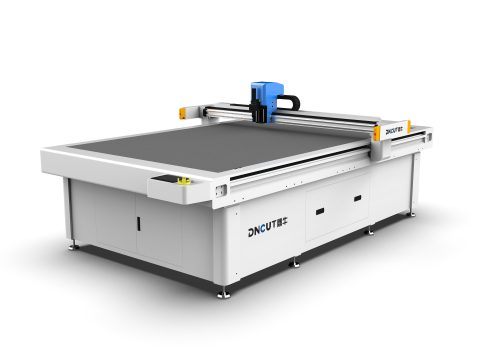
- Standard cutting machine (such as DN5): Suitable for single-material, medium-capacity applications, such as batch cutting of corrugated paper and gray board paper.
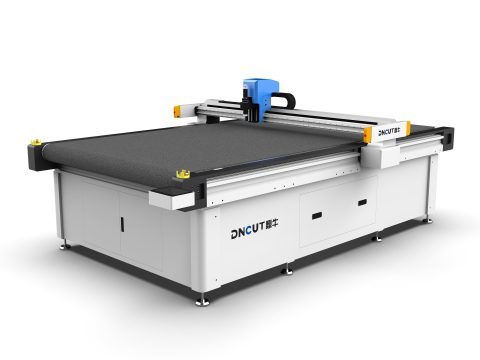
- General-purpose cutting machine (such as DN6): Has a wider parameter adjustment range, suitable for mixed production of multiple materials, such as processing corrugated paper, foam, and hollow board at the same time.
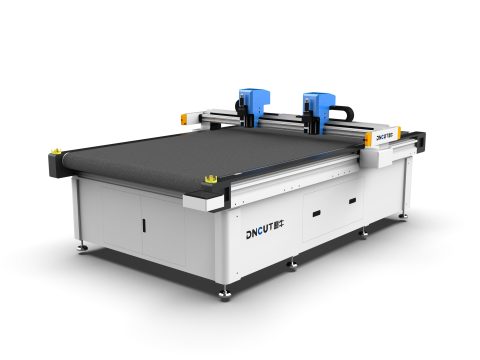
- Intelligent dual-head cutting machine (such as DN6-2D): Dual heads are independently controlled and can cut two different materials simultaneously or perform dual-station operations. It is suitable for packaging and printing enterprises with high production capacity and multiple varieties, especially for complex shape cutting of foam and pearl cotton.
When actually selecting a model, it is also necessary to consider the maximum material size, stack thickness, cutting accuracy requirements (usually within ±0.2mm), and software compatibility (whether it supports direct CAD import).
06Summary
Cutting solutions for the packaging and printing industry require fine-tuned parameters based on material characteristics. Corrugated paper and gray board paper are suitable for high-speed stacked cutting, honeycomb paperboard and hollow board require low-speed single-sheet processing, and foam and pearl cotton require control of vibration frequency to avoid melting. Through proper blade selection, stacking techniques, and troubleshooting, oscillating knife cutting technology can significantly improve production efficiency and cut quality, replacing traditional die cutting as the preferred solution for small-batch, multi-variety orders.