01Core Challenges in Soft Furnishing Cutting
Soft furnishings cover sofas, mattresses, curtains, home textiles, and upholstered materials, whose fabrics and fillings vary greatly: from decorative fabric as thin as 0.3mm to sponge composite material up to 100mm thick, from elastic knits to rigid non-woven fabrics. Common problems during cutting include: frayed edges, dimensional deformation, interlayer slippage, inconsistent sponge compression rebound. Traditional manual cutting or low-precision equipment can lead to material waste rates as high as 8%-12%, while CNC oscillating knife cutting can keep waste within 3%.
02Material Characteristics and Cutting Parameters
1. Sofa Fabric (velvet, linen, technical fabric)
These fabrics typically weigh 200-400g/m² and are 0.5-1.5mm thick. When cutting, note the following:
- Blade selection: Use a sharp-angle oscillating knife (angle 15°-20°) to avoid pulling fibers.
- Cutting speed: Recommended 8-12m/min; too fast will cause edge burning or fraying.
- Vacuum adsorption: Control vacuum pressure at -0.6 to -0.8bar to ensure the fabric stays flat and does not move.
- Cutting mat: Use a felt mat or breathable PVC mat to extend blade life.
For highly elastic knitted sofa fabrics, pre-shrinking treatment is recommended before cutting; using dual-beam synchronous cutting (such as the DN6-2H model) can reduce single-beam back-and-forth time and increase efficiency by more than 30%.
2. Mattress Fabric (jacquard, knit, non-woven)
Mattress fabric often reaches a width of 2.2-2.4m, with a weight of 150-350g/m². Cutting key points:
- Multi-layer cutting: Can stack 6-10 layers, use a circular knife or sharp knife, combined with an automatic feeding system to reduce manual fabric-laying errors.
- Tension control: Set unwinding tension at 5-10N; too much will cause fabric stretching deformation.
- Cutting precision: Repeat positioning accuracy must be ≤±0.2mm to ensure seamless mattress border splicing.
For mattress fabrics containing latex or sponge composites, reduce cutting speed to 6-8m/min and add cooling air blow to prevent the adhesive layer from melting and sticking to the blade.
3. Curtain Fabric (blackout, sheer, cotton-linen)
Curtain fabric is usually thinner (0.2-0.8mm) and prone to sliding. Recommended solution:
- Zoned vacuum adsorption control: For curtain fabric with a width of 2.8m, use zoned vacuum adsorption to prevent edges from curling up.
- Blade: Use an oscillating knife (frequency 2000-3000Hz) for flat cuts without fraying.
- Cutting speed: Sheer curtains 8-10m/min, blackout fabric 10-12m/min.
- Layout optimization: Use automatic layout software to increase utilization to over 92%.
4. Home Textile Fabric (bedding, pillows, blankets)
Home textile fabrics come in many varieties, from pure silk to polyester fleece. Key parameters:
- Blade angle: Use 15° for thin materials and 20°-25° for thick materials.
- Cutting mode: For small-batch, multi-variety production, use a general-purpose cutting machine (such as DN6) for quick tool changes, with tool change time <30 seconds.
- Suction force: Adjust according to fabric breathability; fabrics with good breathability require increased vacuum flow.
5. Sponge composite materials (sponge + fabric, sponge + non-woven fabric)
Sponge thickness is 5-100mm, and after lamination the fabric easily separates from the sponge. Cutting solution:
- Blade: Use a long-edge oscillating knife (blade length 50-100mm) to reduce sponge compression.
- Cutting speed: 3-6m/min; too fast a speed will cause sponge tearing.
- Auxiliary measures: Use freeze cutting (-10℃) to improve the smoothness of the sponge cut edge, or use an ultrasonic knife for edge sealing.
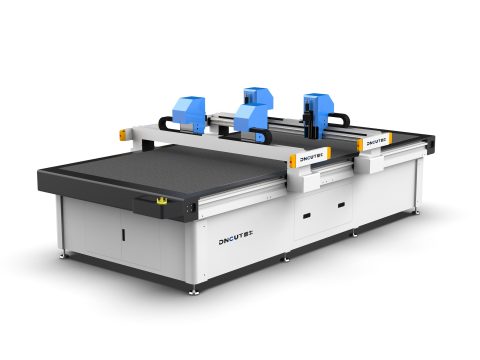
- Equipment requirements: A high-rigidity frame is required, such as the DN8 custom all-purpose cutting machine, which can be equipped with dual cutting heads to cut sponge and fabric simultaneously.
6. Upholstery materials (leather, PU, PVC)
Upholstery materials require mark-free cutting to avoid scratching the surface. Recommendations:
- Blade: Use a round knife or drag knife; edge sharpness must be checked regularly (sharpen once every 8 hours).
- Cutting speed: Leather 6-8m/min, PU 8-10m/min.
- Protective film: Apply PE protective film before cutting to prevent scratches from the suction table surface.
- Precision: Upholstery seams have high requirements, and equipment repeat positioning accuracy must be ≤±0.1mm.
03Cutting process optimization suggestions
1. Layout and nesting
Use automatic layout software (such as OptiCut) to optimize layout according to fabric width and grain direction, which can improve material utilization by 5%-15%. For directional fabrics (such as fleece), set one-way layout to avoid color differences.
2. Multi-layer cutting strategy
For stackable materials such as mattress fabric and home textile cloth, it is recommended that the number of stacked layers not exceed 8, with thin paper separation between layers to prevent suction adhesion. The thickness deviation of each layer must be controlled within ±0.5mm.
3. Blade maintenance
Inspect the edge of oscillating blades every 200-300 meters of cutting, and every 50 meters for sponge cutting. Using an automatic sharpening device can reduce downtime.
4. Environmental control
The workshop temperature is recommended to be 18-25℃ and humidity 50%-65%. Too high humidity will cause sponge to absorb moisture and deform, while too low humidity easily generates static electricity, making thin materials difficult to suction.
04Equipment selection reference
According to production capacity and material complexity, the following configurations can be considered:
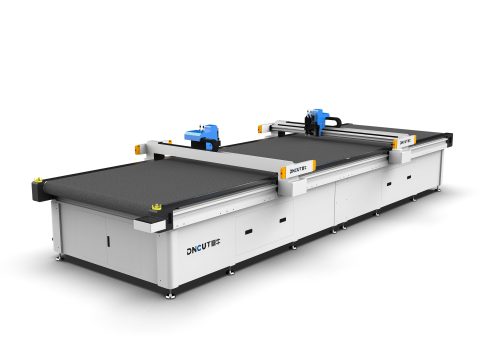
- Large-volume single material (e.g., mattress fabric): dual-beam intelligent cutting machine (e.g., DN6-2H), dual cutting heads working synchronously, efficiency increased by 40%.
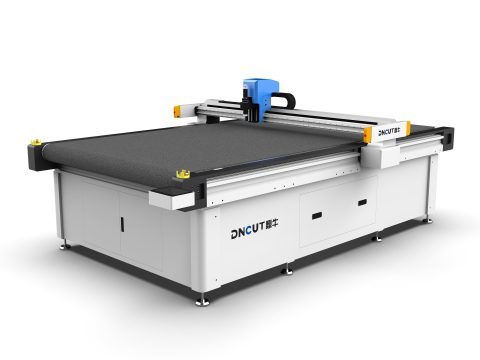
- Multiple varieties in small batches (e.g., home textiles, curtains): general-purpose cutting machine (e.g., DN6), easy tool change, supports multiple tools.
- Sponge composites and upholstered furniture: customized all-purpose cutting machine (e.g., DN8), high-rigidity structure, can be equipped with long-blade knife and circular knife, suitable for materials up to 100mm thick.
When selecting a model, focus on: number of vacuum adsorption zones, tool magazine capacity, maximum cutting speed, repeat positioning accuracy. For the upholstered furniture industry, it is recommended to choose models with automatic feeding and intelligent nesting functions to reduce manual intervention.
05Common Problems and Solutions
- Burrs on cut edges: reduce cutting speed, replace with sharp blades, increase vacuum adsorption force.
- Interlayer slippage: reduce the number of stacked layers, use clamps or double-sided tape to secure the edges.
- Sponge compression without rebound: use a long-blade knife, reduce cutting speed, or use freeze cutting.
- Fabric scorching: check whether the tool is overheated, reduce speed, increase air-blow cooling.
Through proper tool selection, parameter optimization, and regular maintenance, upholstered furniture cutting can achieve high-precision, high-efficiency production, with material utilization reaching over 95%.