01Core Challenges and Solutions for Footwear and Bag Leather Cutting
The footwear and bag industry involves a variety of materials such as genuine leather, microfiber, PU leather, luggage leather, upper leather, mesh fabric, and lining fabric. Its cutting faces three major challenges: large differences in material characteristics (natural grain and uneven thickness of genuine leather, high density of microfiber, easy edge melting of PU leather), high precision requirements (upper cut piece tolerances often need to be within ±0.5mm), and balancing efficiency and waste (every 1% increase in genuine leather utilization can significantly reduce costs). Traditional die cutting has problems such as slow changeover, uneconomical small-batch production, and poor adaptability to natural defects. Intelligent oscillating knife cutting machines achieve flexible cutting without dies through digital path planning, automatic nesting, and vacuum adsorption fixation, and are especially suitable for multi-variety, small-batch orders. This solution is based on actual production data and provides full-process guidance from equipment selection to process parameters.
02Applicable Materials and Key Points for Equipment Selection
Material Characteristics and Cutting Difficulties
- Genuine leather: thickness 1.0-3.0mm, with differences between parts, blood vessels, and growth lines; visual recognition of defects and optimized nesting are required. During cutting, stretching deformation must be avoided; it is recommended to use an oscillating knife + low adsorption force zoned control.
- Microfiber: thickness 0.8-2.0mm, high density and tightly packed fibers, high cutting resistance; requires a highly rigid knife holder and sharp blades, and the feed speed should be reduced by 10-15%.
- PU leather: thickness 0.5-1.5mm, obvious thermoplasticity, easy edge melting during high-speed cutting; the knife speed should be controlled at 200-400mm/s, and cold air cooling should be added.
- Luggage leather: thickness 1.5-4.0mm, often with backing; a large-amplitude oscillating knife (amplitude ±2mm) is required to ensure complete cutting.
- Upper leather: thickness 1.2-2.5mm, complex cut piece shapes with many small rounded corners, requiring high dynamic precision; models with a vision system are recommended for contour compensation.
- Mesh fabric: thickness 0.5-1.5mm, prone to fraying; a hot cutting knife or serrated knife is required, and adsorption force should be reduced to prevent mesh deformation.
- Lining fabric: thickness 0.3-0.8mm, light, thin, and prone to wrinkling; low vacuum adsorption and smooth feeding are required, and the cutting speed can be increased to 800-1200mm/s.
Equipment Selection Reference
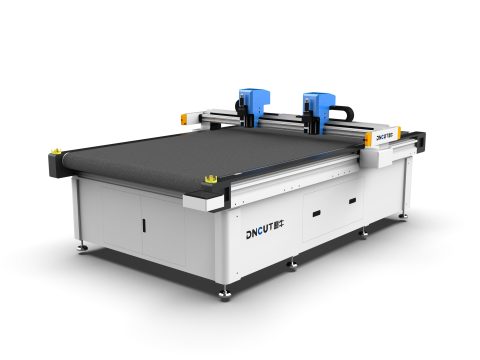
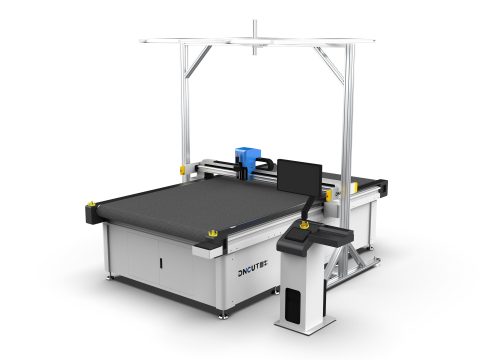
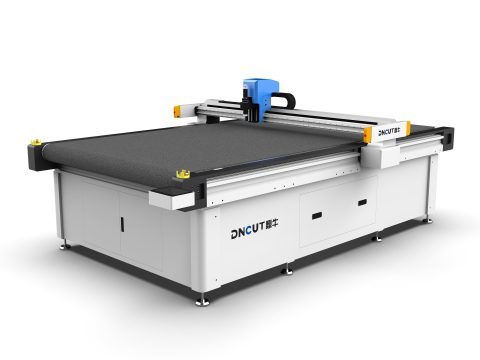
Different configurations can be selected according to capacity and precision requirements: dual-head cutting machines are suitable for large-batch orders, with dual stations operating alternately and efficiency increased by 40-60%; large vision cutting machines are equipped with high-resolution cameras to automatically identify leather contours and defects, enabling intelligent nesting and increasing material utilization by 5-8%; general-purpose cutting machines are cost-effective and suitable for small-batch, multi-variety production. When selecting, pay attention to: cutting working area (commonly 1600×2500mm), number of vacuum zones (at least 4 zones), number of knife heads (single-head/dual-head), and whether automatic tool changing is supported (such as V-shaped knife, round knife, punching knife).
03Cutting Process Parameter Setting Guide
Blade Selection and Installation
- Genuine leather/microfiber: use wavy-edge blades (edge angle 20°) to reduce cutting resistance and extend service life.
- PU leather/luggage leather: use straight-edge blades (edge angle 30°) with a cooling air nozzle.
- Mesh fabric: use serrated blades or hot cutting knives (temperature 180-220°C).
- Lining fabric: use pointed blades (edge angle 15°) to ensure smooth cuts.
During installation, ensure that the blade protrusion length is 0.5-1.0mm greater than the material thickness. Too short will cause incomplete cutting, while too long can easily break the blade.
Recommended Core Parameters
- Cutting speed: Genuine leather 300-500mm/s; microfiber 200-400mm/s; PU leather 200-400mm/s (can be increased to 500mm/s with cooling); luggage leather 150-300mm/s; shoe upper leather 250-450mm/s; mesh fabric 400-600mm/s; lining 800-1200mm/s.
- Oscillation frequency: Genuine leather/microfiber/luggage leather: 1800-2200 times/min; PU leather: 1500-1800 times/min (to prevent melted edges); mesh fabric/lining: 2500-3000 times/min.
- Vacuum adsorption: Genuine leather/microfiber: -60 to -80kPa; PU leather: -40 to -60kPa (to prevent deformation); mesh fabric: -20 to -30kPa; lining: -10 to -20kPa.
- Knife entry method: Vertical entry for thick materials, angled entry (30°) for thin materials to reduce impact.
- Overcut setting: For closed shapes, overcut amount 0.5-1.0mm to ensure the start and end points coincide.
Multi-layer cutting strategy
Lining and mesh fabric can be cut in multiple layers (typically 3-5 layers), ensuring no slippage between layers, using zoned adsorption and a pressure frame. Genuine leather and microfiber are recommended for single-layer cutting to ensure accuracy. PU leather can be cut in 2 layers, but cooling time needs to be increased.
04Intelligent nesting and vision recognition applications
The core of genuine leather cutting is maximizing utilization. The large vision cutting machine scans the entire leather sheet with a camera, identifies contours and defects (blood vessels, scars, holes), and the software automatically generates a nesting plan to avoid defect areas. In actual production, for shoe upper leather, intelligent nesting improves utilization by 5-8% compared to manual nesting; for luggage leather, by 3-5%. Operating points: scan first, then nest, set the minimum ignored defect size (e.g., 2mm×2mm), and define piece priority (important pieces placed in high-quality areas first). For synthetic materials such as microfiber and PU leather, there are no defect concerns, so automatic nesting can be used directly to pursue maximum utilization.
05Common problems and solutions
- Burrs or melted edges at the cut: Reduce cutting speed by 10-20%, increase cooling airflow, or replace with a sharp blade. For PU leather, try liquid nitrogen cooling (special configuration).
- Material displacement causing accuracy out of tolerance: Check whether vacuum adsorption is uniform, add zoned adsorption or use pressure rollers; for mesh fabric, reduce adsorption force and fix edges with tape.
- Short blade life: When cutting microfiber, reduce oscillation frequency to 1800 times/min and use coated blades (e.g., TiN coating) to extend life by 30%.
- Thick material not cut through: Increase blade extension length, increase oscillation amplitude to ±2.5mm, reduce cutting speed to below 150mm/s, and cut in two passes (first pass cuts half the depth).
- Low nesting utilization: Enable common-line cutting (adjacent pieces share the cutting line) to reduce idle travel; set minimum piece spacing to 0.5mm, which can be reduced to 0.3mm for genuine leather (requires high-precision equipment).
06Maintenance and safety specifications
Clean the knife head and guide rails daily, and check blade wear (once every 8 hours, every 4 hours for microfiber materials). Calibrate vacuum adsorption pressure and camera accuracy weekly (using a standard calibration board). Safety aspects: hands must not enter the cutting area while the equipment is running, and light curtain protection must be installed; wear cut-resistant gloves when changing blades; dust generated by PU leather cutting requires connection to an exhaust device.
07Summary
The key to the success of shoe and bag leather cutting solutions lies in material adaptability, fine parameter adjustment, and intelligent nesting. By reasonably selecting equipment configurations (dual-head for efficiency, vision for utilization rate, general-purpose for cost reduction) and strictly executing process parameters, a cutting accuracy of ±0.3mm, a material utilization rate increase of over 5%, and a production efficiency improvement of 30-50% can be achieved. It is recommended that enterprises first conduct small-batch trial cutting, record the optimal parameter combinations, and then scale up the promotion.