
Blade Selection for Oscillating Knife Cutting Machines: From Parameters to Practice
Oscillating knife cutting machines are widely used for cutting flexible materials, composite materials, and honeycomb structures. As the component that directly contacts the material, the blade’s selection directly affects cutting quality, efficiency, and cost. Based on practical engineering experience, this article systematically outlines the key elements of blade selection and provides actionable parameter recommendations.
1. Blade Types and Application Scenarios
Blades commonly used in oscillating knife cutting machines are mainly divided into three categories: Drag Knife, Oscillating Knife, and Rotary Knife. The primary consideration in selection is material characteristics and cutting requirements.
- Drag Knife: The blade is fixed and cuts by being dragged by machine motion. Suitable for thin, low-density materials such as paper, film, and foam (density ≤25kg/m³). Cutting speed can reach 60m/min, but it cannot cut high-density or thick materials.
- Oscillating Knife: The blade oscillates up and down at high frequency (typically 5,000-20,000 times/min), suitable for cutting medium- to high-density materials such as EVA, PVC, rubber, and honeycomb paperboard. The oscillation amplitude is adjustable (0.5-5mm), and cutting thickness can reach 50mm (depending on the material).
- Rotary Knife: The blade cuts by rotating, suitable for thick and homogeneous materials such as sponge and fiber cotton. Cutting thickness can exceed 100mm, but cutting accuracy is slightly lower than that of the oscillating knife.
In actual selection, material hardness, thickness, density, and cutting pattern complexity must be considered. For example, when cutting carbon fiber prepreg, an oscillating knife with a dedicated blade can reduce delamination; when cutting honeycomb paperboard, the high-frequency impact of the oscillating knife can prevent crushing.
2. Analysis of Blade Geometric Parameters
Blade geometric parameters include tip angle, blade thickness, edge form, etc. These parameters directly affect cutting resistance and cut quality.
2.1 Tip Angle
The tip angle is the core parameter in selection. Common angles are 20°, 30°, 45°, and 60°. The smaller the angle, the sharper the edge and the lower the cutting resistance, but the lower the tip strength, making it prone to wear or chipping.
- 20°-30°: Suitable for thin soft materials (such as fabric, leather, film), with high cutting speed and smooth cuts. However, service life drops significantly when cutting high-density materials.
- 45°-60°: Suitable for medium- to high-density materials (such as EVA, rubber, honeycomb paperboard), with high edge strength and impact resistance, but increased cutting resistance requires appropriately reduced feed speed.
Recommendation: When cutting foam (density 30kg/m³), use a 30° blade with a feed speed of 15m/min; when cutting EVA (density 80kg/m³), use a 45° blade with a feed speed of 8m/min.
2.2 Blade Thickness
Blade thickness affects rigidity and cutting stability. Thin blades (0.6-1.0mm) are suitable for fine cutting but are prone to deflection; thick blades (1.5-2.0mm) have good rigidity and are suitable for cutting thick materials, but the cut is wider. Typically, when cutting thickness ≤10mm, use a thickness of 0.8-1.2mm; when cutting thickness >10mm, use a thickness of 1.5-2.0mm.
2.3 Edge Form
Edges are divided into single-edge and double-edge. Single-edge blades are subjected to unidirectional force during cutting, suitable for straight-line cutting; double-edge blades are subjected to symmetrical force, suitable for curve cutting and reducing deflection. For complex patterns, double-edge blades are recommended.
3. Material Matching and Parameter Recommendations
Different materials require matching with different blade materials and parameters. The following are selection recommendations for common materials:
- Fabric/Textiles: Use a 30° single-edge blade made of high-speed steel (HSS), oscillation frequency 8,000-12,000 times/min, feed speed 20-30m/min.
- Leather: Use a 30°-45° double-edge blade made of carbide (tungsten steel), oscillation frequency 10,000 times/min, feed speed 10-15m/min.
- EVA/Foam: Use a 45° single-edge blade made of carbide, oscillation frequency 12,000-15,000 times/min, feed speed 5-10m/min.
- Honeycomb Paperboard: Use a 60° double-edge blade made of carbide, oscillation frequency 15,000 times/min, feed speed 3-5m/min.
- Carbon Fiber Prepreg: Use a 30° double-edge blade with diamond coating, oscillation frequency 20,000 times/min, feed speed 2-4m/min.
Note: The above parameters are reference values and must be adjusted according to material batch and equipment condition in practice.
4. Blade Material and Life Management
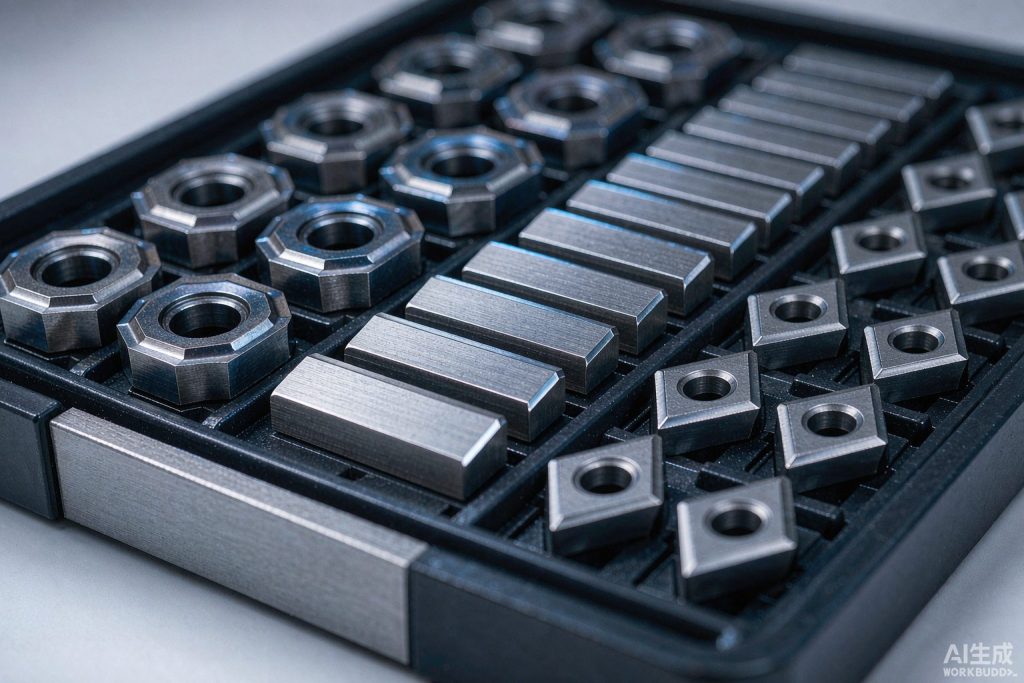
Blade materials mainly include high-speed steel (HSS), carbide (tungsten steel), and diamond coating. HSS has good toughness but average wear resistance, suitable for soft materials; carbide has high hardness (HRA≥90) and good wear resistance, suitable for medium- to high-density materials; diamond coating is used for highly abrasive materials and can increase service life by 5-10 times.
Blade life is affected by material abrasiveness, cutting parameters, and maintenance methods. It is recommended to establish blade life records: check edge wear every 500 meters cut or every 8 hours. When burrs appear on the cut or cutting resistance increases by 20%, the blade should be replaced or reground promptly. Carbide blades can be reground 3-5 times, and the angle must be inspected after each regrinding.
5. Common Selection Misconceptions and Countermeasures
- Misconception 1: Pursuing the sharpest blade. An excessively small angle causes the tip to chip easily, especially when cutting materials containing hard particles. Countermeasure: Select the angle based on material hardness; err on the larger side.
- Misconception 2: Ignoring oscillation parameter matching. A mismatch between blade angle and oscillation frequency leads to rough cut surfaces. Countermeasure: Pair small-angle blades with high-frequency oscillation (≥15,000 times/min), and large-angle blades with low-frequency oscillation (5,000-10,000 times/min).
- Misconception 3: Blade generalization. Different materials require dedicated blades; mixing them causes a sharp drop in service life. Countermeasure: Establish a material-blade correspondence table and manage by category.
6. Maintenance and Storage Recommendations
Blades should be stored in a dry environment and protected from impact. During installation, ensure moderate clamping force (torque 2-3N·m); too loose causes deflection, too tight damages the blade holder. Regularly clean adhesive residue from the blade; acetone can be used for wiping. For coated blades, avoid scratching the edge with hard objects.
Through scientific selection and maintenance, cutting efficiency and quality can be significantly improved. It is recommended to evaluate blade usage quarterly and optimize the selection plan.