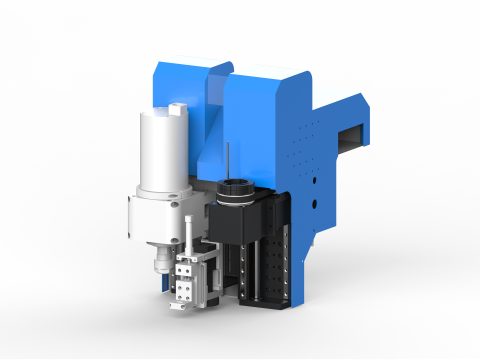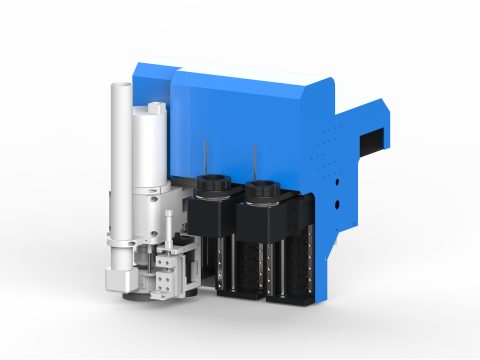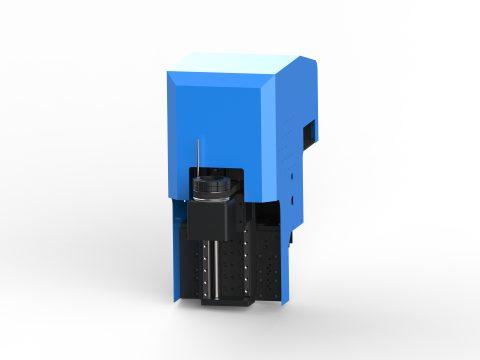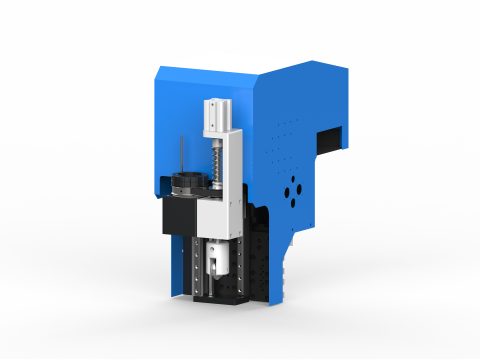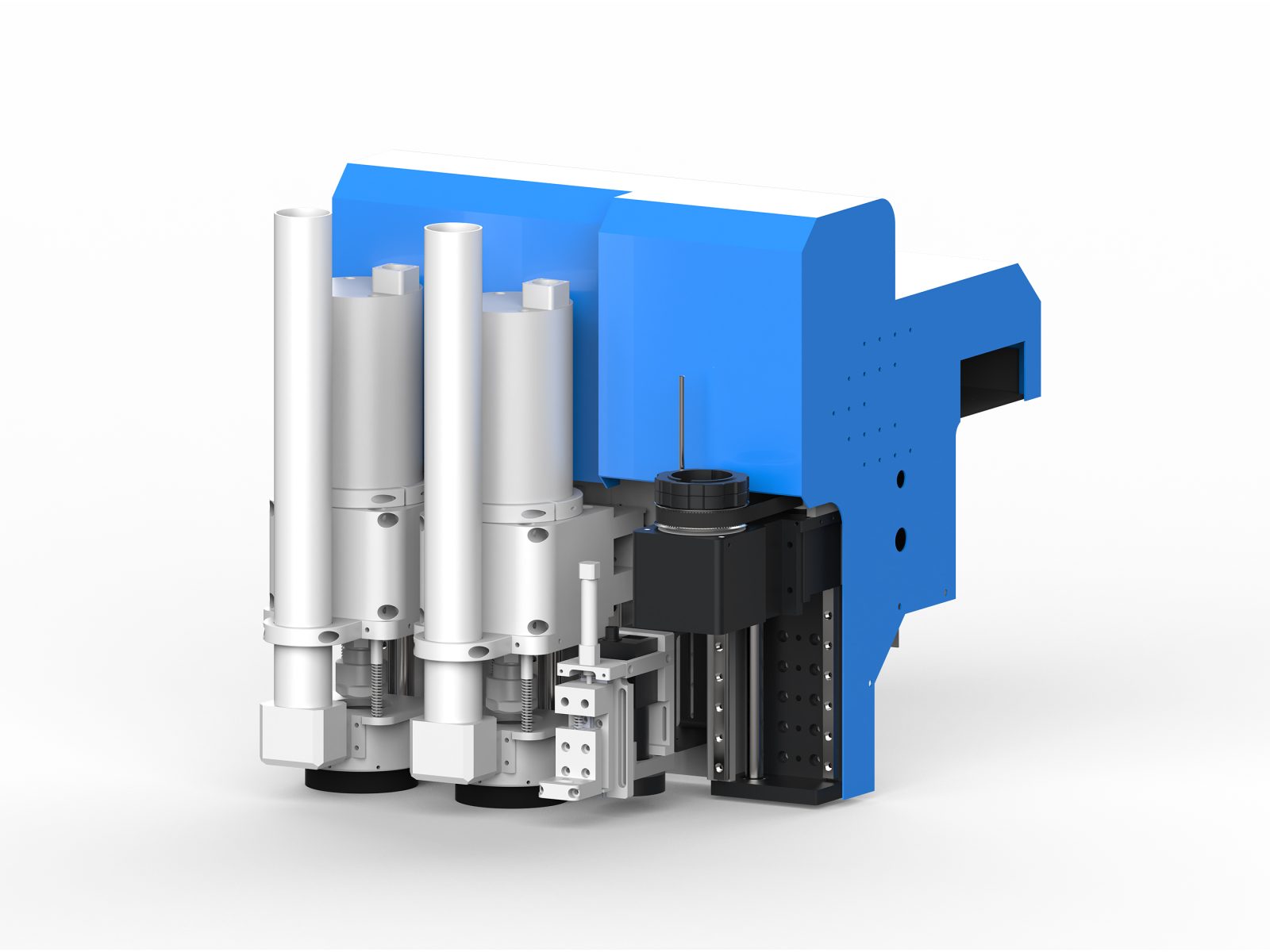
The E2A head combination is a modular head configuration designed for multi-process composite machining scenarios, composed of dual spindles, a single tool holder, and a CCD vision component. The dual spindles can respectively hold milling cutters, continuously completing multiple hard material processes such as slotting, engraving, and cutting on the same machine, reducing tool changes and secondary clamping; the single tool holder supplements the oscillating knife cutting needs of soft materials; the CCD vision component is responsible for identifying printed patterns and registration marks, ensuring precise alignment between the cutting path and the pattern contour. This combination is suitable for machining tasks that require both hard material milling and soft material cutting in a single clamping, and have requirements for printed pattern alignment.
Core Features
- Dual spindles working in coordination: The two spindles can respectively hold milling cutters of different specifications, and slotting, engraving, and cutting processes are completed consecutively on one machine, reducing mid-process tool changes and repeated tool setting.
- Tool holder supplements soft material cutting: The single tool holder can be equipped with tools such as an oscillating knife to handle the cutting of soft materials like leather, foam, and corrugated paper, complementing the hard material processes of the spindles.
- CCD vision alignment: The vision component identifies printed patterns and registration marks on the material surface and automatically corrects the cutting path, making it suitable for orders with requirements for pattern contour alignment accuracy.
- Modular combination structure: The spindles, tool holder, and vision component are combined according to process requirements, and the module configuration can be adjusted later according to product changes, balancing current machining and capacity expansion.
- Multi-process single clamping: Hard material milling and soft material cutting are completed within the same head combination, reducing cumulative errors caused by workpiece handling and secondary positioning.
Applicable Materials and Industries
This combination is suitable for slotting, engraving, and cutting of hard plates such as acrylic, PVC board, MDF, and aluminum composite panels, and can also process soft materials such as leather, foam, corrugated paper, and adhesive labels. Typical applications include advertising letters and signage production, display props and light box panel processing, printed product pattern contour cutting, as well as small-batch multi-variety orders for electronic auxiliary materials and packaging sample boxes that have requirements for vision alignment.
Selection and Configuration Recommendations
This combination features a spindle power of 2.2kW, and with different cutting tools it can handle the common power requirements for grooving, engraving, and hard board cutting.
When the processing requirements involve both hard material milling and soft material cutting, and the incoming material has printed patterns that require visual alignment, the E2A head combination is a more suitable choice; if the work is primarily single soft material cutting, the spindle configuration can be simplified to control costs. In terms of supporting equipment, it can be used in combination with an automatic feeding platform and a roll material feed rack to improve continuous operation efficiency; on the software side, it is recommended to pair it with a cutting control system that supports CCD visual recognition and path correction, and to reserve tool library management interfaces for commonly used tools and milling cutters to facilitate quick switching between multiple processes.
Key Technical Parameters
- Head Model: E2A (head combination)
- Processing Height: 60mm (standard)
- Combination Configuration: Dual spindle + single tool holder + CCD pen
- Spindle Power: 2.2kW
- Replaceable Modules: Tool holder / oscillating knife / servo oblique cutting knife / circular punch / spindle / CCD vision component / inkjet head (optional depending on model support)
- Applicable Materials: Fabric, leather, foam, EVA, composite materials, cardboard, acrylic, wood board, etc. (depending on the selected module)
- Applicable Processes: Contour cutting, punching, creasing, grooving, milling, vision-positioned cutting, inkjet marking (depending on the selected module)
- Applicable Models: Dingniu oscillating knife cutting machine series (head board mounted per model customization)
- Remarks: The head can be customized in combination according to materials and processes; the specific configuration is subject to the selection plan
FAQ
What materials is the E2A head combination suitable for?
It is suitable for hard materials such as acrylic, PVC, and MDF, as well as soft materials such as leather, foam, and corrugated paper.
What is the function of the CCD vision module?
It recognizes printed patterns and positioning marks on the material surface, automatically corrects the cutting path, and ensures precise alignment between the cutting contour and the pattern.
How does the dual-spindle configuration improve processing efficiency?
The two spindles can hold different milling cutters, continuously completing grooving, engraving, and cutting processes, reducing tool changes and secondary clamping time.
Can this combination be upgraded later?
It features a modular design, allowing tool holders or vision modules to be added as needed, with flexible configuration adjustments to adapt to production capacity changes.
Further Reading
- Practical Guide to Oscillating Knife Cutting Machine Maintenance and Repair
- Working Principle and Parameter Settings of Oscillating Knife Cutting Machine
- Practical Guide to Precision Adjustment of Oscillating Knife Cutting Machine
The core advantage of the E2A model head combination lies in integrating hard material milling and soft material cutting functions into the same module. Through the coordinated work of dual spindles and a single knife seat, it reduces workpiece handling and secondary clamping. The dual spindles can be equipped with different tools respectively, for example, one for grooving and one for engraving, eliminating the need to change tools when switching and significantly shortening auxiliary time. The single knife seat is specially designed for soft materials and can be equipped with an oscillating knife for high-precision cutting, avoiding material deformation. This division-of-labor collaboration mode is particularly suitable for small-batch, multi-variety composite processing orders, helping users quickly respond to market changes.
The addition of the CCD vision component further improves machining accuracy and automation. This component captures printed patterns or positioning marks on the material surface through a high-resolution camera, automatically calculates the cutting path offset using software algorithms, and compensates in real time. For applications with high alignment requirements such as contour cutting of printed materials and die cutting of electronic auxiliary materials, CCD vision alignment can control the error within ±0.1 mm, reduce manual intervention, and improve the yield rate. At the same time, the vision system supports recognition of multiple marks, adapts to the alignment needs of different materials, and enhances the versatility of the equipment.
In terms of model selection and configuration, the E2A head combination shows good scalability. Users can choose the number of spindles or the type of tool holder according to current processing needs. When expanding the business in the future, they only need to add the corresponding modules to upgrade functions without replacing the entire machine. The matching automatic feeding platform and roll material feeding rack can enable continuous operation and improve production efficiency. On the software side, it is recommended to pair with a control system that supports CCD vision recognition and path correction, and to reserve a tool magazine management interface for quick switching among multiple processes. A reasonable configuration and supporting solution can maximize the effectiveness of this combination and create long-term value for users.